



Featured 1
Now that it’s back, the caretaker provision must be made permanent


An Independent Newsweekly


Featured 1

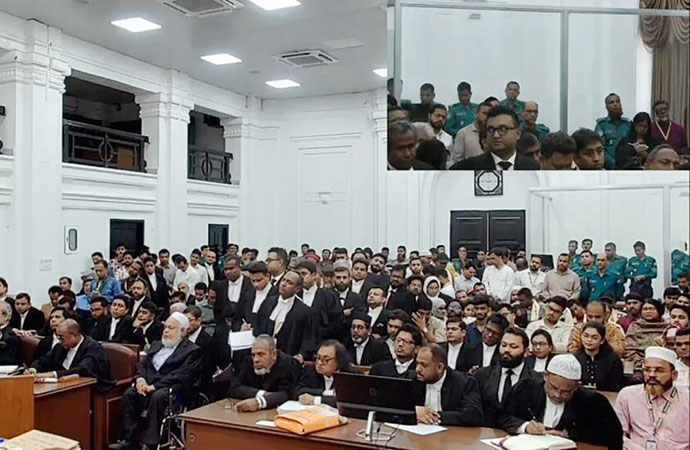
Disposing of what the Chief Justice himself described as the most important case to have come before it - meaning in the period under the interim government of Dr Muhammad Yunus, that took the state's reins in the wake of last year's Uprising - the Appellate Division this week ordered that the caretaker government system be reinstated in the country's constitution, thus reviving the 13th amendment to the constitution that contained the caretaker provision. In what was perhaps her most brazen act of political chicanery, and the very foundation of her authoritarian hold on power for almost 15 years, Sheikh Hasina had engineered its removal in highly dubious circumstances in 2011.
I should just confess at the outset to a particular soft spot for the provision, since many of the earliest discussions on its design and structure were held at the Dhaka Courier/UNB premises at the Cosmos Centre. That discussion is for another day.
Officially, the caretaker system was introduced in the Constitution through the 13th amendment in 1996 - the one important act of the BNP upon retaining office through a one-sided election on February 15, 1996. Three lawyers, including filed a writ petition challenging the amendment in 1998. The petition was dismissed in 2004, and the petitioners appealed in 2005. Acting on that appeal, a full bench of the Appellate Division delivered a verdict declaring the 13th amendment null and void.
Following the verdict, the Sheikh Hasina-led Awami League government rammed the 15th amendment through Parliament, taking advantage of its brute majority to abolish the caretaker government system, among other things. The huge, sprawling text of the 15th amendment is perhaps the closest thing we have to a 'Magna Carta' for Awami League's fascist era.
The provisions relating to a non-partisan caretaker government shall, however, take effect solely 'on the basis of future applicability'. The apex court in its observation confirmed that the next national election would be held under the interim government and the caretaker government system would be applied from the 14th parliament - i.e. the one after the next.
In its judgment, the Court stated that the Appellate Division's earlier ruling was "manifestly flawed on multiple counts". That ruling has now been "entirely invalidated". The controversial Chief Justice who authored that judgement, Khairul Haque, was arrested on less serious charges in an unrelated case in the wake of the Uprising. Many have questioned the wisdom behind the arrest, and indeed, keeping him under arrest for months on end. Judicial misconduct is always extremely difficult to prove, and any evidence of it would not be expected to survive till this day. Meaning it is highly unlikely that the state will ever be able to bring a case against Haque - against his contribution to the 15th amendment at least, that came in the form of the 2011 judgement.
In such a situation, it is perhaps wiser to release Haque with a nod to his senior citizen status, and seize the moral high ground. A large part of the work that needed to be done, in order to undo the ills inflicted on the constitution by the AL regime, has now been done. Let us look forward to the new possibilities now, by rising above personality clashes or the need to punish anyone.
A Independent Newsweekly
© Copyright 2026 | Designed by ARK Reepon & Developed by Cosmos Group Software Team





Leave a Comment
Recent Posts
Is the international community ...
A spate of downgraded economic projections, from Bretton Woods to Mani ...
A Childhood Lesson in Arithmet ...
As children, we learned a simple mathematical rule: if we know the pri ...
Indian authorities launched a major security crackdo ..
Police dispersed garment workers from the Azampur ro ..
Why Saudi Arabia has struggled to defend itself agai ..
Iran-backed Houthis strike Saudi oil company Aramco’ ..