



Featured 1
Are the AL-era megaprojects safe?


An Independent Newsweekly


Featured 1
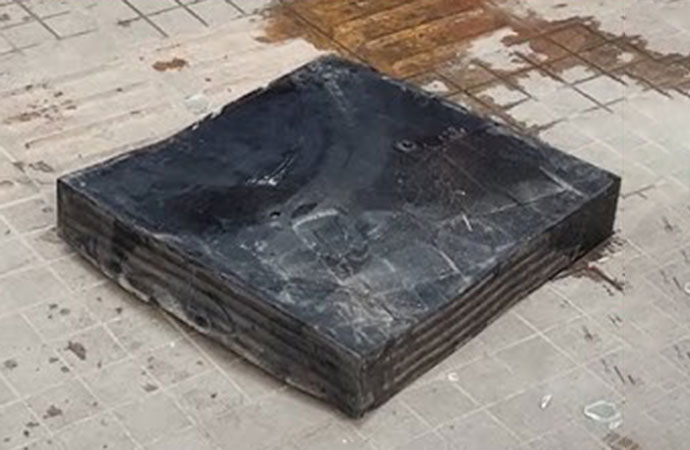
We are disturbed by the sudden and catastrophic incident that occurred last Sunday (Oct. 26), when a bearing pad, which works as a kind of shock absorber on the gigantic infrastructure of Dhaka's Metrorail, fell off and tragically killed a pedestrian on the spot, near the station in Farmgate. It is even more disturbing that the tragedy unfolded just three pillars down from a similar, indeed identical, incident just over a year ago, in September 2024, although on that occasion we were at least spared any casualties.
Bearing pads, that weigh upto 150kg and are made of layered rubber and steel, falling off within the first two years of an infrastructure's inauguration, is an extremely rare occurrence - almost unheard of. The fact that it has now happened twice on Dhaka's cherished Metrorail has caused a new wave of concern over the fate that awaits the country when it comes to many of the previous regime's shiny and hyped up 'megaprojects' in the infrastructure sector.
Many of these have become part and parcel of Bangladeshis' daily lives. But given the incompetence and sheer zeal for corruption that the previous regime became synonymous with, are we sitting on top of, or alternatively standing beneath ticking time bombs, like Abul Kalam, the 35-year-old victim of last week's accident?
Dhaka's Metrorail project was approved in 2012 at an estimated cost of Tk 21,985 crore. The cost has since then breached Tk 33,472 crore, with around Tk 20,000 crore coming as a loan from the Japan International Cooperation Agency (JICA). The construction cost per kilometre, Tk 1500 crore, is far higher than in neighbouring countries and among the highest, if not the highest, in the world.
The overall system design, selection of contractors and construction supervision were the responsibility of a consortium of consultants called NCDM Association, with Japan's Nippon Koei in the lead. From all that we know now, one thing we can say for sure is that the bearing pads, on either occasion, could not have simply slipped out in one single motion. The weight of the viaduct sitting on top of it simply wouldn't allow that. Most likely, it was the end result of a series of displacements occurring over time, caused by frequent train movement on the tracks that are laid on the viaduct. As such, it points to a flaw in the design that failed to account for this particular portion of the route being at a rising curve.
It has now come out that the Metrorail was inaugurated in haste prior to the 2024 election, without a full safety audit by an independent, third party firm. A number of other safety protocols were also ignored by the Dhaka Mass Transit Company Limited, the Metrorail operator. Sheikh Moinuddin, special assistant to Chief Adviser Muhammad Yunus in the Ministry of Roads, Bridges and Transport, has pledged to form "a separate team to inspect safety and quality of work and carry out necessary maintenance."
Which of course is imperative. But it might just be a good idea to also extend the remit of such a team beyond the Metrorail, to all vital infrastructure projects completed under the Awami League.
A Independent Newsweekly
© Copyright 2026 | Designed by ARK Reepon & Developed by Cosmos Group Software Team




Leave a Comment
Recent Posts
Is the international community ...
A spate of downgraded economic projections, from Bretton Woods to Mani ...
A Childhood Lesson in Arithmet ...
As children, we learned a simple mathematical rule: if we know the pri ...
Indian authorities launched a major security crackdo ..
Police dispersed garment workers from the Azampur ro ..
Why Saudi Arabia has struggled to defend itself agai ..
Iran-backed Houthis strike Saudi oil company Aramco’ ..