



Column
Just moralising

An Independent Newsweekly

Column
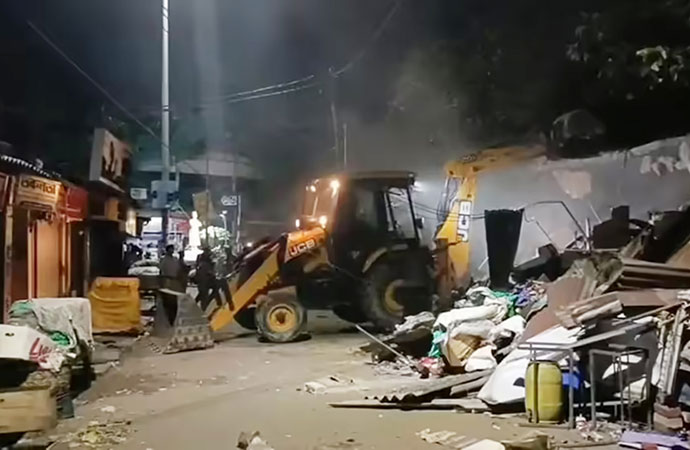
A bulldozer brings down a stall near Dum Dum Junction railway. Photo: Collected
There are heart-breaking sights of the makeshift stalls of humble hawkers in West Bengal lying destroyed in the current drive against unauthorised constructions on footpaths and railway property. Newspaper reports and videos of the demolition bear testimony to the concept of a "political economy" struggling against that of a "moral economy".
According to the Centre of Economy Studies, with the rise of capitalism, "classical political economy arose at the end of the 18th century to understand how it was possible that through private ownership and markets, goods and services were provided to people. Classical political economists systematically analysed the economy by looking at the tendency of markets to move towards equilibrium and the power struggles between landowners, capitalists and workers. They argued that labour is the source of all value in opposition to physiocracy, with its focus on agriculture, and mercantilism, with its focus on exports, money and extraction. Based on the labour theory of value, most classical political economists argued for free trade and free markets."
Political economy rested on market-friendly laws. Those laws exist to this day. By the yardstick of political economy, the civic right of unimpeded access to footpaths and railway platforms is an economic one that overrides the illegal occupation of public spaces by hawkers struggling to make a living in the informal economy.
The legal position is clear. According to a report in The Telegraph Online, West Bengal Chief Minister Suvendu Adhikari asserted: "People have a right to walk on pavements. No one has the right to encroach on a pavement. The people have elected me; I am accountable to the people. No one has given me the right to hand over to some people the wide roads of Calcutta and the pavements meant for pedestrians. People's rights will get the highest priority. The interests of an individual or a group will not be the priority." The Telegraph commented: "Hawkers - a term that in Calcutta parlance also covers the owners of illegal, makeshift stalls built on encroached space - have since Independence and Partition gobbled up pavements across the city, the process escalating further in the last two decades."
All true. However, those remarks and their provenance serve to underline the "political" dimension of the economy.
Indeed, even by the laws of political economy, there is a case to be made for hawkers. They provide cheaper food and services than those offered by legally-sanctioned shops. In doing so, they enable the market to move towards equilibrium at its lower end. And they are not small players. According to a study, India's informal economy accounts for more than 80 per cent of its total workforce and roughly half of its national output. This massive economic engine consists of millions of self-employed individuals, street vendors, casual labourers and micro-enterprises that operate without formal contracts, regular wages or social security benefits.
Moral Economy
There has been political resistance to the anti-hawker drive in West Bengal. It speaks of a moral economy, a concept explained by the British historian E.P. Thompson in his 1971 essay, "The Moral Economy of the English Crowd in the Eighteenth Century". Thompson looked into the peasant riots of 18th-century England, which he saw as being not only a spasmodic reaction to hunger but as acts which defended traditional rights or customs and which were supported by a wider moral consensus in the community, including a gentry keen on maintaining a degree of equilibrium between paternalist authority and the revolting crowd. Thompson wrote: "It is of course true that riots were triggered off by soaring prices, by malpractices among dealers, or by hunger. But these grievances operated within a popular consensus as to what were legitimate and what were illegitimate practices in marketing, milling, baking, etc. This in its turn was grounded upon a consistent traditional view of social norms and obligations, of the proper economic functions of several parties within the community, which, taken together, can be said to constitute the moral economy of the poor. An outrage to these moral assumptions, quite as much as actual deprivation, was the usual occasion for direct action."
From a moral economy point of view, the economic survival of hawkers in West Bengal is a component of the same laws of social equilibrium that apply to pedestrians.
In The Moral Economy of the Peasant: Rebellion and Subsistence in Southeast Asia (1976), the American political scientist James C. Scott applied the concept to Vietnam. He did not deal with riots, which were rare, but the absence of riots, or the preservation of equilibrium in the face of hunger. He spoke of the existence of a "subsistence ethics" which depended on patterns of reciprocity, generosity, communal land and work sharing that helped to keep families alive. Again, the laws of political economy receded in the face of a moral economy - only so as to keep society afloat.
In the case of West Bengal today - and of other places where hawkers are treated as economic eyesores - governments need to take an empathetic view of humans trying to make a non-violent living in society. Hawkers do not steal, rob or kill - acts of desperation that some of them might be driven to, if their sources of income are cut off. They sell. Selling is a function of the laws of demand and supply on which the economic system rests.
Criminalising them will eat its way into the political economy one day - because the moral economy has a way of taking revenge in the very act of disappearing.
The writer is Principal Research Fellow of the Cosmos Foundation. He may be reached at epaaropaar@gmail.com
A Independent Newsweekly
© Copyright 2026 | Designed by ARK Reepon & Developed by Cosmos Group Software Team




Leave a Comment
Recent Posts
The right time for an apology
The publication of the posthumous memoirs of lawyer Abdur Razzaq, who ...
Human rights experts commissio ...
Human rights experts commissioned by the UN’s top human rights b ...
Teesta erosion leaves several hundred families homel ..
Housing Without Houses: The Hidden Cost of Banglades ..
The Election Commission will review the timeframe
The story behind the Arafat brothers' ‘Kolpona’