



Column
Iran and America at War


An Independent Newsweekly

Column
Collected
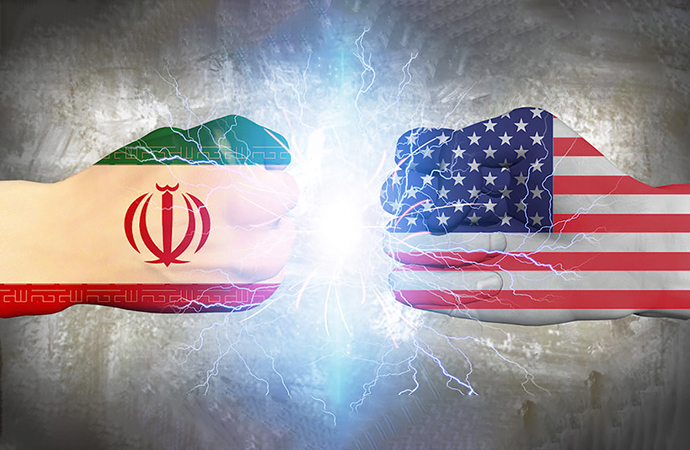
America's Iran War - or Iran's America War - reveals two important facets of how ideologically-incompatible countries behave in mutual conflict.
For America, Iran is too fragile a modern nation to survive the death of its supreme leader, Ayatollah Ali Khamenei, who was killed at the start of the war. Americans believe that a theocratic state such as Iran cannot outlive the secular assassination of a leader who embodied the state's governing philosophy based on a unique and hybrid theocracy known as velayat-e faqih (or Guardianship of the Islamic Jurist). That system, established after the 1979 revolution in Iran, combines democratic elements such as popular elections with divine authority but places ultimate power in the hands of a Supreme Leader - a top Shia cleric - who oversees state institutions based on Islamic law and the principles of Tawhid, or monotheism.
For Iran, America is an apostate of a state whose secular philosophy of life cannot even begin to understand what it means to live under divine dispensation, let alone accept it. Not only is there no velayat-e faqih in faithless America, democracy there presumes to make the laws of God subservient to those of man. American mortals delude themselves into believing that secular laws can compensate for the absence of divine law. When an unpredictable president bent on overturning the rules of global statecraft launches an attack on eternally ordered Iran, the signs are clear: This is a war between the Iranian good and the American evil. In that avowed accounting, Mojtaba Khamenei, Ali Khamenei's son, has been chosen as his successor.
These are simplistic accounts of the complex interplay of psychological forces on which governments depend when they go to war, but they make a point. The world is not governed by what is true but by what people believe to be true. Since humans are divided and not united by belief, one woman's nectar is another woman's poison; one man's heaven is another man's hell. In a world of assumed truths, perception is reality. Citizens live in the peace they desire, and perish in the war that turns their illusions of reality into rubble. It is the same in the case of America and Iran.
Mohammad Mansour writes eloquently about this issue in Al Jazeera. He says that the American decapitation of the Iranian leadership risks giving birth to a "garrison state - a paranoid, militarised system fighting for its existence with no political red lines left to cross". He cites the bases of Iran's national resilience, rooted in its dual military structure. "The government is protected not just by a regular army (Artesh), but also by the Islamic Revolutionary Guard Corps (IRGC) - a powerful parallel military force constitutionally tasked with protecting the velayat-e faqih system... Supporting them is the Basij, a vast paramilitary volunteer militia embedded in every neighbourhood, specifically trained to crush internal dissent and mobilise ideological loyalists."
However, given the war, Mansour adds: "Perhaps the most significant shift in the immediate aftermath is Iran's pivot from religious legitimacy to survivalist nationalism. Aware that the death of the supreme leader might sever the spiritual bond with parts of the population, surviving officials are reframing the war not as a defence of the clergy, but as a defence of Iran's territorial integrity."
How interesting. Velayet-e faqih has been suborned by American and Israeli firepower. Even as Tehran fights back with missiles and drones that it uses to bombard Israel and its Arab neighbours, weapons built no doubt during the Ayatollahs' regime, it appears that the defence of Iran has shifted perceptually from theocracy to nationalism. Now, nationalism is considered a grave sin in Islam when it manifests itself as asabiyyah (tribalism/fanaticism) that violates the unity of the Ummah (or global Muslim community). While Muslims are permitted to love their country or culture, Islam prohibits prioritising national identity over religious belonging. True, Tehran's war nationalism is an act committed under severe international duress and it does not absolve Iranians from the need to love fellow-Muslims along with fellow-Iranians, but the shift from the religious certainties of the velayet-e faqih state to the threatened reality of Shia Persian nationhood is noteworthy.
As for America, it is always in flux and will always be. There will never be a velayet-e faqih there. Whether it prevails over Iran will depend on weapons, not divine ordination. Perhaps neither Washington DC nor Teheran will lose. Both will win, one with a mercurial president and the other with a dynastic survivor.
Let us see.
The writer is Principal Research Fellow of the Cosmos Foundation. He may be reached at epaaropaar@gmail.com
A Independent Newsweekly
© Copyright 2026 | Designed by ARK Reepon & Developed by Cosmos Group Software Team






Leave a Comment
Recent Posts
Dhaka, Tokyo relationship to c ...
Deputy Chief of Mission of the Embassy of Japan in Bangladesh Yoshida ...
Democracy puts a premium on et ...
And just like that, the deed was done. With a volley of 'Ayes!’( ...
Dhaka still eyeing ‘conducive’ setting for PM’s Delh ..
Gallery Cosmos Artist Residency, 2026
Summit seeks reinstatement of FSRU deal
Hatful of medals for Bangladeshi whiz kids at WMI 20 ..