



Column
From Exhibition Halls to Rural Fields: The Missing Link in Bangladesh’s Agricultural Modernisation

An Independent Newsweekly


Column
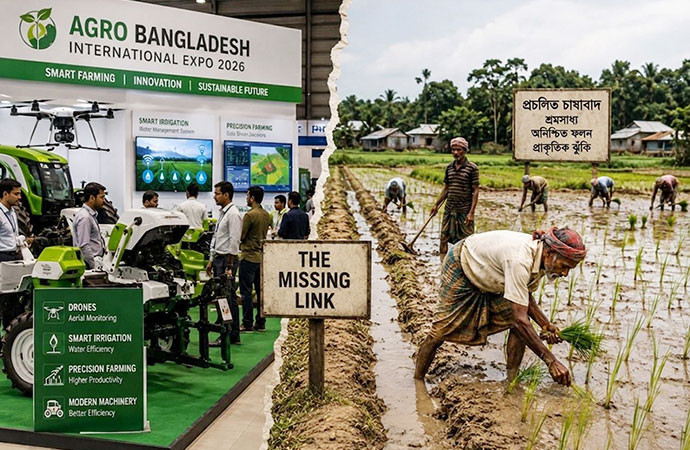
Visitors to the Agro Bangladesh International Expo 2026 in Dhaka were amazed at the advancements in agriculture, including the use of drones, smart irrigation, and precision farming techniques. But in rural Bangladesh there are millions of farmers using traditional methods and practices, leaving a huge innovation to implementation disconnect.
A Modern Agricultural Dream on Display
The 9th Agro Bangladesh International Expo 2026 at International Convention City Bashundhara (ICCB) in Dhaka highlighted cutting-edge machinery, digital farming, and smart irrigation systems, embodying the nation's desire to modernise its farming practices. But the real farmers of the country, who are in Kurigram and Bhola are still on the old ways and are still in the hands of manual works and uncertain rain. This increasing gap between technology and the users has now emerged as one of the major gaps in agricultural modernisation in Bangladesh.
Bangladesh's Agricultural Success Story - But with Structural Weaknesses
Since Independence Bangladesh has made tremendous advancement in agriculture despite decreasing land area, the rice production has more than tripled. The country at present is one of the biggest producers of rice in the world and the production of fisheries, poultry and vegetables has greatly increased. Almost 40 million people are still employed in agricultural activities. However, it is still a fragile sector. Agriculture accounts for just about 11-12 percent of total GDP and employs about 37-40 percent of the population. At the same time, Bangladesh is estimated to be losing 60,000-80,000 hectares of agricultural land every year due to urbanisation and infrastructure development, and the impacts of climate change are causing greater floods, salinity, droughts, and irregular rainfall. The problem at hand is simple: less land, less farmers and increasing climate risks and food demand. With traditional farming, the future food security of Bangladesh cannot be ensured.
How Asian Countries Modernised Agriculture
The neighbouring Asian countries modernised agriculture, modernising the farmers first. Today, agricultural mechanisation level in China is above 70 percent in the major crops and China helps millions of small farmers by introducing agricultural machinery sharing cooperatives and rural technology centres. Since the 1980s, Vietnam has increased rice yields from approximately 16 million metric tons to more than 43 million metric tons, with rice exports growing from almost 7-8 million metric tons per year at present through irrigation, mechanisation and training the farmers. Thailand enhanced the agriculture sector by integrating farmers into agro-processing and cold storage and export value chains which became a key export earner. In contrast, India pushed a push to digital advisory and to subsidised mechanisation, and in the process, distributed thousands of farm machines each year via state-run schemes.
Major Limitations in Bangladesh's Agricultural Modernisation
1. Lack of Practical Farmer Education
Many farmers still rely entirely on traditional farming knowledge. Modern agriculture now requires understanding of irrigation efficiency, soil health, mechanisation, climate adaptation, and post-harvest management. Without practical training, farmers often hesitate to adopt unfamiliar technologies.
2. Weak Agricultural Extension Services
Field-level technical support remains insufficient compared to the size of the farming population. Demonstration farms and practical training opportunities remain limited in many districts.
3. Small and Fragmented Landholdings
Most farmers own small and scattered plots of land, making mechanisation difficult at an individual level. Cooperative farming and machinery-sharing systems remain weak.
4. Declining Youth Interest in Agriculture
Young people are increasingly leaving agriculture for urban jobs or overseas migration because farming is still viewed as physically exhausting and financially uncertain.
5. Urban-Centred Technology Exposure
Modern agricultural technologies are often displayed in expos and seminars in Dhaka, while rural farmers - the actual users - remain disconnected from practical exposure.
Course of Action: What Bangladesh Must Do
1. Take Agricultural Expos to the Farmers
Agricultural technology fairs should not remain confined to Dhaka. Region-based expos must be organised across farming districts according to local crop patterns - rice technologies in paddy-producing belts, saline-resistant farming in coastal areas, tea technologies in Sylhet, or vegetable farming systems in northern districts. Farmers rarely have the time or financial ability to travel to Dhaka. Technology must therefore be taken within their easy reach, with government-supported transport and field demonstrations.
2. Establish Upazila-Based Demonstration Farms
Every upazila should have practical demonstration farms where farmers can directly observe mechanised cultivation, smart irrigation, and climate-resilient farming methods in real conditions.
3. Strengthen Continuous Farmer Training
Agricultural education must become regular, practical, and field-oriented rather than occasional and theoretical.
4. Create Community Machinery Banks
Most small farmers cannot afford expensive machines individually. Cooperative machinery-sharing centres can make mechanisation financially possible.
5. Expand Digital Agricultural Services
Mobile-based weather alerts, market prices, crop advisory systems, and digital farming guidance should reach even remote villages.
6. Rebrand Agriculture as a Smart Profession
Modern agriculture is increasingly technology-driven. Bangladesh must encourage educated youth to see farming as a modern economic and entrepreneurial sector.
7. Protect Fertile Agricultural Land
Strong land zoning and policy enforcement are urgently needed to prevent uncontrolled loss of farmland to housing and commercial expansion.
Modernisation Must Reach the Fields
Exhibitions and imported machinery will not be enough for Bangladesh's agriculture future. The change cannot take place until the rural farmers are trained and empowered to effectively utilize the modern technology. True success of agricultural modernisation will be judged beyond the exhibition halls and in the agricultural fields where farmers are able to raise their productivity, alleviate their hardships and reinforce the nation's food security.
Major General (Retd) Md Nazrul Islam is a former executive chairman of BEPZA, a retired Major General of the Bangladesh Army, and a PhD researcher on technology, workforce transformation, and industrial competitiveness.
A Independent Newsweekly
© Copyright 2026 | Designed by ARK Reepon & Developed by Cosmos Group Software Team




Leave a Comment
Recent Posts
Mosque in my memory
Recently, I saw a pamphlet published by the Islamic Foundation which s ...
Why the fastest-growing Ebola ...
The Ebola outbreak in eastern Congo is now the fastest-growing one in ...
US reimposes its blockade on Iran after Tehran’s att ..
Oil Shocks Are No Longer So Shocking
Bangladesh urged to build AI capacity, strengthen di ..
Metamorphosis: Bishwajit Goswami on Art, Nature and ..