



Column
Climate Change Business ventures: Turning disasters into profit


An Independent Newsweekly



Column
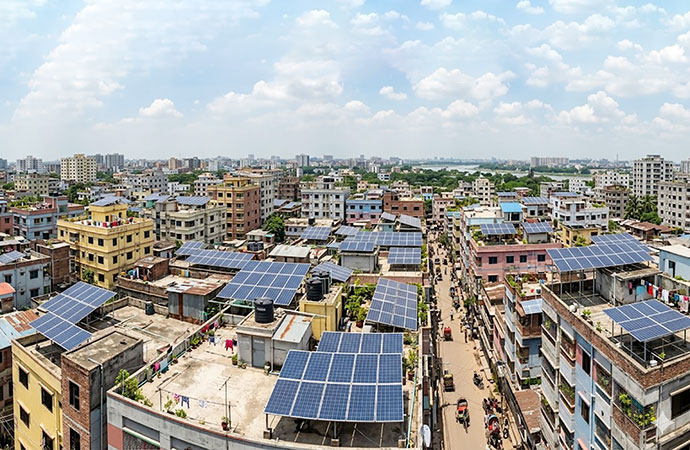
Will the future look like this Rooftops with solar panels
While Bangladesh remains one of the most negatively affected human zones due to climate change, certain economic opportunities have opened up that can significantly help cope with the challenges of CC. It's stated that the sector could be as high as $200 billion dollars. For example, Denmark's CIP is proposing a $1.3 billion offshore wind farm, EU has committed €3.7 billion for energy transition and other big ventures are in the offing. However, the biggest opportunities are in the middle to micro level ventures related to the climate change scenario.
The main sectors
The major sectors are in the following economic zones. First is, renewable energy and Infrastructure development. These include solar energy projects where the market is expected to reach 3.9 GW by 2030. Utility-scale solar parks, rooftop systems for factories, solar-powered irrigation pumps to replace diesel are all on the list. B. Electric Vehicles are now big with manufacturing facilities for 2/3/4 wheelers and building charging station networks. C. Wind Energy: Potential for both onshore and offshore wind farms along the 700km coastline. D. Climate-Smart Agriculture. E. Development and sale of saline-tolerant and drought-resistant seed varieties.
But other sectors are also growing: These include floating and Saline-Adaptive Farming: Innovative business models like mangrove-based pisciculture and spirulina farming in coastal regions. G. Sustainable Materials and Circular Economy in most waste production areas. H. Investment in 100% biodegradable jute-based packaging and materials to replace plastics. I. Turning textile waste into premium fibers through recycling facilities. J. Desalination plants, rainwater harvesting, and greywater recycling systems for urban and coastal areas. K. Climate Risk Insurance that protects farmers and industries against flood and cyclone damage.
Credit Obstacles
Obviously, obstacles are high which includes initial capital costs for green technologies (e.g., solar PV, energy-efficient machinery) that require significantly higher upfront investment-up to 30% more than conventional alternatives. So limited access to Finance is the next with small and medium enterprises facing problems to secure formal bank loans due to strict collateral requirements, paperwork and a lack of established credit history. Lending rates for SME loans can be as high as 12.5% to 40% when sourced from microfinance or informal lenders.
Commercial banks often view such CC projects as risky due to their long payback periods and the use of relatively new, unproven technologies in the local market.
Policy challenges
A recent paper prepared by Earth Income, an outfit interested in funding ventures in this sector says certain obstacles need immediate addressing. They say, weak policies are leading to conflict between various ministries and a general lack of coordination. A good example is gaps in national grid expansion and solar home system goals and objectives. Lengthy and complex licensing, registration, and approval procedures is another. There is no specific "Green Industrial Policy" which means lack of clear incentives such as tax breaks or swift approvals for CC businesses.
Structural and Technical Constraints already exist such as land scarcity which is expected in a densely populated country, weak Infrastructure including weak power supply, unreliable utilities, weak transportation networks etc. And the shortage of technical expertise is of course everywhere creating heavy dependence on expensive foreign consultants.
International partnerships and the role they hope to play
Bangladesh is rapidly scaling its climate agenda through a multi-layered support ecosystem. At the forefront is the Bangladesh Climate and Development Platform (BCDP), a pioneering regional collaboration launched in 2023. Key contributors include the World Bank, providing $1 billion in climate credits and piloting carbon market transactions, and the IMF, which approved a $1.4 billion Resilience and Sustainability Facility to manage decarbonisation risks.
Financial depth is further provided by the Green Climate Fund (GCF), currently overseeing $400 million in projects. The GCF partners with local entities like IDCOL to fund green technology in the garment sector. Meanwhile, the ADB specifically targets CCUS technologies, utilizing depleted gas wells for CO2 storage.
JICA and GIZ provide essential loans and policy support for energy-saving initiatives and global funding access. In the private sector, SGS Bangladesh offers specialised CCUS advisory, covering capture plant design and compliance. Finally, the UNDP serves as a technical integrator, developing "SDG Thematic Bonds" to unlock private investment. Together, these organisations bridge the gap between ambitious climate targets and the practical technical and financial frameworks required for a successful energy transition.
Some notable efforts
Bangladesh is advancing its energy transition through localised innovations, including Akij Group's industrial CO2 capture for food-grade reuse and Shahjibazar Power's waste heat recovery systems. IDCOL is facilitating this shift by financing solar irrigation and low-emission brick kilns, while the RMG sector and community-led initiatives, such as women-managed water desalination plants, drive economic resilience and climate adaptation. These efforts highlight a blend of industrial efficiency, financial mechanisms, and community empowerment in sustainability.
But the bigger story could be at the micro level community and women-Led Ventures. Some of these are:
Groups like Golap Mohila Dal operate solar-powered desalination plants in coastal Satkhira, turning clean water scarcity into a profitable community service. Smallholders are switching to high-value, resilient crops like quinoa and sunflowers to combat soil salinity and river erosion. Another is the Char Montaz Dry Fish is an 800-woman based cooperative producing chemical-free dried fish, creating a resilient value chain for coastal communities.
Meanwhile, jute alternatives startups like Tulika are replacing plastics with biodegradable jute products, tapping into the global eco-market and BD Highway Turbine is a youth-led venture generating renewable energy from the wind turbulence of highway traffic.
Things are moving and success stories are more frequent than before. What it needs now is a push to show that climate change based economics is not a choice but the principal way out for Bangladesh from climate change disasters itself.
The above article was presented at a seminar organised by the Earth Journalism Network.
A Independent Newsweekly
© Copyright 2026 | Designed by ARK Reepon & Developed by Cosmos Group Software Team




Leave a Comment
Recent Posts
A presidential lament
So there will be a new president of the republic no later than August ...
Major General (retd) A. R. Kha ...
Former adviser and retired Major General Dr. Abdur Rahman Khan, widely ...
India needs to be more sensitive to Bangladeshi peop ..
FM says Saudi-led coalition reflects Dhaka’s maritim ..
Time for Dhaka-Beijing to jointly create prosperity: ..
Beyond the Crown: Samanzar carries Bangladesh’s hygi ..