



Column
America at 250: Still Working Through Its Contradictions

An Independent Newsweekly




Column
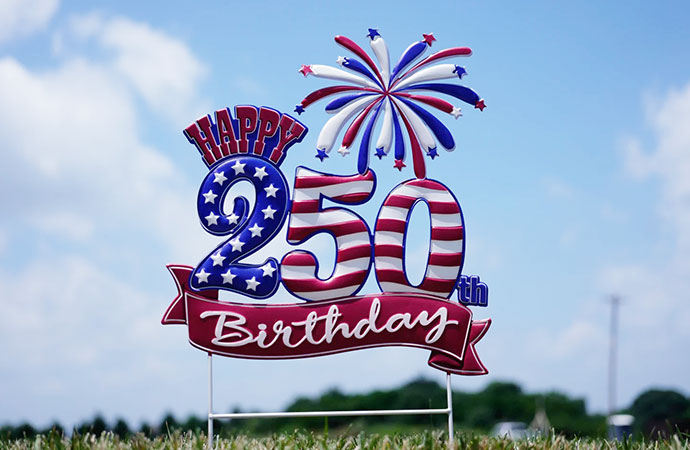
Photo: AP/UNB
America turned 250 this week. Rarely has the republic seemed more uncertain about itself.
When Benjamin Franklin emerged from Philadelphia's Constitutional Convention on September 17, 1787, he was greeted by a crowd eager to learn what the delegates had accomplished after four months of often bitter debate. Among them was Elizabeth Willing Powel, who asked the question that would echo through American history: "Well, Doctor, what have we got?"
Franklin's reply has become part of the nation's political scripture.
"A republic-if you can keep it."
Two hundred and fifty years later, Franklin's warning no longer reads like a historical curiosity. It reads like a challenge.
The United States has survived a civil war, economic depression, world wars, political assassinations, Watergate, terrorism, and bitter cultural upheavals. Time and again, Americans assumed that however fierce their disagreements, the constitutional system itself would endure.
Today that confidence has begun to erode.
The central question confronting America on its 250th birthday is no longer whether the country remains the world's richest or most powerful nation. It undoubtedly is. The question is whether the constitutional republic Franklin helped create can still restrain political power, accommodate an increasingly diverse society, and preserve the democratic ideals on which it was founded.
The Imperial Presidency
No issue illustrates that anxiety more vividly than the growing power of the presidency.
After winning a second term through democratic elections, President Donald Trump has pursued an extraordinarily expansive view of executive authority. His supporters argue that he is finally dismantling an unelected bureaucracy that has accumulated power for decades. His critics believe he is testing the constitutional limits of presidential power in ways unseen in modern American history.
The debate itself is hardly new.
In 1973, at the height of the Watergate crisis, the distinguished historian Arthur Schlesinger Jr. warned that successive presidents had steadily accumulated powers never intended by the Constitution. He gave that phenomenon a memorable name: "the imperial presidency." At the time, the phrase referred largely to Richard Nixon's abuse of executive authority. Few imagined that it would again become central to the national conversation half a century later.
After Nixon resigned, President Gerald Ford sought to reassure a shaken nation.
"Our Constitution works," he declared. America would once again be governed by laws rather than by the will of a single individual.
That reassurance today sounds less certain.
Recent Supreme Court decisions have significantly strengthened presidential authority, while Congress has often appeared reluctant to challenge the executive branch. The result, many constitutional scholars argue, is an office considerably more powerful than the one envisioned by the framers.
It is this transformation that journalists Maggie Haberman and Jonathan Swan examine in their recent book Regime Change: Inside the Imperial Presidency of Donald Trump. Their argument is not simply about one president. It is about a presidency that increasingly resembles the concentration of executive power the founders sought to prevent.
The irony is difficult to miss.
A nation born in rebellion against monarchy now finds itself debating how much authority one elected leader should possess.
That debate is about far more than Donald Trump. It goes to the heart of Franklin's challenge. Two hundred and fifty years after independence, Americans are once again asking whether constitutional restraints remain strong enough to preserve the republic they inherited.
The Shining City and Its Shadows
President Ronald Reagan famously described America as a "shining city upon a hill"-a nation confident in itself, prosperous, and open to all who sought freedom. It was an image of optimism that captured how millions of Americans wished to see their country.
There is much truth in that vision.
No nation has attracted more dreamers. Millions have crossed oceans, deserts and political frontiers to build new lives here. Dissidents escaping dictatorship found refuge in America. Scientists found laboratories. Entrepreneurs found opportunity. Students found universities unlike any in the world. Even today, despite all its political turmoil, the United States remains the destination of choice for millions who believe that talent matters more than birth.
Yet Reagan's shining city always cast long shadows.
The Declaration of Independence proclaimed that "all men are created equal." But when the Constitution was drafted eleven years later, it accepted slavery as part of the constitutional order. Millions of Black Americans were treated not as citizens but as property. Native Americans, the continent's original inhabitants, scarcely figured in the constitutional imagination at all.
That contradiction was not an accident. It became America's defining dilemma.
The Yale historian Edmund Morgan called it "the American paradox"-the uneasy coexistence of slavery and liberty. America proclaimed universal freedom while denying it to millions. The nation's greatness has always rested not on resolving that contradiction, but on repeatedly confronting it.
Each generation has widened the circle of those entitled to the American promise.
The abolition of slavery. Women's suffrage. The civil rights movement. Marriage equality. Each advance encountered fierce resistance. Each expanded the meaning of citizenship.
That struggle, however, has never truly ended.
Today's America is experiencing another profound transformation. Within little more than a decade, non-Hispanic whites are expected to become a numerical minority. Immigration from Asia, Latin America and Africa has reshaped the country's demographic landscape, making the United States more diverse than at any point in its history.
For many Americans, that diversity represents the country's greatest strength. For others, it has become a source of deep anxiety.
Donald Trump has become the most influential political voice of that anxiety. His promise to "Make America Great Again" is understood by supporters as a call to restore national confidence, secure the border, and defend traditional values. Critics hear something different: nostalgia for an America in which political and cultural power rested overwhelmingly with white Christians.
Few episodes captured that divide more vividly than the white nationalist march in Charlottesville, Virginia, in 2017. Carrying tiki torches, demonstrators chanted, "You will not replace us"-a slogan reflecting the fear that demographic change would eventually displace white Americans politically and culturally. Trump's observation that there were "very fine people on both sides" transformed Charlottesville into a defining symbol of America's continuing struggle over race and national identity.
There is another America
It is the America that elected Barack Obama, the son of a Kenyan immigrant, to the presidency. It is the America where an immigrant from Bengal, Fazlur Rahman Khan, designed the Sears Tower, once the tallest building on earth. It is the America where immigrants from countries that Trump once dismissed as "shitholes" now lead some of the world's most innovative companies, teach in its universities, command its hospitals, and serve in its armed forces.
That, too, is America.
At 250, the United States remains caught between two competing visions of itself. One looks backward, seeking security in a more homogeneous past. The other looks forward, embracing an increasingly pluralistic future. The argument between those two visions did not begin with Donald Trump, and it will not end with him.
It has been part of the American story from the very beginning.
America's political divisions are driven by more than race and identity. They are also rooted in widening economic inequality.
The United States has never promised equality of outcome. It has, however, long promised equality of opportunity. For generations, Americans accepted that some would become extraordinarily wealthy because they believed hard work could still lift ordinary people into the middle class.
Increasingly, many no longer believe that bargain holds.
Growing wealth inequality
Today, the wealthiest one percent own roughly one-third of America's wealth. The top ten percent control nearly two-thirds of all household wealth. Meanwhile, housing has become unaffordable in many cities, higher education leaves millions burdened with debt, healthcare remains prohibitively expensive for many families, and wages have failed to keep pace with the rising cost of living.
America remains one of the richest countries in history. Yet it is also a country where millions of children experience food insecurity and where an increasing number of working families struggle to imagine a better future for their children.
The result has been a profound crisis of confidence.
According to Gallup, barely half of Americans today say they are very or extremely proud of their country, the lowest level in decades. Among younger Americans, the decline has been even more pronounced. They have inherited unprecedented technological opportunity alongside soaring housing costs, crushing student debt, and an economy that many believe rewards inherited advantage more than hard work.
The opposites: Trump and Mamdani
That frustration has produced two very different political responses.
One is Donald Trump. The other is Zohran Mamdani.
At first glance, they appear to have nothing in common. Trump speaks the language of national identity, borders, tradition, and cultural restoration. Mamdani speaks of affordable housing, universal childcare, public transportation, and economic justice. One looks backward toward an America rooted in tradition. The other looks forward to an America transformed by diversity and demographic change.
Yet both draw strength from the same underlying reality: millions of Americans believe that the political and economic system no longer works for ordinary citizens.
That is why Mamdani's rise matters far beyond New York City.
His election is not merely the story of a young Muslim immigrant becoming mayor of America's largest city. It is a sign that a new generation of Americans is demanding a different social contract-one that places greater emphasis on economic security, affordability, and the responsibilities of government. Just as Trump gave voice to voters who felt abandoned by globalization and cultural change, Mamdani has become the voice of younger Americans who believe the country's extraordinary wealth has become concentrated in too few hands.
The contest between them is therefore about much more than policy.
Donald Trump and Zohran Mamdani represent two competing stories about what the United States should become. One imagines a nation reclaiming a familiar past. The other imagines a nation embracing an unfamiliar future.
Neither vision is likely to disappear. At 250, America has not resolved that argument.
It has merely entered another chapter in it.
An Unfinished Republic
What, then, should America celebrate on its 250th birthday?
Certainly not perfection.
No nation that tolerated slavery for nearly a century, dispossessed its indigenous peoples, fought costly and often misguided wars abroad, and now finds itself so bitterly divided can claim moral perfection. Nor can a country where wealth has become so concentrated, political discourse so poisoned, and trust in public institutions so diminished pretend that all is well.
Yet neither should Americans celebrate only their failures.
For all its contradictions, no country has done more to shape the modern world. The United States helped defeat fascism, rebuilt Europe after the Second World War, led the scientific revolution that transformed medicine and technology, and created universities and research institutions that continue to attract the world's brightest minds. It gave millions of immigrants not merely refuge but opportunity. Even today, people continue to risk everything to reach America's shores-not because they believe the country is perfect, but because they believe it remains possible.
That may be America's greatest achievement.
Unlike most nations, America was never founded upon a common ancestry, language or religion. It was founded upon a proposition-that liberty belongs to every human being, and that government derives its legitimacy from the consent of the governed.
The tragedy of American history is that the nation has so often betrayed that proposition.
The glory of American history is that generations of Americans have refused to abandon it.
The abolitionists invoked it against slavery. The suffragists invoked it against the exclusion of women. Martin Luther King Jr. invoked it against segregation.
Immigrants still invoke it every time they choose America over safer, richer or more familiar alternatives. The American story has therefore never been a steady march toward perfection.
It has been an argument. An argument over who belongs. An argument over what equality really means.
An argument over how much power government should possess, how much wealth one society should tolerate at the top while poverty persists below, and whether America is defined by race, religion and ancestry-or by an idea that anyone, from anywhere, may become an American.
Donald Trump and Zohran Mamdani are merely the latest participants in that argument.
Neither will settle it. Nor should they.
Because America was never meant to be a country without disagreement. James Madison understood that factions were inseparable from human nature. The Constitution was designed not to eliminate conflict, but to prevent conflict from destroying the republic.
That is why Benjamin Franklin's reply remains so remarkably contemporary.
"A republic-if you can keep it."
The founders did not promise that the republic would survive. They entrusted its survival to future generations.
At 250, America has reached another of those defining moments. One path leads toward a more fearful, inward-looking and ethnically exclusive nation. The other points toward a more pluralistic republic that seeks once again to enlarge the meaning of American citizenship.
Which path the country ultimately chooses no one can yet know.
But perhaps that is the wrong question.
The more important question is whether Americans still possess the civic imagination, the constitutional discipline, and the moral courage to keep arguing without abandoning the republic itself.
For two hundred and fifty years, that has been the real American experiment.
It still is.
Hasan Ferdous is a journalist and author, based in New York
A Independent Newsweekly
© Copyright 2026 | Designed by ARK Reepon & Developed by Cosmos Group Software Team






Leave a Comment
Recent Posts
The government passes the test ...
One of the cornerstones of the political earthquake Bangladesh witness ...
The government hiked the price ...
The government hiked the price of a 12kg cylinder of liquefied petrole ...
Police in France stand accused of using excessive fo ..
The India-Pakistan Cold War
A week on from DNCC’s eviction drive, Mirpur-10 rema ..
Equal Service, Unequal Pensions: Time for a Fairer S ..