



Column
A time to read, a time to remember: “Kherokhata” by Tahmina Saleh

An Independent Newsweekly
Column
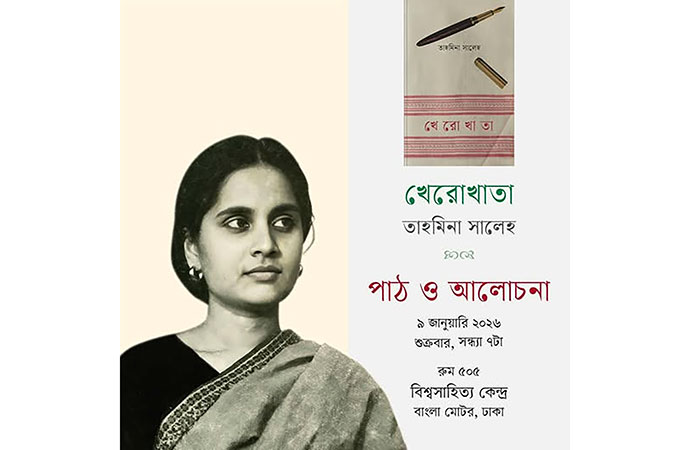
Once in a while, there will come a book which will not knock on the door but just walk by a reader who will hear the footsteps and read it because of good fortune and circumstances. "Khorokhata" is such a book because it treads so softly on the literary landscape of Bangladesh that few will probably hear of it though it's such a precious book mixing public and private memories and putting them together with sensibility and sense that is all too rare in Bangladesh's social media driven cultural world.
That's very sad because the pages of the smallish in size book holding 200 + pages contain the reflections of a remarkable mind. It's hugely sensitive, austere and yet full of precise observations of the world around her which is missed by many.
She talks about her world where the past and the present come together to create a world laced with colours of her thoughts. It's said in a voice that we hear less and less, a voice never noisy and always careful to leave behind the perfumed shadows of time by a person who looks at the world which can no longer surprise or shock but still is wonderous, joyous or heartbreaking but balanced in its depiction by its simplicity and grace.
Soft footfalls of the past
Tahmina Saleh was born in 1938, way back when the first government was formed in Bengal on the basis of elections of 1937. In so many ways, she is just a child of history which later birthed Bangladesh in 1971. Two years after her birth the Lahore Resolution (1940) which first mentioned an "independent state "that ultimately after trudging through many political forests emerged as Bangladesh.
It's not only history but speaks of several pioneering generations that would birth a new people for a new land. It's from that era and that generation and the next few that she came and today is perhaps one of its most graceful members. We are lucky to have met such a person through the book.
What struck me as a reader was her graceful tone and language where nothing is overstated no matter how intense the subject matter is. She speaks of her husband's near death at Pakistani hands in 1971 for no crimes committed other than not being on their side or of losing him to cancer several years later but the voice is never shrill or shaken. Few have carried across their emotions so well to the reader even when discussing such tragedies without raising their voice. Its culture and class.
In this age of social media where loud voices are an absolute necessity if one wants to be heard, Tahmina achieves the same effect with her measured tones. What secret does she carry that her words are always so comforting, brave and ultimately triumphant as she confronts life from her first to her 8th decade of life.
History, memories and a lost world
She speaks in a gentle voice about the world past and present in a prose she wrote which were posted on her Facebook page. Her friends list is quite small and such gems were written without any kind of pressure of emoji hunts as many posts now are. She probably never wished for more ears because she would never want to be so loud.
Yes but she was actually a 14 year old girl who had broken Section 144 in the Dhaka University as a schoolgirl on 21st February 1952.. Yet almost none would know her as one of "them" who live in a world of constant glorification. She does speak with her quiet disdain for such noise that celebrity days bring because in her world, that didn't matter. She speaks of that brave and bleeding day, visiting the DMCH and seeing the injured and yet they are just stated as background to the history without any background cacophony. That is what is most impressive about the book. She speaks with such grace even under the pressure of so much history.
Yet it's also a book of family memories and how people were. Of her beloved sisters and brothers, in-laws and cousins and nephews and nieces. It's almost as if one is visiting the large joint families of the past where amidst all the chaos of change, war and transitions, they stood strong like a fortress against the angry tides of history. One feels soothed, calmed and can remember the past including one's own without the sense of trauma that the past often evokes now.
Tahmina Saleh will not spend time marketing her books but her family should because such efforts showcase not just a voice that is increasing lost under the many layers of ugly social noise but the era when so much happened and how they belonged to all and which she described with the pen of a participant dressed as an observer.
The book should be made digitally available to all so that people can become not just familiar with a rapidly fading world but a mind that is able to express her world with such grace and dignity.
A Independent Newsweekly
© Copyright 2026 | Designed by ARK Reepon & Developed by Cosmos Group Software Team






Leave a Comment
Recent Posts
Dhaka, Tokyo relationship to c ...
Deputy Chief of Mission of the Embassy of Japan in Bangladesh Yoshida ...
Democracy puts a premium on et ...
And just like that, the deed was done. With a volley of 'Ayes!’( ...
Dhaka still eyeing ‘conducive’ setting for PM’s Delh ..
Gallery Cosmos Artist Residency, 2026
Summit seeks reinstatement of FSRU deal
Hatful of medals for Bangladeshi whiz kids at WMI 20 ..