



Business
A Fatal Challenge to Mainstream Economics


An Independent Newsweekly






Business
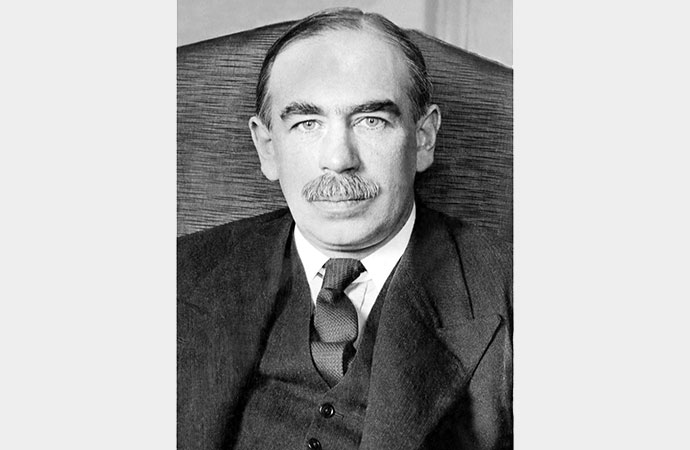
John Maynard Keynes. Photo: en.wikipedia.org
The intellectual project on which mainstream economists were raised, and which still forms the backbone of textbook education, has disappeared. What remains is a pastiche of attempted patches, apologies, and corruptions of “heterodox” ideas, all peddled by exponents of an “orthodoxy” that lacks a theoretical core.
In what is best read as a preemptive swipe at Isabella Weber's new book, Anti-Fascist Economics, Jason Furman, the chair of the White House Council of Economic Advisers during US President Barack Obama's second term, recently offered the following half-truth: "the fatal challenge to heterodox economics is that there isn't actually orthodox economics."
The truth lurking inside this statement is that "mainstream" economics is now a swirling mass of ad hoc ideas and methods, all revolving around an empty core. The theoretical project on which mainstream economists were raised, and that still forms the backbone of textbook education-with its focus on rationality, competition, supply and demand, price adjustment, general equilibrium-has disappeared. What remains is a pastiche of attempted patches, apologies, and corruptions of "heterodox" ideas.
Furman names many of the main currents within the swirling mass: "behavioral, information failure, institutions, bubbles, financial fragility [the nerve!], labor monopsony (sort of), Schumpeterian creative destruction," as well as randomised controlled trials and other, supposedly purely empirical, methods. It all amounts to a striking acknowledgment of intellectual fracture, engineered from within.
Consider "information failure"-or asymmetry-which was emphasised long ago by Joseph E. Stiglitz, an "orthodox" economist par excellence, until he was mugged by reality during Bill Clinton's presidency. Was Stiglitz describing a defect that can, in principle, be repaired by better, more complete, "symmetric" information, thus rescuing the competitive model from the critique? Or did he open a window onto a fatal flaw of markets? If I read him correctly, Stiglitz himself has remained ambivalent about this key question, preserving his orthodox authority by declining to face the full consequences of his own critique.
Something similar can be said of Paul Krugman, whose early fame stemmed from pursuing the implications of "increasing returns"-or declining unit costs as the scale of production grows. Increasing returns does explain a lot, including the triumph of the North in the US Civil War, the rise of the United States to world power in the 20th century, and the rise of China today. It also obviates the neoclassical doctrine of comparative advantage and the mainstream devotion to free trade. Yet even more than Stiglitz, Krugman studiously avoided the logical implications of his own ideas.
The "behaviorists," meanwhile, hijacked the terminology of a rich tradition in organisational sociology to advance a research programme that consisted (at least initially) of "testing" the so-called "rationality" postulates underlying the standard microeconomic model. What they discovered (surprise, surprise) is that real people behave differently. But has that changed the dreary underpinnings of textbook supply-and-demand dynamics? Not a bit.
This brings us to institutions, financial fragility, monopsony, and "Schumpeterian creative destruction." In each case, the mainstream has stripped a subversive tradition of its intellectual roots, sending, respectively, Thorstein Veblen and John R. Commons, Hyman Minsky, Joan Robinson and E.H. Chamberlin, and Joseph Schumpeter himself down the memory hole. Every one of these figures was a scathing critic of the neoclassical mainstream. (My father, John Kenneth Galbraith, also synthesised several of these traditions.)
Notably missing from Furman's list is the most egregious example, the so-called "New Keynesians"-the camp to which he belongs-who have reduced John Maynard Keynes to an unrecognisable caricature. Against this backdrop, the "heterodox" are the actual intellectual heirs of the discarded giants. The post-Keynesians have read Keynes thoroughly; Modern Monetary Theory draws on Keynes, Minsky, Wynne Godley, and Abba Lerner; and evolutionary economics builds on Veblen and Commons. Moreover, there is also Marxism and its offshoots-an entire category now airbrushed from history-as well as feminist, ecological, and other branches.
To apply the term "heterodox" to this assortment of marginalised economists is an unfortunate trap. It defines a series of diverse and deep traditions by what they refuse, namely absorption into a mainstream that lacks a theoretical core. It conflates a loose coalition-extending across the spectrum even to the "Austrians" (Friedrich August von Hayek and Ludwig von Mises most prominently) on the political right-with a clear-cut, unified theoretical basis that has not yet been consolidated.
Furman is therefore not entirely wrong to describe heterodoxy as a political project, though it would be more accurate to call it a loose mutual-support network for the academically endangered. But as the Austrian school economist James Broughel of George Mason University points out, the mainstream is a far more powerful, and no less political, project. If this is hard to see, that is because its central goal nowadays is merely to maintain control over resources, appointments, curricula, and public policy.
It doesn't have to be this way. In Entropy Economics, Jing Chen and I pointed out that most (though not all) "heterodoxy" rests on the straightforward insight that the basic principles underpinning physical, biological, organisational, and social reality must necessarily also underpin economics. Yet this is a foundation that the mainstream, stuck in an intellectual context that was obsolete by the early 19th century, cannot even acknowledge, let alone accept, without collapsing.
In my latest book, The Power to Destroy, I detail the recent real-world consequences of applying the dominant, vacuous mess of mainstream ideas to economic policy. And in Anti-Fascist Economics, Weber presents concrete proposals for ensuring an affordable, tolerable, sustainable economic life-the popular demand in Europe and in America that will shape our politics in the foreseeable future.
No wonder the "orthodox" economists sense trouble.
From Project Syndicate
A Independent Newsweekly
© Copyright 2026 | Designed by ARK Reepon & Developed by Cosmos Group Software Team










Leave a Comment
Recent Posts
A political earthquake in Amer ...
The American midterm elections have delivered a resounding political r ...
‘A beautifully American story’ ...
Campaigning relentlessly across Michigan, Abdul El-Sayed didn’t ...
Consumers fear paying Tk 2500 for 12-kg LPG cylinder ..
UNB Chief Editor mourns death of Bogura corresponden ..
Enayetullah Khan attends FICAC 2026 North America Re ..
Democrats won control of both chambers of Congress i ..