



Reportage
When a Gulf Tycoon Warns Washington about a War of Choice

An Independent Newsweekly

Reportage
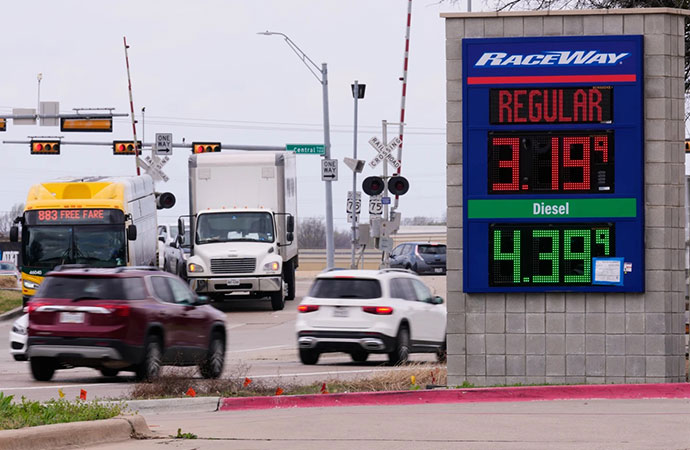
Drivers navigate a busy intersection past a sign displaying the current gas prices at a filling station in Plano, Texas, March 6, 2026. Photo: AP/UNB
Historians distinguish between two kinds of war: wars of necessity and wars of choice. The former are fought because survival demands it; the latter because leaders believe they have the power to wage them.
The war now unfolding in the Gulf-pitting Iran against the United States and Israel-appears increasingly to belong to the second category. Now in its second week, the conflict already seems to have lost its strategic moorings. President Donald Trump, who ordered the strikes, appears uncertain how the war should end-or even why it had to begin now.
That uncertainty helps explain an extraordinary message that surfaced this week from the Persian Gulf.
Late one evening, a post appeared on X that few in Washington expected to read. It was not written by an Iranian official, an anti-war activist, or a European diplomat. It came from Khalaf Ahmed Al-Habtoor, one of the United Arab Emirates' most powerful businessmen-and a longtime associate of Donald Trump.
His question to the U.S. president was blunt:
Who gave you the authority to drag our region into a war with Iran?
In the cautious political culture of the Gulf, where criticism of American policy is rarely voiced publicly, such language is extraordinary. It signals a fear now spreading across the region: that a war launched suddenly and without consultation could set the entire Middle East on fire.
From business partner to public critic
Al-Habtoor is hardly an outsider to Trump's world. With major investments in hotels, luxury real estate, construction and education, he is among the UAE's most prominent business figures, with a fortune estimated at more than $3 billion.
At one time he and Trump even discussed building a Trump Tower in Dubai's Palm Jumeirah. The project never materialized, but the relationship remained cordial. During the 2016 presidential campaign, Al-Habtoor publicly praised Trump as a "man of action."
That history makes his recent open letter all the more striking.
Within days of the U.S.-Israeli strike on Iran, anxiety has swept the Gulf states. If the conflict escalates, regional leaders fear that the first countries to suffer will not be Washington or Tel Aviv, but the energy-exporting states of the Gulf themselves.
Al-Habtoor captured that fear in stark terms:
"Before deciding to go to war, did you consider the devastation it could bring? If this conflict expands, the first to burn will be the countries of the Gulf."
He also raised an uncomfortable question: was the war Trump's own decision-or the result of pressure from Israeli Prime Minister Benjamin Netanyahu and his government?
Peace rhetoric and war
Trump has often portrayed himself as a champion of peace. Recently he even announced the creation of a so-called "Board of Peace." Al-Habtoor pointed out the irony. Why launch a war that threatens the stability of the entire Middle East before the ink on that peace initiative had even dried?
True leadership, he wrote, is not defined by the willingness to wage war but by wisdom, restraint and respect for others.
Why the letter matters
The significance of Al-Habtoor's intervention lies not only in what he said but in who said it.
Gulf rulers and business elites almost never criticize Washington publicly. Their relationship with the United States rests on security alliances, arms purchases and vast financial ties.
If someone as well-connected as Al-Habtoor has chosen to speak out, it suggests that anxiety in the region runs deeper than many outsiders realize.
The stakes are enormous. According to estimates cited by the Financial Times, Gulf countries collectively hold nearly $2 trillion in investments in the United States. Some policymakers in the region are reportedly considering whether those financial commitments should be reassessed if the war escalates.
International commercial law allows investment agreements to be renegotiated under extraordinary conditions such as war or systemic economic shocks. If that happens, the consequences would reach far beyond the Middle East.
A four-fold global threat
The Iran war now presents at least four major risks to the global economy.
First, nearly 20 percent of the world's oil and gas shipments pass through the Strait of Hormuz, which lies in Iranian waters. Any disruption could push oil prices beyond $150 per barrel.
Second, energy shortages would hit major importing economies-particularly China, India and Japan-triggering industrial slowdowns, rising food prices and political instability.
Third, the Gulf monarchies have accumulated roughly $4 trillion in sovereign wealth funds, largely derived from energy exports. If export revenues collapse, governments may be forced to liquidate portions of those funds.
Fourth, about $2 trillion of that capital is invested in the United States. A sudden withdrawal-even partial-could rattle financial markets already struggling with rising costs and declining purchasing power.
Echoes of the 1970s
For economists, the current crisis recalls the 1973 oil embargo, when Arab exporters curtailed supplies during the Arab-Israeli war. Oil prices quadrupled, plunging the global economy into stagflation-a toxic combination of high inflation and stagnant growth.
Despite decades of policy adjustments, the world economy remains deeply dependent on Middle Eastern energy-and increasingly on Gulf investment capital, which has become a central artery of global finance. As one Arab analyst recently wrote in the Beirut daily An-Nahar:
"The Gulf states are no longer merely oil producers. They are the financiers of globalization. If their stability is shaken, the shock will travel through every major market."
The trap of wars of choice
U.S. intelligence agencies have repeatedly conducted war-game simulations of a conflict with Iran. Their conclusion was consistent: entering the war might be straightforward, but exiting it would be extraordinarily difficult.
Those warnings appear to have been ignored.
Critics within the United States are now raising similar concerns. Commentator Tucker Carlson, usually counted among Trump's supporters, recently warned that those who push nations into war rarely pay the price themselves. Ordinary citizens do.
Trump himself appears caught between contradictory impulses. At a recent press conference in Florida he suggested the war was essentially over-while also threatening strikes that could endanger Iran's survival.
Once leaders step onto the battlefield, events often take on a momentum of their own. The historian John Lewis Gaddis summarized the dilemma succinctly:
"Wars of necessity arise when there is no alternative; wars of choice arise when leaders believe they have options but choose force anyway."
Many critics now believe the confrontation with Iran belongs in that second category.
The United States has faced this debate before. The invasion of Iraq in 2003 was widely described-even by some of its original supporters-as a war of choice, launched with confidence but without a clear exit strategy.
History's lesson is sobering. Wars of choice often begin with decisive speeches and confident predictions. They rarely end that way.
Al-Habtoor's warning therefore resonates far beyond one businessman's protest. It reflects a growing recognition across the Gulf that the consequences of this war may ultimately be borne not by those who ordered it, but by millions who had no voice in the decision.
And history suggests one final truth.
Wars of choice are easy to begin. Escaping them is far harder.
A Independent Newsweekly
© Copyright 2026 | Designed by ARK Reepon & Developed by Cosmos Group Software Team





Leave a Comment
Recent Posts
Why not zero tolerance for mea ...
While the nation continues to be swept up by World Cup fever, we must ...
The Long Present: A Dialogue A ...
The exhibition The Long Present, currently on view at Bengal Shilpalay ...
South Asia’s cultural future lies in collaboration: ..
Tribandhon: Three Artistic Voices in Conversation
A B-52 bomber crashed shortly after takeoff at a US ..
Amid intense political controversy, Bangladesh Bank ..