



Reportage
The Mathematics of Discontent: Decoding the Strategic Friction within the NCP


An Independent Newsweekly



Reportage
On the evening of February 28, 2025, at Dhaka's Manik Mia Avenue, the era of dynastic politics faced its first true challenge as student leaders officially launched the National Citizen Party (NCP). Following this historic debut, the NCP transitioned from revolutionary activism to the complex machinery of electoral politics in preparation for the February 12, 2026, general election. The party faced three strategic paths: allying with the BNP, forming a coalition with Jamaat-e-Islami, or remaining independent. The eventual decision to join the Jamaat-led 11-party alliance on December 28, 2025, sparked a heated debate regarding the move's moral legitimacy, leading to a wave of high-profile resignations, giving the party a fractured identity tugging between Leavers (those who left the party) and Retainers (those who stayed within) . Whether the NCP will maintain this alliance remains an open question, and an issue that requires serious contemplation. This is in part because NCP arguably redefines the nature and pattern of youth politics of future Bangladesh, and in part to assess the future course of NCP as a party that thus far failed to live up to the post-July expectations.
Given the emotional and evolving nature of this issue, developing a method that might answer these questions in a relatively unbiased and objective way is an intellectual challenge. The researchers of Global Research Alliance for Bangladesh (GRAB) developed and applied a robust quantitative method to analyse the positions of both the 'Retainers' and 'Leavers,' evaluating the NCP's long-term viability as a political force.
By processing a corpus of transcribed interviews/news conferences (YouTube videos), and Facebook posts through Google DeepMind's Gemma-27b large language model, we were able to translate qualitative political rhetoric into a quantitative Bayesian Game Theory framework. This methodology does not merely count keywords; it utilises a process known as Thematic Intensity Mapping. By weighing the frequency and strategic importance of specific linguistic indicators-such as "red lines," "dissent," or "electoral necessity"-the model assigns normalised values between 0.0 and 1.0 to critical variables. This allows us to strip away the emotional weight of political posturing and reveal the underlying mathematical probability of the party's next strategic move.
The Architecture of Discontent
The first revelation of the data is the absence of genuine cohesion. The model identified a shared Commitment Level of a mere 0.3 across both factions. In the lexicon of political science, this suggests a "low-trust equilibrium." Neither the Leavers nor the Retainers are bound by deep-seated loyalty; rather, they are tethered by situational necessity.
This instability is exacerbated by staggering "Internal Costs"-the quantitative measure of friction, stress, and interpersonal conflict. The Leavers recorded a friction score of 0.8, reflecting a profound sense of betrayal. The Retainers fared slightly better at 0.7, yet this remains an alarmingly high threshold of internal strife. Essentially, the NCP is operating in a state of permanent high-tension, where the energy spent on internal navigation outweighs the energy spent on external strategy.
The divergence becomes most acute when examining "Strategic Utility"-the perceived benefit of a particular political path. The Leavers calculated a Utility score of 0.6 for exiting the party, suggesting that the "profit" of ideological purity now outweighs the benefit of remaining. Conversely, the Retainers' Utility score sat at 0.4. They are not staying because they are convinced of the alliance's brilliance; they are staying because the immediate cost of departure is currently too high.
Perhaps most damning is the "posturing gap" in Signal Credibility. The Retainers, despite their public displays of confidence, possess a Credibility score of only 0.2. The model classifies this as "cheap talk"-rhetoric that is mathematically inconsistent with the party's internal atrophy. The Leavers, however, maintain a score of 0.4. In short: when the leadership speaks of stability, they are likely performing; when the dissenters speak of leaving, they are likely planning.
The Illusion of Stability
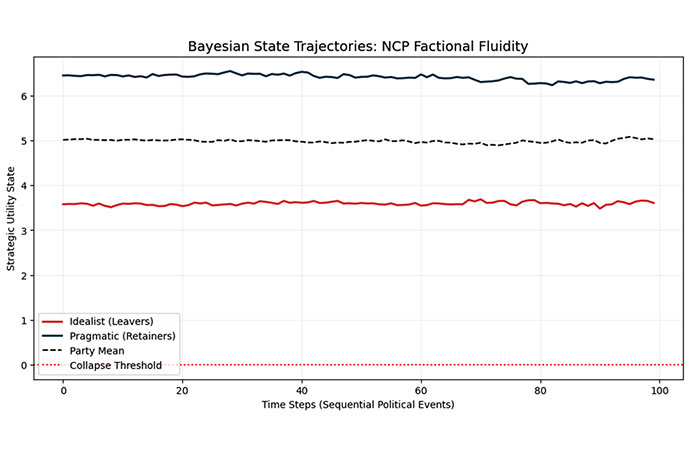
When these variables are fed into a Monte Carlo simulation-running ten million iterations of potential futures-a deceptive picture of stability emerges. In a controlled, "fair-weather" environment, the party appears stable. As seen in the Bayesian State Trajectories (Figure 1), the Strategic Utility of the Pragmatists remains high (approximately 6.4), while the Idealists hover around 3.5. Both remain comfortably above the "Collapse Threshold" of zero.
This is what economists call "Structural Lock-in." Structural lock-in occurs when self-reinforcing mechanisms trap an organisation or system in a specific equilibrium, making strategic change exceptionally difficult or costly. Under current conditions, the cost of a unilateral break is too high for either side to justify. The party survives not because it is healthy, but because it is trapped in a state of mutual inertia. The "Survival Score" for Retainers (6.46) is nearly double that of the Leavers (3.57), suggesting that the pragmatic wing possesses a sufficient resource buffer to weather minor turbulence.
However, this stability is a mirage. It assumes a static environment, ignoring the "Black Swan" events that define Bangladeshi politics.
The Breaking Point
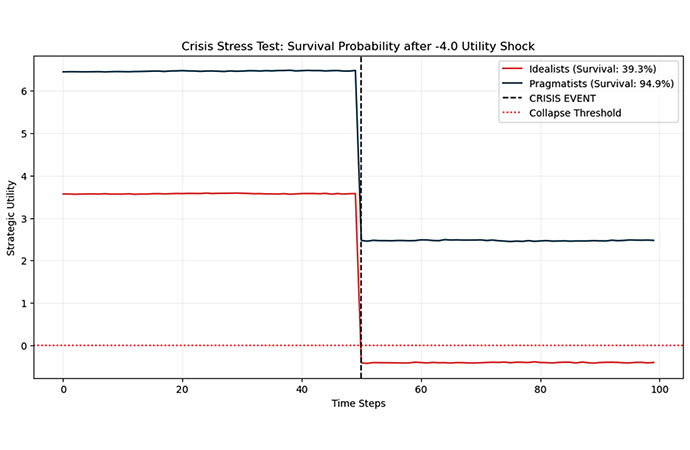
The true vulnerability of the NCP is revealed when the model is subjected to a "Crisis Stress Test." By simulating a catastrophic -4.0 utility shock-representing a major scandal or a failed electoral gamble-the asymmetry of the party's fragility is laid bare.
As illustrated in Figure 2, the Pragmatists are remarkably resilient. Despite the shock, their utility drops but remains well above the collapse threshold, yielding a survival probability of 94.9%. The Idealists, however, are obliterated. Their utility plummets directly into negative territory, leaving them with a survival probability of only 39.3%. The NCP is not a unified ship; it is a vessel where one half is bolted to the hull and the other is merely clinging to the railing.
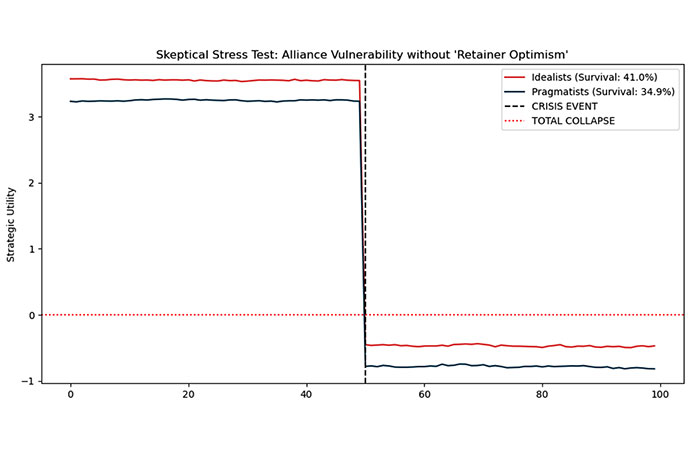
The most harrowing scenario, however, is the "Skeptical Stress Test" (Figure 3). Here, the model strips away "Retainer Optimism"-the inflated buffers created by leadership rhetoric-and replaces them with a "Skeptical Reality."
The results are catastrophic. Upon the occurrence of a Crisis Event, the strategic utility of both factions collapses. While the Idealists (41.0% survival) and Pragmatists (34.9% survival) both plummet, the buffer that previously protected the Pragmatists vanishes. In a climate of high skepticism, the party ceases to be a strategic fortress and becomes a psychological house of cards. A single external shock does not merely bruise the party; it triggers a total strategic failure.
Conclusion: The Cost of the Mask
The National Citizen Party stands as a cautionary tale of the "optimism gap." The leadership continues to project a facade of unity, but the underlying mathematics tell a story of bifurcation. The Retainers are calculating the benefits of institutional power, while the Leavers are calculating the cost of their own dilution. They are no longer operating within the same strategic reality.
The NCP is currently held together by the heavy inertia of the status quo and a collective fear of the unknown. But as the political landscape shifted during the 2026 elections, the party's 'Structural Lock-in' inevitably gave way, plunging the factions into an active crisis marked by the emergence of a rebel platforms. The question is no longer whether the alliance will shift, but whether the cost of maintaining the mask of unity will eventually exceed the cost of a total collapse. For a party born from the desire to redefine the future of a nation, the NCP may find that its greatest challenge is not the opposition it faces, but the mathematical instability of its own foundation.
A Independent Newsweekly
© Copyright 2026 | Designed by ARK Reepon & Developed by Cosmos Group Software Team






Leave a Comment
Recent Posts
When the moral compass is lost
The brutal and depraved cases of rape and murder of four young childre ...
UNGA Presidency: Attention now ...
Questions continue to surround what Foreign Minister Dr Khalilur Rahma ...
The Mathematics of Discontent: Decoding the Strategi ..
Indirect 'tax traps' in budget risk widening economi ..
From Early Leadership to Plastic Crisis: Bangladesh’ ..
Eat well