



Reportage
Exploring Offshore: One last time?


An Independent Newsweekly

Reportage
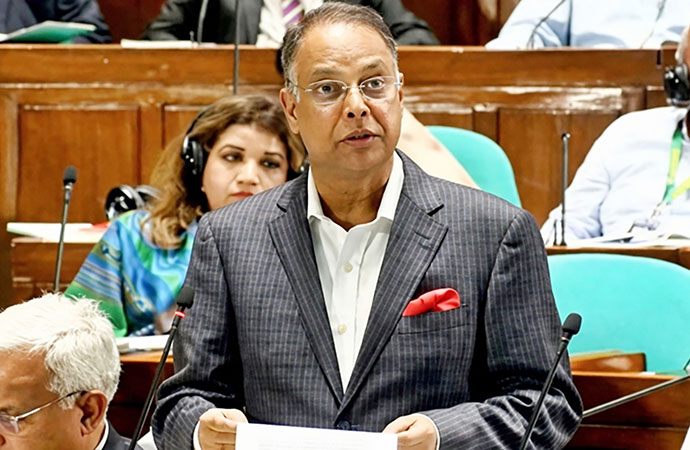
Energy and Mineral Resources Minister Iqbal Hasan Mahmud. Photo: Collected
On April 19, Power, Energy and Mineral Resources Minister Iqbal Hasan Mahmud stood on the floor of Parliament and briefed the House on the state of the country's most precious natural resource - gas.
Over the years, Bangladesh's total recoverable gas reserves had come to stand at 29.74 trillion cubic feet, Iqbal Hasan reported. Of which 22.11 trillion cubic feet, roughly three quarters had been extracted by December 2025, leaving a remaining reserve of 7.63 trillion cubic feet as of January 1, 2026.
And how long could that last?
According to the energy minister, unless new gas fields are discovered and supply continues at the current rate of approximately 1.7 billion cubic feet per day, these reserves would run out in roughly 12 years. As these reserves have dwindled, so has the daily supply from them.
Bangladesh is lucky that its own reserves are still at a level that roughly 65 percent of the country's daily gas supply is being met from these domestic sources, although a large portion of the estimated daily demand goes unmet. It is what leads to chronic shortages for industry in particular, while most households are used to regular disruptions to their low-thrust gas supply.
Back in 2017, 2.7 billion cubic feet per day was coming from domestic gas fields. That is the equivalent of total supply today, with around 952 million cubic feet per day coming from imported liquified natural gas (LNG), that the country started importing in 2018.
Only too aware of the painful cost of having to import energy from international markets, its impact on the country's balance of payments, Petrobangla has been devising various projects to try and extract every last iota of what God has given Bangladesh.
Including the most recent one found in Bhola, Illisha-1, the country has a total of 29 gas fields. Since the discovery of Illisha-1, and before that as well, there have been a number of voices insisting on ramping up exploration of the country's own gas reserves instead of relying on imported LNG whose price fluctuates frequently in the volatile international energy market. Geoscientists have long been suggesting that significant gas resources still remain underground in the country, and the present gas demands may well be met through extracting our own gas. Experts opine that Bangladesh could avoid the import of LNG for several years until its own gas resources are exhausted.
As the energy minister told his fellow MPs that day, Petrobangla has a master plan to drill a total of 50 wells and conduct workover operations on 100 others. Of these, 26 wells have already been drilled or worked over, with the remaining projects at various stages of progress. Overall it has met with mixed results, but even if you were to add them all up, they could never offer the kind of boost to the reserve figure that a new discovery could.
Regarding seismic surveys to uncover potential new areas for exploration, Iqbal Hasan said state-owned BAPEX has completed the acquisition of 3,600 kilometres of 2D seismic data in Blocks 7 and 9, with data processing currently underway. These are the onshore blocks where BAPEX, operating under the umbrella of Petrobangla as its exploration arm, has managed to gain the necessary experience over the years, to go with the technical know-how they possessed, to take care of the onshore assets.
Meanwhile, preparations are in progress to launch 3D seismic data acquisition across 1,450 square kilometres covering the Habiganj, Bakhrabad, and Meghna areas through the Bangladesh Gas Fields Company Limited, or BGFCL. Additional large-scale 3D seismic surveys are also being planned across various parts of the country through BAPEX and Sylhet GAS Fields Limited.
Unfortunately BAPEX has utterly failed to develop a division that could explore the country's offshore resources, leaving the country totally dependent on the IOCs (international oil companies) to come in and make their bids if they do fancy exploring for hydrocarbons in Bangladesh's marine territory, that extends deep into the Indian Ocean following the demarcation of the maritime boundaries between India, Bangladesh and Myanmar - on the basis of the much-celebrated decision in 2014 of the UN court that acts as the authority on the laws of the sea - ITLOS.
For the last 12 years though, Bangladesh has been unable to attract much interest from these IOCs, thanks to a number of factors. The Awami League regime that ruled the country for 15 years from 2009-24 showed a distinct lack of interest and initiative in this regard, with most people now ready to admit some of the conflicts of interest that led to progressively greater dependence on importing LNG, that AL bigwigs controlled.
The recent war in West Asia served as yet another reminder of the sheer uncertainty that countries expose themselves to, by depending on the international market for their energy sources.
A new chapter?
Petrobangla will launch an international tender early next week for oil and gas exploration in 26 offshore blocks, ending a 23-month hiatus. The tender will use a revised Bangladesh Offshore Model Production Sharing Contract (PSC) 2026, which energy officials say has been amended to attract foreign companies. The cabinet committee on economic affairs has already granted in-principle approval to the draft.
Sources at the Energy Division and Petrobangla confirm that preparations to float the tender are in their final stage. The notice will run in local and foreign newspapers, after which the Energy Division and Petrobangla will hold "road shows".
Energy and Mineral Resources Secretary Mohammad Saiful Islam told vernacular business daily Bonik Barta: "The international tender notice for offshore exploration will be published next Sunday. We've completed all preparations."
He added that the terms in the PSC for the international companies had been made more attractive than the previous round. "Our aim is to maximise foreign participation in the tender."
The Energy Ministry plans to do this by arranging a series of road shows and writing to foreign embassies. There is a sense of optimism that the PSC amendments will yield strong results. The tender is part of the elected government's 180-day action plan, which prioritised raising domestic gas output, rehabilitating wells, and finalising both offshore and onshore model PSCs. Within three months of taking office, it has commendably finalised the offshore PSC and is now moving to the tender stage.
The cabinet committee on economic affairs granted in-principle approval to the draft Bangladesh Offshore Model PSC 2026 on May 7. Petrobangla officials said the government adopted the framework to tackle escalating LNG import bills, rising global fuel prices, and the imperative of long-term energy security.
Bangladesh's last offshore bidding round, issued in March 2024 under the then-Awami League government, drew no response in the end. The original six-month deadline, which ran till the end of September, was then extended by three months. By then though, a bout of political instability had settled in the nation in the form of the July Uprising - which is probably what turned off several of the firms from participating in the end. The kind of long-term, capital-heavy investment entailed by oil and gas exploration, especially in deep seas, is not something companies will risk in the midst or even with any hint of political instability.
Several firms bought data but none submitted an offer. The tender expired during the subsequent interim administration.
Petrobangla formed a committee to investigate which found that international companies wanted revisions to gas prices, profit-sharing into the workers' welfare fund, pipeline construction costs and recommended revisions on a range of issues, including offshore areas.
Energy officials say the revised 2026 PSC addresses those demands. It will adjust gas prices every five years within a predetermined floor and ceiling.
Under the revised terms, companies will relinquish only 20 percent of their exploration area during the exploration phase, down from 50 percent. Mandatory profit-sharing to the workers' welfare fund drops from 5 percent to 1.5 percent. Pipeline tariffs will now be negotiated directly with bidders. Full cost recovery for infrastructure investment remains.
To improve commercial viability, the gas price benchmark switches from high-sulphur fuel oil to Brent crude. For deepwater gas, the formula sets the price at up to 11 percent of the three-month average Brent price, applied to a floor of $70 a barrel and a ceiling of $100. The 2023 pricing structure had used 10 percent of Brent.
The revised PSC also replaces the London Interbank Offered Rate (LIBOR) with the Secured Overnight Financing Rate (SOFR) as the benchmark interest rate. Wood Mackenzie, the international consultancy, recommended this change and the Law Ministry later approved it.
Taking chances
Offshore gas reservoirs are complex and require a total understanding of the deep-marine settings based on large-scale regional 2D and high-resolution 3D seismic data coverage, proper analogue study, preparation of appropriate geo-models with advanced tools and technologies. Apart from Sangu, we will only find records of some sporadic exploration drilling activities, e.g., Sonadia-1 by Cairn Energy, Reju by Oakland International, Sandwip East-1 by Shell Bangladesh Ltd., Magnama-1 and Hatiya-1 by Capricorn Energy, and Magnama-2 by Santos, carried out from 1998 to 2017.
The Bay of Bengal holds 26 blocks - 15 in deep water and 11 in shallow. ConocoPhillips took two deepwater blocks in 2010, completed a 2D survey, and quit after the government refused its demand for a higher gas price. Australia's Santos and South Korea's Posco Daewoo also signed contracts and later walked away. India's ONGC was the sole company still exploring two shallow blocks, SS-4 and SS-9, before it too pulled out.
After more than two decades of the twenty-first century, the total number of exploratory wells drilled in the Bay of Bengal is only four, while considering the Sangu Appraisal (Sangu South) wells, the total number is less than twenty. The new government would do well to address this lopsided balance, at least to some extent.
After taking office on February 18, the BNP-led government received a five-year plan from the Energy and Mineral Resources Division. The plan set a 100-day target for finalising a model production-sharing contract for oil and gas exploration in onshore and offshore blocks, a goal the division has now met with the completion of the Model PSC 2026. It also proposed launching a bidding round in the 2026-27 fiscal year. Other objectives included completing seismic data acquisition - a 500 line-kilometre 2D survey, a 3D survey in the Charfesson area of Bhola, and surveys of the Lalabazar, Goainghat, Kailashtilla South and Fenchuganj West structures in the Sylhet region onshore.
Preparatory work for the tender was finalised in February before the national election, following scrutiny of the draft Offshore Model PSC 2026 by the Law Ministry. The ministry raised several queries on both the offshore and onshore provisions. Petrobangla has since supplied the requested information.
The newly elected BNP-led government had been in power for just 11 days when war erupted in the Middle East. The conflict has sent global energy prices soaring. Oil has crossed $100 a barrel, while LNG is trading near $16.50 per million British thermal units on the Japan-Korea Market. Bangladesh's most recent spot purchase of LNG was at $21 per MMBtu. If the Middle East crisis persists, securing oil and gas from international markets will become increasingly difficult and expensive. That makes it imperative for countries to literally explore their options, and secure a diverse range of sources, in order to be truly energy secure in the future.
Internationally reputed companies have testified that there is more untapped natural gas in Bangladesh than had been extracted by it. A two-year joint study by the US Geological Survey (USGS) and Petrobangla showed that Bangladesh has undiscovered natural gas to the tune of about 32 trillion cubic feet. The Norwegian Petroleum Directorate (NDP), in a collaborative study with the Hydrocarbon Unit (HCU) under the Ministry of Energy and Power of Bangladesh, estimated 42 trillion cubic feet of undiscovered gas.
Ramboll, a European oil and gas consultant, similarly suggested that there is about 34 trillion cubic feet of undiscovered gas in Bangladesh. As Bangladesh consumes about one trillion cubic feet of gas per year, it means that 34 trillion cubic feet would be there for at least 30 years for the nation to consume.
And yet the country has historically lagged behind in exploration to find and tap its reserves compared to the US, Norway and Australia, and even compared to India's Tripura state. Bangladesh has so far drilled about 100 exploratory wells while Tripura has drilled more than 150.
As Petrobangla commences this new bidding round next week, let us hope it is the start of setting that record straight.
A Independent Newsweekly
© Copyright 2026 | Designed by ARK Reepon & Developed by Cosmos Group Software Team






Leave a Comment
Recent Posts
Mosque in my memory
Recently, I saw a pamphlet published by the Islamic Foundation which s ...
Why the fastest-growing Ebola ...
The Ebola outbreak in eastern Congo is now the fastest-growing one in ...
US reimposes its blockade on Iran after Tehran’s att ..
Oil Shocks Are No Longer So Shocking
Bangladesh urged to build AI capacity, strengthen di ..
Metamorphosis: Bishwajit Goswami on Art, Nature and ..