



Column
Too many graduates, too few jobs: The ignored crisis

An Independent Newsweekly


Column
AI Generated Image
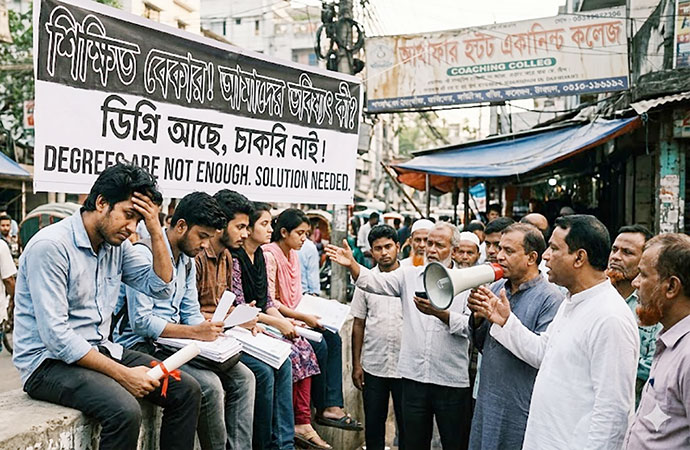
Bangladesh produces over 700,000 university graduates every year but the economy produces only around 300,000 jobs in the formal sector for which all these graduates compete. The national unemployment rate of graduates is around 13.5% (very inaccurate and underestimated), of which 1/3 are recent graduates.
It's a crisis that is not recognised by the State. What they see is a political angle. Regime change politics begins from here as these angry and desperate people at one stage turn to protest that moves from an economic issue to a political one.
This strange phenomenon is called "credential inflation" which means the job market is filled with graduates but are not trained and skilled with what the industry or labour market needs.
The roots
Bangladesh has a strange educational system whereby the objective is production of cheap degrees not skills or education. And the education sector is not standardised. Thus, production of graduates not employable education becomes the key.
Most of the graduates - 2/3- come from the National University-affiliated colleges not Universities. The quality of education here is poor and the teaching is also the same. They are not at all skills or market driven. Most are graduates in humanities and only few from sectors which come with a job tag. So, unemployment or delayed employment is guaranteed. Those from public Universities are only slightly better off as they all try to become BCS officers and spend years waiting for BCS or government jobs. And only few find such jobs.
The key fact is that Bangladesh doesn't have a developed formal sector which means the State and the government which operates it are very weak. The best indicator of that is the informal economy is responsible for 85% of all jobs in Bangladesh. It basically means the informal sector is where ultimately almost everyone goes for an income. However, graduates look to be hired by the formal sector which just doesn't have the capacity to do so. Hence the gap and the consequent crisis.
The Degree society
There are several motivations for graduate degrees. One, it means they can sit for the BCS exams, the ultimate destination for all. It's not just regular salary, prestige, security and pension but also enrichment as extra job income has been normalised in Bangladesh society.
This pushes millions in all the education sectors, private or public to try for GOB jobs. However, as reports show it's almost entirely made up of public University graduates and neither private university and certainly not National University graduates have a chance to get hired. But the dream pushes them all into delayed employment too.
Most will thus be forced to join the informal sector and do whatever they can, work that didn't need a degree for which their family paid or the time they spent on. However, the credential mentality dominates and extends all over the social spaces.
So, although informal society and its economy dominates Bangladesh, the aspiration is to go formal through the degree route though the destination doesn't exist or never did for an overwhelming 85 %.
The informal degree production sector
The equation is simple. Millions seek degrees and are ready to pay for it even though the system can't hire them. It's a long-lasting sustainable demand. Hence the market responds by opening private sector production units for providing the same. It's a market situation which is inevitable.
Those who keep saying about "quality education" forget that the market is informal and the formal governance system can't control it because the demand-supply equation is independent of government orders. And the GOB only cares about loyalists produced by the public University system who are familiar with the loyalty-reward equation from the start.
It has also been argued that keeping the most politically active generation locked into education for several years followed by graduation but delayed employment is useful for any government to keep political unrest safe. However, as records show when such resentment explodes after being pent up for long, it can be very explosive and cause a very large long-lasting political crisis leading to regime change as the "quota movement" shows.
The informal job sector patterns
Just as many private universities operate in the formal sector but function informally, the private economy sector is also structurally limited. The skills -match is a recurring issue. Just as the university education is not skills linked or employment market sensitive, the pressure on the informal sector to produce high skill-based products is also weak.
The reasons for this are, overwhelming level of demand, price sensitive buyers and complete oversupply of labour who are mostly unskilled hence cheap. If an unskilled person can do the work, why hire a skilled? This results in depressed wages and in this case the informal market which has no degree need, simply doesn't need graduates.
There is a higher layer in the informal economy towards which these graduates gravitate but initial wages are very low. In fact, a CPD study suggests that over 73% of technical graduates earn less than 10,000 taka per month initially, which is lower than the wages of some unskilled labourers. Basically, the skill level of even tech graduates from formal educational institutions is lesser than that of informal sector workers who have learnt their skills through their apprenticeship.
The crisis is clear. The Bangladesh economy can't produce jobs but produces graduates and this dichotomy creates conflicts and resentment that often results in mass upsurge with expected outcomes. Till date no solution has been suggested.
A Independent Newsweekly
© Copyright 2026 | Designed by ARK Reepon & Developed by Cosmos Group Software Team





Leave a Comment
Recent Posts
Getting off on the right foot
Prime Minister Tarique Rahman’s first official visit abroad sinc ...
After Forty-Seven Years of Hos ...
Only a few days ago, President Donald Trump was calling Iran's lea ...
India announced the resumption of tourist visas for ..
World Cup reaches halfway mark as knockout drama awa ..
DU: In the hotbed of the culture war, is cultural sp ..
At least 164 people have died and 971 were injured a ..