



Column
Bangladesh chooses to put itself first

An Independent Newsweekly
Column
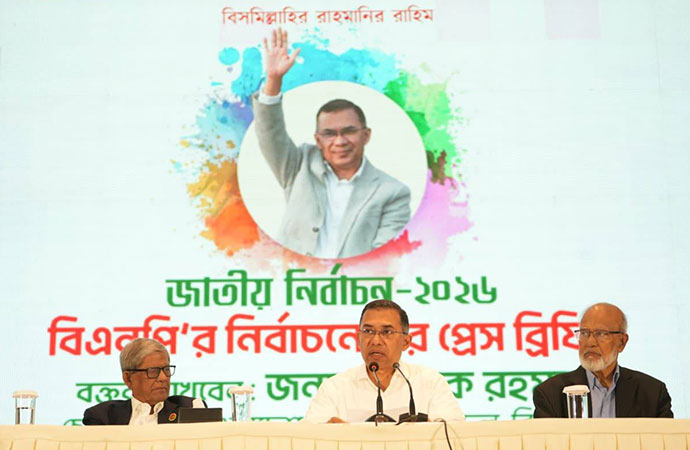
Finally the people of Bangladesh have spoken, and they have delivered their verdict resoundingly in favour of the BNP and Tarique Rahman to take the reins of this broken nation, to pick up the pieces of its broken republic after an age of authoritarianism, and to try and take it forward. A decisive and resounding result is the best result the country could have delivered, and that is what they have done, in favour of the most sensible option on its table.
Even a week ago, there was an apparent panic in Dhaka's elite circles and chatterati, regarding the Islamist wave represented by the resurgent Jamaat-e-Islami, and the alliance they formed with the young revolutionaries who brought down the Awami League. Those fears have all proved to be unfounded. To say nothing of the fears that the election would not even be held. Chief Adviser Muhammad Yunus had promised the best, and most beautiful election in Bangladesh's history. With no one killed on Election Day for the first time in 35 years I believe it is safe to say that he got closer to that objective than almost anyone could have expected. He and his team of advisers can now ride off into the sunset with their heads held high.
And Bangladesh's vaunted army, which must be fatigued after spending the longest time aiding the civil administration with special magistracy powers, can finally return to the barracks. Its presence on Election Day has come in for particular praise from the public.
To the extent that this election was a product of the July Uprising, the result was expected to reflect it. While the Hasina government was toppled through that monumental movement, the interim government was sworn in on the same constitution that bore the ousted dictator's imprint all over it. While foreign newspapers and media outlets regularly describe it as a revolution, among Bangladeshis themselves, there is notable hesitation and hair-splitting, and an internal debate that seems to have settled on it being an uprising - not a revolution. These tendencies all speak to that aversion to radical upheaval, and the search for a safe harbour, over new pastures.
In this situation, the BNP emerged in many people's eyes as the most safe and pragmatic option. That is what the leadership style of their new chairman reflects. Since arriving back in Bangladesh on December 25, Tarique has been the centre of attention, treated almost as a godsend by liberal sections of society fearing an Islamist takeover. He has not hesitated in pushing his daughter Zaima into the spotlight, having her accompany him during important meetings, for example with the Indian foreign minister, Subramaniam Jaishankar, when he came to attend the funeral of the BNP's late chairperson, the thrice-former premier, and of course Tarique's mother, Begum Khaleda Zia. The massive crowds greeting Tarique on his return, followed by huge turnout at Begum Zia's subsequent funeral, served to shift the momentum of the election back decisively towards the BNP, from a point where it seemed to be slipping away.
He has made all the right noises so far, but now he must govern in the style to reflect that too. The BNP's incoming administration will need to address a raft of challenges, from weak institutions to a sluggish economy heavily dependent on garment exports and remittances to the growing effects of climate change in one of the world's most densely populated countries. It will also need to navigate tricky foreign policy issues, particularly relations with India, the implications of the intensifying US-China rivalry and the lack of progress toward resolving the status of more than one million Rohingya refugees.
Beyond job opportunities, Bangladeshi young people want to see their country run with greater integrity and the benefits of growth distributed more broadly. Any stumble in seeing through reforms would risk reinforcing a perception that the political change they were promised has been cosmetic. The party of Zia has been presented with an incredible opportunity to correct past mistakes, and overhaul the public's perception from the term they served in 2001-6. Let us hope they take it.
Enayetullah Khan Editor-in-Chief, United News of Bangladesh (UNB) and Dhaka Courier
A Independent Newsweekly
© Copyright 2026 | Designed by ARK Reepon & Developed by Cosmos Group Software Team





Leave a Comment
Recent Posts
An important show of unity, in ...
So the government was finally forced to bite the bullet this week, and ...
How a School Campaign in Khuln ...
It is easy to think of Sundarbans conservation as a distant effort inv ...
Nuclear energy is having a global revival 40 years a ..
What counts as a win when victory is out of reach?
MW Bangladesh presents ‘Maya: Bengal in Motion’
Scrambling for Africa