



Reportage
UNGA: Dr Khalilur keen to act as bridge-builder, seeks common ground despite growing divisions


An Independent Newsweekly
Reportage
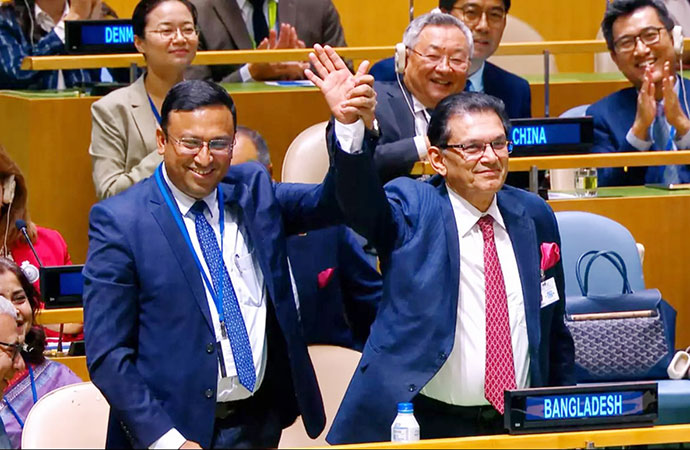
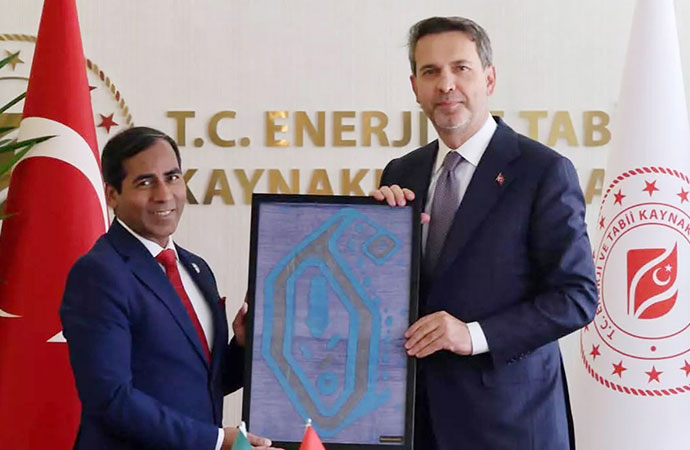
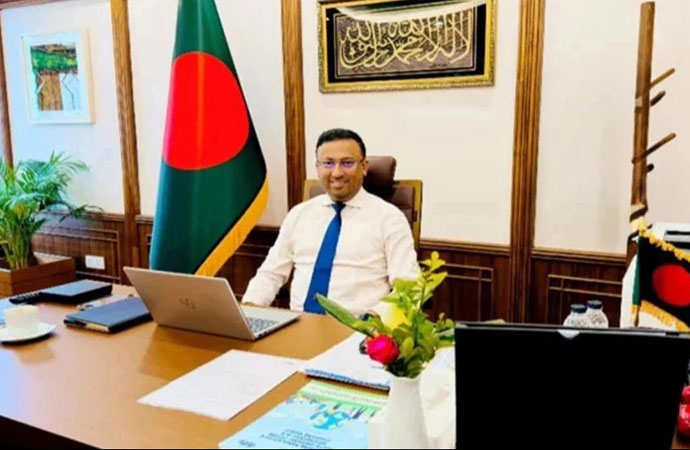
Foreign Minister Dr Khalilur Rahman has been elected President of the 81st session of the United Nations General Assembly, securing the post in a vote held at UN Headquarters in New York on Tuesday, June 2, 2026. Photo: Collected
International community pouring in congratulatory messages for President-elect
Foreign Minister of Bangladesh and President-elect of the UN General Assembly's 81st session Dr Khalilur Rahman has said he is taking on the role "with humility and respect" at a moment when confidence in the international system is under strain.
His Presidency will coincide with one of the most consequential processes on the UN calendar - the selection of Secretary-General António Guterres's successor, whose term ends on December 31, 2026.
The 81st session will open on September 8, with world leaders gathering two weeks later for the annual high-level debate at UN Headquarters, in New York.
"The UN will commence its ninth decade at a time when trust in our organisation is being tested on multiple fronts," the Foreign Minister told the UN Member States.
Taken together, Dr Khalilur said, these challenges tend to undermine the public trust and confidence in the ability of our organisation to deliver its promises."
The President-elect said he intends to act as a bridge-builder, promising to engage all Member States and seek common ground despite growing divisions.
"As your president, I will dedicate myself to rebuilding trust, nurturing consensus, and opening space for good faith negotiations that will lead to outcomes for all that are owned by all," he said.
Dr Khalilur also pledged to uphold the UN Charter, maintain geographical and gender balance within his office and support the needs of smaller delegations.
He was elected UNGA President on Tuesday after defeating Andreas Kakouris of Cyprus in a closely contested vote, positioning himself to steer the world body through a pivotal year marked by intensifying global crises, UN reform efforts and major leadership transitions.
The international community is pouring in congratulatory messages for Dr Khalilur, following his election as the President of the 81st Session of the United Nations General Assembly (UNGA).
This milestone is being widely celebrated as a reflection of Bangladesh's growing global stature and Dr Rahman's distinguished diplomatic career, an official told UNB.
In a secret-ballot election, Dr Khalilur secured 99 votes to Kakouris's 91. A total of 190 ballots were cast, with no invalid votes or abstentions.
The Presidency rotates among the UN's five regional groups, and the 81st session falls to the Asia-Pacific group. Dr Rahman will serve a one-year term starting on September 8.
Dr Khalilur brings more than four decades of diplomatic and multilateral experience to the role.
Bangladesh's Foreign Minister since February, he previously served as National Security Adviser and High Representative on the Rohingya Issue during the interim government led by Prof Muhammad Yunus.
A career diplomat, he joined Bangladesh's foreign service in 1979. He also held senior UN positions in New York and Geneva.
A World Under Pressure
The election comes amid what the current General Assembly President Annalena Baerbock described as an exceptionally difficult period for multilateral diplomacy.
Addressing Member States after the vote, Baerbock said the UN was facing "not only headwinds, but immense pressure," with consensus increasingly difficult to achieve and defence of the UN Charter becoming "a daily necessity."
"The role of the president of the General Assembly is no longer simply procedural," she said.
Challenges Ahead
She warned that the international environment was unlikely to become easier during the coming year, as the Assembly continues work on implementing the Pact for the Future, advancing reform efforts through the UN80 initiative and navigating broader geopolitical divisions.
Secretary-General António Guterres echoed those concerns, describing a world confronting "conflicts, divisions, rising inequality and climate chaos."
He also pointed to slowing progress on the Sustainable Development Goals (SDGs), declining funding for humanitarian action and development, and international institutions that remain "stuck in the world as it was in 1945, not the world of today."
Six Priorities for 81st Session
Dr Khalilur said his presidency would focus on six broad priorities: peace and security; accelerating progress on the SDGs; climate action and environmental protection; human rights; governance of emerging technologies, including artificial intelligence, and UN reform.
Drawing on Bangladesh's experience in peacekeeping, he pledged to support preventive diplomacy, peacebuilding and civilian protection.
He also highlighted the need to address development financing gaps, advance implementation of the Global Digital Compact and strengthen the UN's effectiveness at a time of growing pressure on multilateral institutions.
'Restoring trust'
Dr Khalilur's overarching theme for the session is "Restoring Trust, Managing Transformation: A United Nations that Delivers for All."
Secretary-General Guterres described the theme as "an inspiring call to action for the multilateral system" and said it reflected a commitment to strengthening global cooperation.
The General Assembly is the UN's most representative body, bringing together all 193 Member States, each with one vote.
While its resolutions are generally not legally binding, the Assembly serves as the principal forum for international deliberation on peace and security, development, human rights and international law.
Landmark Victory
This "landmark" victory is a strong testament to the confidence and trust that the international community places in Bangladesh, as well as to the country's growing diplomatic stature and constructive engagement within the multilateral system, said the Ministry of Foreign Affairs.
Dhaka said this achievement is not only the election of a Bangladeshi candidate to one of the most distinguished positions within the United Nations; it also constitutes a significant international recognition of Bangladesh's longstanding commitment to multilateral diplomacy, international peace and security, sustainable development, and global cooperation.
The successful outcome reflects the convergence of three key factors: the visionary leadership and timely guidance of Prime Minister Tarique Rahman, the coordinated and intensive diplomatic efforts undertaken by Bangladesh within a limited timeframe, and the extensive experience, professional excellence, and international standing of Dr. Khalilur Rahman, said the Ministry.
At the time the BNP-led Government assumed office, less than three months remained before the election.
Despite the limited preparation period, Prime Minister Tarique Rahman took a firm and decisive position in support of Bangladesh's candidacy.
By nominating Foreign Minister Dr. Khalilur Rahman, he expressed strong confidence that Bangladesh would emerge victorious through focused diplomatic engagement and strategic outreach to Member States.
In this context, Prime Minister Tarique Rahman recalled Bangladesh's successful election to a non-permanent seat on the United Nations Security Council in 1978.
At that time, under the courageous and visionary leadership of the late President Ziaur Rahman, Bangladesh mounted an effective diplomatic campaign within a short period and prevailed over the then formidable candidate, Japan, to secure its election to the Security Council.
Drawing inspiration from that historic achievement, he had expressed firm confidence from the outset that Bangladesh would similarly succeed in the election for the Presidency of the 81st Session of the General Assembly.
One of the biggest challenges for Bangladesh has been the severe limitation of time.
Although Bangladesh formally announced its candidature in 2020, the government nominated Foreign Minister Dr. Khalilur Rahman as its candidate on 27 February 2026, following which the country launched its full-scale international campaign.
Through high-level bilateral meetings, sustained diplomatic outreach, and multilateral engagement with all 193 UN member states, Bangladesh has actively sought to build broad international support within a very short time.
Bangladesh, in practical terms, has successfully conducted five years' worth of diplomatic campaigning in just three months.
In contrast, Cyprus announced its candidature as early as 2016 and has maintained a continuous campaign for nearly a decade, particularly intensifying its outreach efforts over the past year.
Bangladesh's campaign has been spearheaded by Foreign Minister Dr. Khalilur Rahman, State Minister for Foreign Affairs Shama Obaed Islam, and the Prime Minister's Adviser on Foreign Affairs Humaiun Kobir, supported by Bangladesh's missions and embassies worldwide.
The distinguished professional experience, diplomatic acumen, and proven leadership credentials of Bangladesh's candidate contributed significantly to this landmark achievement.
A major milestone in the campaign came on 13 May 2026, when Bangladesh's candidate Dr. Khalilur Rahman participated in the Interactive Dialogue organised by the current President of the General Assembly, Annalena Baerbock.
During the two-and-a-half-hour session, Dr. Rahman presented his vision statement and outlined his priorities and work plan for leading the General Assembly. The dialogue was widely praised within diplomatic circles.
Following these extensive engagements and consultations, nearly 30 Member States formally conveyed their support for Bangladesh's candidacy, reinforcing growing confidence in the country's vision and leadership.
This broad-based endorsement placed Bangladesh on a clear and credible path towards electoral success.
Bangladesh's campaign has placed particular emphasis on strengthening effective multilateralism, safeguarding the interests of developing countries, enhancing international cooperation for climate-vulnerable states, advancing the implementation of the Sustainable Development Goals, supporting UN peacekeeping efforts, and amplifying the voice of the Global South.
The campaign has been widely viewed as issue-based, inclusive, and grounded in principles.
Bangladesh expressed its profound appreciation to the Member States of the United Nations for the trust and confidence reposed in Bangladesh through this historic election.
It reaffirmed its unwavering commitment to the purposes and principles of the United Nations Charter and to working constructively with all Member States in advancing multilateralism, international peace and security, sustainable development, and effective global cooperation.
Bangladesh last held the prestigious position in 1986-87, when then Foreign Minister Humayun Rasheed Chowdhury was elected President of the 41st General Assembly.
Four decades later, the country sought to reclaim the post and succeeded.
Those who follow foreign affairs have been informally discussing whether Dr Khalilur would step down from his current responsibilities as Bangladesh's Foreign Minister to serve full-time at the UN, or attempt to carry out both roles simultaneously.
Foreign Minister Dr Khalilur, however, made it clear during the informal interactive dialogue at the UN on May 13 that resignation is not the only option.
"Will I resign? No, my Prime Minister (Tarique Rahman) has told me very clearly that he's going to let me off for one year to do a full-time job. Resignation is not the only option. I can get a leave," said Dr Khalilur while responding to a question during the informal dialogue.
There have been instances in the past where foreign ministers simultaneously served as President of the United Nations General Assembly while retaining their ministerial portfolios.
For example, Abdulla Shahid of the Maldives concurrently served as the country's Minister of Foreign Affairs while serving as President of the 76th session of the UNGA in 2021.
A Independent Newsweekly
© Copyright 2026 | Designed by ARK Reepon & Developed by Cosmos Group Software Team





Leave a Comment
Recent Posts
The right time for an apology
The publication of the posthumous memoirs of lawyer Abdur Razzaq, who ...
Human rights experts commissio ...
Human rights experts commissioned by the UN’s top human rights b ...
Teesta erosion leaves several hundred families homel ..
Housing Without Houses: The Hidden Cost of Banglades ..
The Election Commission will review the timeframe
The story behind the Arafat brothers' ‘Kolpona’