



Reportage
The People’s House Returns


An Independent Newsweekly
Reportage
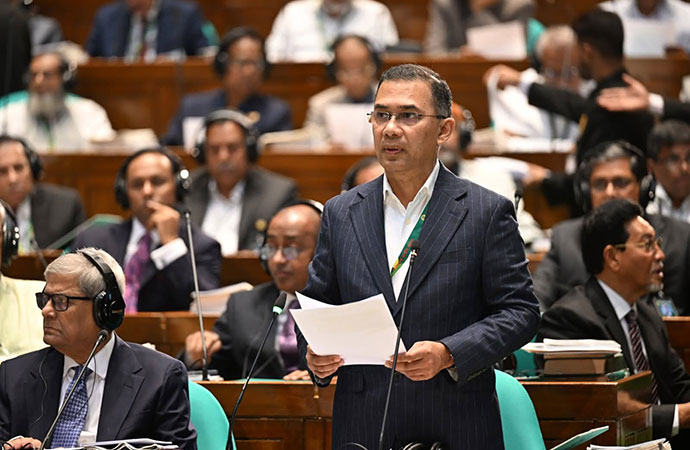
Prime Minister Tarique Rahman. Photo: BNP Media Cell
And so exactly a month after having held a by-and-large acceptable, free-and-fair election for the first time in at least 18 years, the country witnessed the 300 (overwhelmingly) men and (tragically few) women elected to represent them under one roof, as the 13th Jatiya Sangshad started its journey on Thursday (Mar. 12).
The product of the July Uprising that uprooted an entrenched fascist regime that had ruled by presenting a facade of democracy for over 15 years, the results of the election, though awarding a super majority to the BNP-led alliance, presented us with the strongest opposition contingent since the 7th JS (1996-2001). The first day itself, in between the host of formalities that had to be completed, presented us with enough evidence to rest assured that whatever else it may be, this isn't going to be a rubber stamp parliament, like at least three of the last four were.
Perhaps that is why there seemed to be unprecedented interest in the proceedings on inaugural day. The great house and symbol of representative democracy for the people of Bangladesh, that itself was vandalised to the tune of damages worth Tk 90 lakh on August 5, 2024 had undergone renovations throughout the interim government's tenure, was ready to host the people's representatives with one important addition to its cavernous session hall.
A large bronze-on-wood inscription of the First Kalima, or Kalima Tayyiba - the foundational declaration of faith in Islam, has been placed on the high wall directly above the Speaker's chair in the chamber. Prime Minister Tarique Rahman's press office has been keen to impress upon journalists that it was done on a personal initiative of the PM. The BNP has always enjoyed quite strong Islamic credentials. In fact that's what birthed the partnership that worked like a charm in the 2001 election.
Despite everything that they did to try and establish their own Islamic credo, the country's alems and ulemas never actually managed to fully trust them or have any faith in them to work towards the flourishing of Islam. The BNP will find them much easier to convince, thanks to long-term credo. And this move by the new PM seemed designed to undercut any efforts to paint his party with the same brush as AL. A visual of the installation went viral on the eve of the inaugural session.
Speaking of MPs going viral even before the inauguration, one of the very new and very, very young faces who got elected for the first time, captivated politicos with an unprecedented initiative two days prior to the opening. Upholding the slogan "Integrity, Justice, and the People are the Capital," Hasnat Abdullah, one of the most prominent and beloved faces of the Uprising, has been elected as the Member of Parliament for Cumilla-4 (Debidwar). The Chief Organiser (South) of the National Citizen Party or NCP, has introduced a unique "Live Class" to ensure accountability to his constituents.
On Tuesday midnight (Mar. 10), during a live broadcast from his verified Facebook profile, Hasnat presented a detailed ledger of government services and development projects allocated to his parliamentary area. Using a digital board and slide presentations, the live session mirrored a classroom teaching style, sparking widespread discussion among the general public.
In this "Live Class," Hasnat provided a ward-based breakdown of ongoing government services, development project progress, and the distribution of relief materials in Debidwar Upazila. He also addressed contractors, guaranteeing a "commission-free business environment" while urging them to increase efficiency to complete projects swiftly.
Towards the end of the broadcast, he emphasised the importance of implementing the "July Sanad" (July Charter), signed on the basis of political consensus.
To continue this initiative, Hasnat announced the launch of a dedicated Facebook page titled "Jobabdihita" (Accountability). He stated that regular updates regarding all work in his constituency will be posted there, and the accounts for every development project will be explained to the public "down to the last penny."
Before entering politics, Hasnat Abdullah was involved in teaching and the coaching profession. While a student at Dhaka University, he gained immense popularity as an English teacher at an institution named "School of Excellence."
It is understood that returning to this familiar medium after being elected as an MP is his chosen method for maintaining transparency before the public. During the live session, he provided the public with a clear understanding of the current status of various field-level projects, including road construction, and offered guidance on the roles and responsibilities of the local residents. A sentiment analysis on social media recorded overwhelmingly positive reactions to MP Hasnat's innovation.
A Mother's Son
Prime Minister Tarique Rahman sought support and cooperation from people and Members of Parliament (MPs) including those from the opposition to transform Bangladesh into a self-reliant, prosperous, safe and democratic country.
"Our political goal is to make every family self-reliant. Through making every family self-reliant, BNP wants to establish a self-reliant, prosperous, secure and democratic Bangladesh," he said while delivering his welcome speech at the outset of the maiden session of the 13th Parliament.
The Prime Minister said in order to achieve the goal, he seeks the support and cooperation of democracy-loving people of the country.
"In this great National Parliament, I also expect the support and cooperation of every elected Member of Parliament from all parties," he added.
Tarique Rahman said he believes that political parties, opinions and programmes may differ. "But there can be no disagreement among us when it comes to establishing an independent, sovereign, secure and self-reliant Bangladesh free from subservience and fascism. There is no conflict on that."
Instead of making the National Parliament the centre of national activities, he alleged that the ousted fascist Awami League government had rendered the parliament ineffective.
"We want to transform this great National Parliament into the central forum for reasoned discussion, debate and the resolution of national problems," the Prime Minister added. Tarique said he was elected for the first time as a Member of Parliament from the BNP and was also elected Leader of the House.
"Although I represent my party in the National Parliament, as Prime Minister I represent the country in this Parliament. Regardless of party, opinion, religion or ethnicity, I represent the people of the country. My politics is the politics of protecting the interests of the country and its people," he added.
The Prime Minister said the politics of the BNP is focused on improving people's living standards and building a self-reliant Bangladesh. Addressing his fellow Members of Parliament, the Prime Minister recalled the sacrifices of countless people who suffered under fascism and those who gave their lives for the country's freedom and democracy.
He also paid tribute to mothers who lost their children, families bereaved of loved ones, and those who endured torture, harassment, or false charges, recognising their contributions to Bangladesh's struggle for democracy.
The Prime Minister honoured the country's brave citizens-from students, farmers, workers, teachers, poets, writers, journalists, doctors, engineers, and lawyers to rickshaw pullers, businesspeople, public and private employees, and homemakers-whose courage and determination could not be broken by violence, harassment, or oppression.
He congratulated these democracy-loving heroes for helping restore democracy as the 13th National Parliament begins its journey.
"After years of struggle-from the 1971 Liberation War to the 2024 fight to protect the country and its people-we are starting a new journey today. I thank Allah for enabling us to take this path towards a just, democratic, and humane Bangladesh," Tarique said.
The Prime Minister also paid heartfelt tribute to the late Prime Minister and his mother, Khaleda Zia, who founded and institutionalised parliamentary democracy in Bangladesh.
Despite years of oppression and attempts to undermine democratic institutions, he said, she fought tirelessly to restore the people's rights and uphold justice.
"She never compromised with dictatorship or fascists in her life. From today, the journey of long-awaited parliamentary democracy begins again. Alhamdulillah. Khaleda Zia could not witness this moment of success for the country and its people. Today, standing in this National Parliament, we pay deep respect to the late Khaleda Zia, a remarkable, admirable, and exemplary leader, in the interest of the country and its people," Tarique said.
He reminded MPs of a statement by BNP founder Ziaur Rahman that the people's interest must come before the interests of any individual or political party. "This is the essence of BNP's politics."
Rahman also referred to the absence of the previous Speaker and Deputy Speaker at the inaugural session, highlighting the long-term impact of authoritarian rule.
In this context, he proposed veteran politician and five-time MP Khandaker Mosharraf Hossain to preside over the House in line with constitutional and parliamentary rules.
Khandaker Mosharraf oversaw the election of Hafizuddin Ahmad as Speaker and Kayser Kamal as deputy speaker, followed by their oath-taking ceremonies. The session was about to start at 12:57pm, but just then the Speaker's microphone was found to be not working, leading to an awkward situation.
After repeated attempts to fix the issue, the Speaker was given a handheld microphone to speak.
As Speaker Hafizuddin Ahmad started to talk, Md Saiful Alam, an opposition MP elected from Dhaka-12, drew the attention of the Speaker and communicated to him that the MPs were still unable to hear anything in their earpieces, although he was audible on television.
"After 17 years, we finally have an effective Parliament, it will take some time to fix everything," Hafizuddin Ahmad said wryly.
Right around then, the Zohr call to prayer started and the newly elected speaker promptly called for a prayer break declaring the session will start again after 20 minutes.
Ameer-e-Jamaat's debut speech
Having helped elect a speaker and deputy speaker, Leader of the Opposition Dr Md Shafiqur Rahman on Thursday congratulated the newly elected Speaker of Parliament and urged him to ensure fairness, justice and a dynamic parliamentary environment for the benefit of the nation.
After the election of the Speaker, Jamaat-e-Islami Ameer Shafiqur Rahman thanked the citizens of the country for electing representatives through their valuable votes and enabling them to speak in the House.
He paid tribute to the martyrs of the movements of 1947, 1952 and 1971 as well as those who sacrificed their lives or endured persecution during what he described as years of fascist rule. He also remembered the victims of the Shapla Chattar incident and others who had suffered oppression, imprisonment or injury during various struggles.
The opposition leader particularly recalled those who fought during the July movement, saying their sacrifices made it possible to form the current Parliament.
"This Parliament is not an ordinary one; it stands upon the blood of July," he said, praying for eternal peace for those who had died and wishing speedy recovery for those injured.
Congratulating Speaker Hafiz Uddin and Deputy Speaker Kayser Kamal, Dr Shafiqur Rahman said Bangladesh had completed 55 years since independence but said parliamentary democracy had functioned effectively only for limited periods during that time.
"Most of the time Parliament became ineffective under the grip of fascism," he said, adding that many previous office-holders had failed to deliver justice to Parliament, the country and its people.
"We believe there will be no distinction between the treasury and opposition benches in your eyes. We hope we will receive justice and the opportunity to speak for the welfare of the nation," he said.
Shafiqur Rahman also urged the Speaker to ensure that Parliament does not become a platform for character assassination, but rather focuses on meaningful debates centred on public welfare.
He expressed hope that the House, which now includes many young members, would become more vibrant and productive, learning from experienced lawmakers who had previously served in Parliament.
Moment of Contention
Some 4-and-a-half hours in, at around 3.40pm, newly-elected Speaker Hafiz Uddin Ahmad invited President Shahabuddin Chuppu to deliver the traditional president's speech. At this time, opposition party Jamaat's members of parliament stood up in protest. They were seen holding placards. The placards had slogans like 'Treachery with July will not be tolerated', 'Stop betraying July', among others.
The Speaker called on everyone to remain calm. The President then entered the parliamentary session. He sat next to the Speaker. Jamaat's opposition members of parliament continued to make noise in the parliament.
Amid all this, President Shahabuddin began his speech. During his speech, the Prime Minister and BNP members of parliament were seen banging on the tables. Members of parliament from the opposition, including NCP, walked out. They later came back.
As it commenced its five-year journey, some 133 Ordinances which were promulgated during the Professor Muahmmad Yunus- led interim government were placed in Parliament on Thursday. Law, Justice and Parliamentary Affairs Minister Md Asaduzzaman placed all these Ordinances in the House.
According to the existing laws of the country, if any ordinance is promulgated during the absence of a Parliament session, they must be placed on the first day of the next available session.
The Ordinances will be sent to the respective ministries to formulate them in bill form, i.e. through legislation. The government will discuss it in the cabinet and either approve or reject them in parliament from next week.
All in all, it was a very lively first day, with a number of young politicians who have entered parliament called upon by the Speaker, from Nahid Islam to Zonayed Saki. Despite the opposition's walkout during the president's speech, it augured well for the next five years, with interest starting to spike, and live broadcast of sessions challenging MPs to up their game. Inside the late, great American architect Louis Kahn's 20th century masterpiece, the deliberations finally felt real rather than choreographed once again. After an age of duplicitous behaviour to keep up appearances, that is a good start.
Additional reporting by UNB
A Independent Newsweekly
© Copyright 2026 | Designed by ARK Reepon & Developed by Cosmos Group Software Team






Leave a Comment
Recent Posts
Parliament 101: Elections have ...
As Parliament returned for its first full week since convening on Marc ...
Tokyo eyes high-level exchange ...
Japanese Ambassador to Bangladesh Saida Shinichi has said his country ...
US assures support for Bangladesh’s energy security
‘Proud past, exciting future’: Irish Ambassador look ..
St Patrick’s Day in Dhaka
FIFA World Cup 2026: All 48 Qualified Teams, Top Sco ..