



Reportage
The BNP faces its Litmus Test


An Independent Newsweekly



Reportage
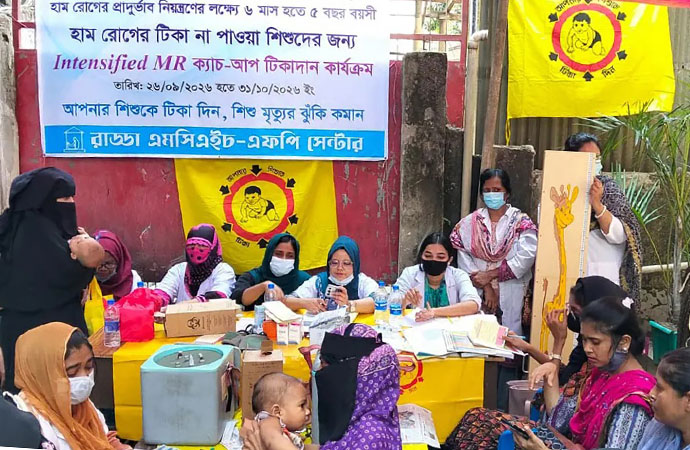
Vaccinators outside the Radda MCH-FP Centre in Mirpur-1. Photo: Collected
Before the February 12, 2026 election that marked Bangladesh's return to a democratic dispensation following the overthrow of the Awami League's authoritarian regime, restoring law and order had become the single most important demand among surveyed voters. A People's Election Pulse Survey of 10,413 respondents, conducted by the pollsters at Innovision, found that 57.5% identified improving law and order as their foremost concern, even ahead of controlling price rises at 54.6%.
The BNP's election manifesto promised strict measures to improve law and order, including strengthening the police, restoring police morale and public trust, and making the police more professional and less politicised. After taking office, Tarique Rahman made the message even more explicit. In his first address as prime minister on February 19, he identified stabilising law and order and controlling corruption as the government's top priorities, saying that the government would be taking the highest measures to ensure peace and security in public life.
An elected government would bring political legitimacy, which would in turn enable the state to re-establish authority and restore public security. Or so the thinking went. Coming up to eight months in of the BNP government, that expectation has not quite been met. The election restored formal political legitimacy, but legitimacy has not automatically translated into effective state control. And that is arguably the central reason the government is now under pressure to demonstrate that it can actually enforce order.
The election restored formal political legitimacy, but legitimacy has not automatically translated into effective state control. The public expectation was not merely that an elected government would be more legitimate than the interim government. It was that elected political authority would finally allow the state to restore everyday security through functioning institutions.
The fact that, months after the election, the conversation has shifted toward whether extraordinary or quasi-extraordinary security measures are necessary - including a re-enactment of Operation Cleanheart, an extraordinary measure implemented under the last BNP-led government - is therefore an indication of the gap between the expectations attached to the February transition and the government's perceived performance on law and order. Although Home Minister Salahuddin Ahmed has quite categorically ruled out another Cleanheart, the mere fact that it had entered the conversation demonstrates the government is now under pressure to demonstrate that it can actually enforce order.
The Challenge Ahead
After the July-August 2024 uprising, there was an enormous demand not simply for a change of government, but for a change in the way the state operates. The BNP's manifesto itself promised a democratic, accountable state and a police force appropriate to a free society.Consequently, the government's dilemma is quite acute, as it looks to take on the challenge of imposing order. If ordinary policing appears ineffective, as it does at the moment, people may demand stronger action. If the government responds with a highly coercive operation, it risks reviving memories of earlier periods of extrajudicial detention and abuse. If politically connected criminals are not effectively prosecuted, confidence in the BNP's ability to restore order may decline. On the other hand if enforcement is perceived as politically selective, the promise of a genuinely different political order is undermined.
Home Minister Salahuddin Ahmad, very much the man in the hot seat, said this week that the government has taken no formal decision to launch a joint operation, but coordinated drives by different law enforcement agencies against crime, extortion and drugs will continue and be intensified.
Such coordinated activities involving police, Border Guard Bangladesh (BGB), Special Response Battalion (SRB) and Ansar are part of regular law enforcement operations, he said.
Asked whether the planned operations would be similar to the "Operation Clean Heart", Salahuddin said, "There is no such plan. This is part of our regular activities," referring to coordinated operations by law enforcement agencies to maintain law and order and combat terrorism, extortion and drugs.
The minister was speaking to reporters after unveiling the foundation plaque for the new headquarters of Bangladesh Ansar and VDP in Dhaka's Tejgaon. Salahuddin said members of law enforcement agencies found negligent in their duties or involved in criminal activities would face more than just withdrawal from their posts. Departmental and legal action, including criminal cases, is being taken where allegations are proved, he said.
Speaking about the new Ansar headquarters, Salahuddin said 3.428 acres, or around 11 bighas, had been allocated by the Ministry of Housing and Public Works for the project.
The new headquarters will address space constraints and transport difficulties at the force's existing headquarters in Khilgaon, he said.
There are currently around 20,000 battalion Ansar members and 60,000 embodied Ansar members in the country. Around six million trained personnel are also under 35,000 VDP team leaders, the minister said.
He said accommodation facilities were also being expanded in Ashulia and Sher-e-Bangla Nagar to address shortages of dormitory and barrack space for Ansar members stationed in Dhaka.
On Dhaka's traffic management, Salahuddin said automation and artificial intelligence were being introduced, including automated processing of traffic cases.
Has crime actually spiked?
Statistics do not support the simple claim that crime has "spiked" across the board since the BNP government took office. The picture is much more mixed, and the distinction between ordinary property crime and serious violence is important (see table).
Theft, robbery, burglary and abduction have generally declined. Murder and some forms of serious violence remain elevated. Mob violence remains a major problem. Political and criminal networks are competing for control of economic spaces such as markets, transport hubs and land. Attacks on police and violence against women and children remain concerns.
The apparent contradiction-overall cases up, while several major conventional crimes are down-comes partly from increases in categories such as murder, rioting, violence against women and children, and attacks on police.
Murder is the worrying indicator, and this is where the government's critics have the strongest statistical argument.
Police recorded 915 murder cases in March-May 2026, or more than 10 cases a day. There were 317 in March, 288 in April and 310 in May.
But even here, comparisons require care. In March-May 2025 there were 993 cases, although 226 were carry-over cases from earlier incidents, giving 767 cases on the comparable basis used by the reporting. So the 2026 figure is higher on that basis, but not evidence by itself of an unprecedented nationwide murder explosion.
Police Headquarters made essentially this argument when responding to Transparency International Bangladesh's criticism: it said 605 murder cases registered during March-April did not constitute an abnormal spike, and that most were associated with personal enmity, family disputes, property/financial conflicts and other non-political causes. The government's Cabinet Division has presented a somewhat more favourable picture. It reported 2,809 serious/heinous crimes in May 2025 versus 2,572 in May 2026, an 8.4% decline. The metropolitan figure fell from 488 to 402.
The statistics don't demonstrate a general crime explosion. But aggregate crime figures obscure the deterioration in the types of violence that most affect perceptions of state authority-murders, political clashes, extortion, mob violence, and attacks on property involving firearms. Just in the last one week or so, masked attackers demolished and looted the Radda MCH-FP Centre in Mirpur-1. Several hundred people allegedly stormed a plot at Chand Udyan in Mohammadpur. Armed men attacked a building in Shyamoli Housing in Adabor. A group of 200 to 250 people attacked the New Gini Properties housing project compound near ECB Chattar, demolishing the studio of popular content creator Salman Muqtadir.
The problem is less that everything is getting worse than that the government has not eliminated the particularly visible forms of disorder-killings, mob justice, political/criminal competition and extortion-that make citizens feel that state authority remains weak.
That distinction is important because it explains why a government can simultaneously point to falling robbery and theft figures and yet feel compelled to contemplate a much more muscular security operation.
The menace of teen gangs
Teen gang culture in Bangladesh, locally called Kishor Gangs, encompasses the presence and activities of organised youth gangs primarily composed of teenagers involved in various criminal undertakings within urban areas of the country. The rise of these gangs has presented significant challenges to law enforcement agencies and communities in Bangladesh.
Police have identified at least 385 teen gangs across the country, including 158 in Dhaka and 98 in Chattogram, in a preliminary nationwide survey amid mounting pressure over a sharp deterioration in law and order. More than 3,000 teen gang members have so far been identified nationwide, with such gangs operating in every metropolitan city, according to the survey.
Police Headquarters said the figure was expected to rise, as data collection and verification were still under way. The exercise comes amid rising reports of rape, murder, extortion, land and property grabbing, robbery and street snatching, fuelling widespread concerns over public safety. At the same time, police have initiated a special drive against teen gang culture in a number of cities, that has resulted in thousands of arrests.
The drive started in Cumilla, following the gruesome murder of thirteen-year-old Ishiat Shahriar Oprotim, who was beaten to death in the Lalmai Hill area of Cumilla on September 18 during an attempt to steal his iPhone by a group of older boys he hung out with.
Police Headquarters sources said the names of many ruling party leaders and activists were emerging as patrons of teen gangs in different parts of the country. According to preliminary police data, Dhaka has the highest number of teen gangs among the country's metropolitan areas, with 158 identified so far. Chattogram follows with 98. Among individual districts, Noakhali has the highest number, with 25 gangs identified.
In Dhaka, more than 800 members have been identified as active in the 158 gangs. The 98 gangs in Chattogram city have around 700 identified active members, while 49 gangs in the Chattogram Range have around 800 members. Police have also identified 15 criminal groups each in the Sylhet and Rajshahi metropolitan areas and 10 in Gazipur.
Based on this information, law enforcement agencies detained over 2000 members of teenage gangs by conducting drives in multiple districts in the wake of the Oprotim murder.
In Lakshmipur, police detained 244 persons from different areas under Lakkipur Sadar Chandraganj, Raipur, Ramganj, Ramgati and Kamalnagar thanas. District police, detectives and respective thana police jointly conducted the raids following complaints of harassment and growing involvement of teenagers in various criminal activities.
Of those detained, 42 were from Lakshmipur Sadar, 21 from Chandraganj, 44 from Raipur, 37 from Ramganj, 44 from Ramgati and 56 from Kamalnagar. Police said the detainees are aged between 14 and 18. Their involvement in criminal activities is being verified, and necessary legal action will be taken following verification.
In Cumilla, police detained 1,293 teenagers. Some 624 teenagers were picked up in the first phase of the drive on the night of September 23, while 254 were detained in the second phase on Saturday night. A third subsequent drive detained a further 415, meaning the total number of detainees in the three phases reached 1,293.
Out of the 624 detainees in the first phase, 451 were released after taking written undertaking from guardians while 173 were sued on various charges. In the second phase, 146 teenagers out of 254 detained were handed over to their families after obtaining undertakings while legal actions were taken against 108 for their involvement in crimes, drugs and link with a banned organization.
In Chandpur, a total of 370 people were detained in a special drive conducted across all eight upazilas of the district.
A Independent Newsweekly
© Copyright 2026 | Designed by ARK Reepon & Developed by Cosmos Group Software Team






Leave a Comment
Recent Posts
A Battle for the Soul of The N ...
Two disturbing incidents came to light this week, even as they went un ...
Dhaka seeks concrete measures ...
State Minister for Foreign Affairs Humaiun Kobir on Thursday urged Sou ...
Bangladesh Embassy in Ireland begins operations
Dinesh Trivedi stresses proper preparations before T ..
The Hope Deficit: Why Bangladesh’s Revolution Must M ..
Iqbal Bahar Chy: Finding freedom in the unplanned