



Reportage
Outbreak


An Independent Newsweekly



Reportage
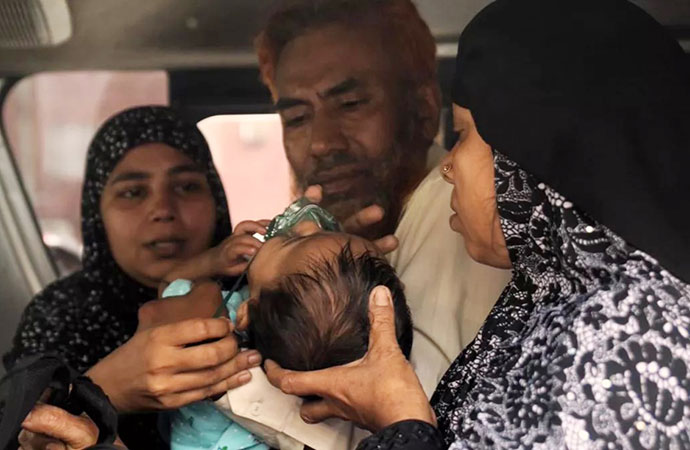
Photo: Tahiyat Nazifa Noor
Inside a cramped vehicle at the parking lot of Bangladesh Shishu Hospital, under dim light and rising anxiety, little Abir lies in his family's arms-his small body weakened, his breathing uncertain.
Around him, worried faces lean in, adjusting an oxygen mask, whispering reassurances that barely conceal their fear.
For Abir's family, the journey from Tangail to Dhaka was long and exhausting.
Abir was first taken for treatment in Tangail. But as his condition worsened, doctors advised an urgent transfer to the capital.
He was brought to the Bangladesh Shishu Hospital in the capital on Monday. What followed was a night of waiting-hours stretching into dawn-with no ICU bed available.
By early afternoon on Thursday, with options running out, his family were finally able to move him again-this time to a private facility in the hope of securing critical care.
Abir's case is emblematic of so many others.
Across Bangladesh, a worrying surge in measles infections is putting immense pressure on an already stretched healthcare system.
At the start of April, we reported on a deadly outbreak of measles that had quickly spread to almost every district in the country, and had already killed between 40 to 100 children. It is distressing to report that over a month later, things have not gotten any better. Indeed we are objectively worse, since the fatalities have kept mounting, and so has the burden of cases. As we knew from the earlier reporting, healthcare authorities were very late to catch on.
Vaccination drive shows promise
Amid the measles outbreak, vaccines were administered last month in the first phase across 30 high-risk upazilas. After one month, it was observed that the number of measles cases in these upazilas had dropped to nearly zero. This was stated at a roundtable discussion titled 'Review of the Measles-Rubella Vaccination Campaign 2026 and Strengthening the Expanded Programme on Immunization (EPI).' The event was held on Wednesday (May 7), at the Prothom Alo office in Karwan Bazar, of the capital.
The presentation at the meeting stated that the success rate of the ongoing Measles-Rubella (MR) vaccination campaign across the country is 93 percent. However, to effectively control the infection, it is essential to ensure at least 95 percent coverage through routine immunisation.
Expressing gratitude to private pharmaceutical companies for providing ventilator support on time, he said that without those ventilators, the death toll would have been even higher. Another 10 ventilators are expected to arrive within the next two to three days.
Alleging mismanagement in the health sector by the interim government, the health minister claimed that the former health adviser had not left even Tk10 taka in the fund for expenditures. He added that 1.5 million doses of measles vaccine arrived in the country yesterday. There will be no further vaccine shortages in the future. By May 10, a total of 108 million doses of vaccines for 10 diseases, including measles, will arrive in the country.
The keynote presentation at the discussion was delivered by UNICEF Health Manager Riad Mahmud. The presentation stated that due to the rising number of measles infections among children, the Measles-Rubella (MR) vaccination campaign was launched ahead of schedule. The program, implemented in three phases, first targeted high-risk municipalities and upazilas, then major city corporations, and finally expanded nationwide. The campaign currently has a 93 percent success rate, with a goal of increasing it to 100 per cent. In the 30 upazilas covered in the first phase, the number of cases has nearly dropped to zero.
On 5 April, the government launched a vaccination campaign in 30 upazilas across 18 districts considered at high risk for measles infection: Barguna Sadar and municipality; Pabna Sadar, municipality, Ishwardi, Atgharia, and Bera; Chandpur Sadar, municipality, and Haimchar; Maheshkhali and Ramu in Cox's Bazar; Gazipur Sadar; Chapainawabganj Sadar and municipality, Shibganj, and Bholahat; Atpara in Netrokona; Mymensingh Sadar, Trishal, Tarakanda, and Srinagar; Godagari in Rajshahi; Mehendiganj and Bakerganj in Barishal; Porsha in Naogaon; Jashore Sadar and municipality; Natore Sadar; Munshiganj Sadar and municipality, Louhajang; Madaripur Sadar and municipality; Nawabganj in Dhaka; Nalchity in Jhalokathi; and Jazira in Shariatpur.
UNICEF Representative in Bangladesh Rana Flowers said that in the future, rather than relying solely on campaigns, the routine immunisation program must be strengthened further. To achieve this, she emphasised reinforcing integrated primary healthcare and ensuring related services such as nutrition and family planning together.
On 12 April, vaccination began in Dhaka North and South City Corporations, as well as in the Mymensingh and Barishal City Corporations. Then, from April 20, the measles vaccination campaign was launched nationwide. However, the presentation also highlighted challenges related to the routine immunisation program (EPI). It stated that at least 95 percent vaccine coverage is necessary to prevent infection effectively. However, the rate of receiving the second vaccine dose remains comparatively low.
According to the data presented on the measles outbreak, 85 percent of infected children are under five years of age. Even more concerning is that 65 percent of the infected children had received no vaccination at all, while 21 percent were only partially vaccinated.
Malnutrition also a factor
At the roundtable discussion, the Prime Minister's Special Assistant for Health, Ziauddin Haider, said that one-third of children infected with measles were under nine months old. Calling the issue alarming, he said that children are supposed to receive antibodies from their mothers after six months of age. Even if children are breastfed, it is urgently necessary to examine whether the breast milk contains sufficient vitamin A or other antibodies.
Ziauddin Haider believes that nearly all children who died from suspected measles in the country were suffering from malnutrition. In his view, vaccination programs alone are not sufficient to prevent measles. He said that 24 percent of children under five in the country suffer from malnutrition. Therefore, attention must also be given to children's nutrition.
UNICEF Representative in Bangladesh Rana Flowers said that in the future, rather than relying solely on campaigns, the routine immunisation program must be strengthened further. To achieve this, she emphasised reinforcing integrated primary healthcare and ensuring related services such as nutrition and family planning together.
The country must develop quality local vaccine production capacity to reduce dependence on imports Firdousi Qadri, Chairperson, National Immunisation Technical Advisory Group
Rana Flowers also said that attention should be paid to school-based vaccination systems. Checking vaccination cards at the time of school admission would make it easier to identify children who were left out. In her opinion, lessons must be learned from recent experiences to ensure that no vaccine shortages occur in the future.
Firdousi Qadri, chairperson of the National Immunization Technical Advisory Group - the technical committee that provides recommendations on vaccination - said that the country must develop quality local vaccine production capacity to reduce dependence on imports. She stressed upgrading the National Drug Control Laboratory to meet World Health Organization standards.
Hasanul Mahmud, Assistant Director of the Expanded Programme on Immunization (EPI), discussed the evolution of the vaccination program and its current capabilities. He said that EPI is currently providing vaccines against 12 diseases. Capacity has been achieved to store three months' worth of vaccines at the district level and one month's supply at the upazila level. In addition, vaccines can now be stored at the central level for six months to one year while maintaining the cold chain.
According to a paper in the International Journal of Infectious Disease, between March 15 and April 29, 35,980 suspected cases, 4,944 laboratory-confirmed cases, 227 suspected measles-related deaths, and 47 confirmed measles-related deaths were reported, resulting in a case-fatality rate of 0.63% (227/35,980) among the suspected cases and 0.95% (47/4,944) among the confirmed cases.
The outbreak affected 61 of 64 districts across all eight divisions, with the highest burden in the central Dhaka division (13,685 cases), northern division Rajshahi (5,832 cases), eastern division Chattogram (4,065 cases), and southern division Khulna (2,337 cases). Children aged under five years accounted for 79% of reported cases1. The daily number of suspected measles cases remains consistently high, with weekly cumulative cases reaching 8,198 in week 17 (starting at 19th April 2026), indicating sustained transmission and ongoing expansion of the outbreak.
Bangladesh has made substantial progress and gained international recognition for the success of its Expanded Programme on Immunization (EPI)4. Since its introduction in 1979, the programme has achieved remarkable gains, increasing the proportion of fully immunized children from just 2% to 81.6%4. It now saves an estimated 94,000 lives and prevents around 5 million childhood illnesses each year, generating an approximate return of $25 for every US$1 invested.
Measles is a highly contagious infection transmitted through respiratory droplets and airborne spread, with the virus remaining infectious in the air up to two hours. It typically presents with fever, cough, coryza, and conjunctivitis, followed by a characteristic maculopapular rash. Severe complications, including pneumonia and encephalitis, are more common in young children and unvaccinated individuals. Measles is one of the most infectious human diseases. For Measles (R0 =12-18), the herd immunity threshold (HIT), estimated as (1−1/R0), is approximately ∼92-95% 5. In real-world settings, the required vaccination coverage must be even higher when accounting for imperfect vaccine effectiveness, clustering of unvaccinated children, and unequal access to immunization services. This explains why even modest reductions in coverage can rapidly lead to large-scale outbreaks.
What led to the outbreak?
According to the IJID, in Bangladesh, routine measles vaccination is provided to children from nine months of age, supplemented by nationwide measles vaccination campaigns conducted approximately every four years. However, no such campaigns have been implemented since 2020, initially due to the COVID-19 pandemic and subsequently because of the political situation. A planned follow-up campaign in 2024 was not implemented due to political unrest. Shortages of health workers were also reported, with 45% of positions vacant in more than half of districts in 2025, while several senior roles in the health sector remained unfilled for months during transitions across three successive governments over the past two years, alongside restructuring of the EPI.
In April 2025, Gavi, the Vaccine Alliance, UNICEF, and the World Health Organization (WHO) reported that around 400,000 children in Bangladesh remain unimmunized, including about 70,000 (1.5%) who have received no vaccines. Coverage gaps are more pronounced in urban areas, where only 79% of children are fully vaccinated, with 2.4% zero-dose and 9.8% under-immunized, compared with 85% coverage in rural areas.
Vaccine hesitancy is not a major driver of under-immunization in Bangladesh, where acceptance of routine childhood vaccination remains generally high. Instead, recent declines in coverage appear to be driven largely by supply-side and systemic constraints, including vaccine shortages, COVID-19-related disruptions to routine immunization services, interruptions to service delivery, and gaps in outreach. These vulnerabilities have been further exacerbated by disruptions to vaccination activities during the 2024 student-led political unrest, compounding existing coverage gaps.
The recent vaccination shortages have not been limited to measles-containing vaccines but have also affected other childhood vaccines delivered through the EPI, including the pentavalent vaccine Diphtheria with an R0 of 2.5-7.2 and HIT of 60-86%; Pertussis, R0=(5-17), HIT=(80-94%); and Haemophilus influenzae type b infection, R0=(1.3-3.3), HIT=(23-69%), as well as Rubella R0=(3.0-7.0), HIT =(67-86%), which is co-administered with measles as MR1 and MR2 doses. Although these infections generally have lower transmissibility than measles and therefore require comparatively lower herd immunity thresholds, this should not be interpreted as a low outbreak risk.
Immunity gaps can accumulate silently, particularly in densely populated and underserved settings, allowing transmission to intensify once a critical threshold is crossed. Of particular concern is pertussis, where higher estimates of transmissibility would raise the herd immunity threshold to approximately 94%, approaching that of measles. Under such conditions, the same structural weaknesses that have enabled the current measles outbreak could facilitate the resurgence of other vaccine-preventable infections. The ongoing outbreak should therefore be viewed as an early warning signal rather than an isolated event.
Without rapid restoration and equitable distribution of vaccination coverage, the risk extends beyond measles to a broader resurgence of childhood infectious diseases in the near future.
In response to the outbreak, Bangladesh has implemented emergency public health measures centred on a nationwide vaccination campaign. The first phase began on April 5, 2026 in 30 of the most affected upazilas (sub-districts), followed by expansion to major cities including Dhaka and Chattogram on April 12, with nationwide rollout from April. Authorities lowered the minimum age for measles vaccination to six months, below the routine schedule of nine months, consistent with WHO recommendations for outbreak settings, to rapidly protect vulnerable infants.
The campaign aims to vaccinate up to 1.2 million children aged 6 months to 5 years, with the target age extended to 10 years in high-risk districts. To support this effort, Bangladesh secured 21.9 million doses of measles-rubella vaccine from Gavi, the Vaccine Alliance, alongside additional procurement funded by the Asian Development Bank and implemented through UNICEF.
The current outbreak highlights the urgent need to restore and sustain high immunization coverage across Bangladesh, with a particular focus on reaching zero-dose and under-immunized children in densely populated urban settings, where the burden of disease is highest. Strengthening routine immunization systems should be prioritised alongside periodic supplementary measles and rubella campaigns to close existing immunity gaps and prevent further accumulation of susceptible cohorts.
Given that recent disruptions have affected multiple components of the EPI, there is a credible risk of resurgence of other vaccine-preventable diseases, particularly pertussis and diphtheria, if gaps are not urgently addressed. The measles outbreak should therefore be treated as a 'sentinel' event, underscoring the need for sustained investment in resilient, equitable, and integrated public health systems to safeguard past gains and prevent wider infectious disease resurgence.
The COVID-19 pandemic caused widespread disruption to routine immunisation services across many low-and middle-income countries, leading to the accumulation of susceptible populations and increasing the risk of outbreaks. The current measles resurgence in Bangladesh is likely to represent only one of a series of outbreaks that may emerge in similar settings in the coming years. This underscores the need for coordinated action by WHO, UNICEF, and Gavi, the Vaccine Alliance, to prioritise restoration of routine immunization, expand catch-up vaccination campaigns, and strengthen surveillance systems in high-risk settings. Let us give our children a fighting chance at least.
A Independent Newsweekly
© Copyright 2026 | Designed by ARK Reepon & Developed by Cosmos Group Software Team




Leave a Comment
Recent Posts
Is the international community ...
A spate of downgraded economic projections, from Bretton Woods to Mani ...
A Childhood Lesson in Arithmet ...
As children, we learned a simple mathematical rule: if we know the pri ...
Indian authorities launched a major security crackdo ..
Police dispersed garment workers from the Azampur ro ..
Why Saudi Arabia has struggled to defend itself agai ..
Iran-backed Houthis strike Saudi oil company Aramco’ ..