



Reportage
Gas Panic


An Independent Newsweekly

Reportage
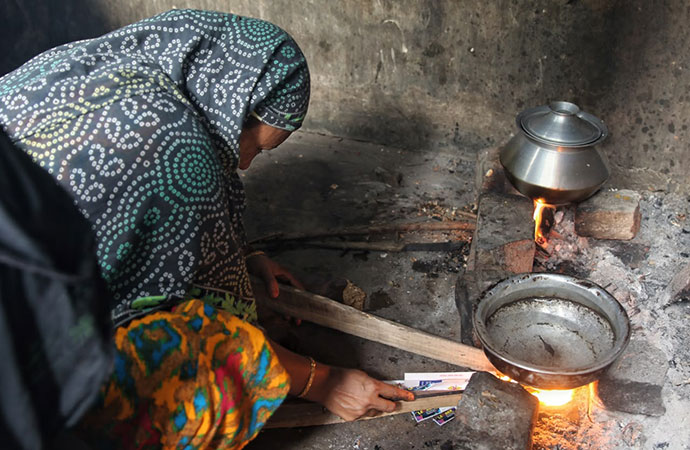
Back to basics. Photo: Tahiyat Nazifa Noor/UNB
On July 21, a fire severely damaged critical systems on an Excelerate Energy-operated floating storage and regasification unit (FSRU) in Moheshkhali, Bangladesh. The blaze burned for over 15 minutes, affecting multiple cable systems essential for operating the FSRU.
The boilers themselves were not directly affected, but replacement cables were not available locally in sufficient quantities and would have to be imported. Petrobangla Chairman Md Abdul Mannan said local and foreign experts were working around the clock to restore operations.
"We are trying our best to start one of the boilers as soon as possible," he said.
State Minister for Power Aninda Islam Amit said the situation could have turned far worse, as an LNG cargo vessel was near the terminal when the incident occurred. Moving it to a safe distance helped avert a major disaster, he added.
Briefing reporters at the Secretariat on Monday (July 27), Amit said: "The fire at the FSRU could have led to a much more serious situation."
He said engineers suspect a boiler explosion initially caused the damage, but other related components may also have been affected.
"Dealing with such an incident is a new experience for everyone -- Excelerate, Summit and the Bangladesh government," he said.
The FSRU shutdown significantly reduced gas supply to the national grid. Total gas supply dropped to 2,151.7 million cubic feet per day (mmcfd) on July 25-26 against an official demand for 3,854 mmcfd. Of the supplied gas, only 501.1 mmcfd came from liquefied natural gas, or RLNG.
Petrobangla data show that the national gas grid received 566 mmcfd of RLNG on July 23, two days after the fire broke out. It then fell to 543 mmcfd the following day before dropping further to 468 mmcfd, marking a decline of nearly 100 mmcfd within a few days.
Bangladesh's two FSRUs have a combined regasification capacity of 1,100 mmcfd, with the Excelerate-operated terminal alone capable of supplying up to 600 mmcfd. Under normal conditions, the country receives around 1,000 mmcfd of RLNG from the two terminals. Since the Excelerate terminal went out of operation following the fire, gas supply has been dependent largely on the Summit-operated FSRU.
Bangladesh currently relies heavily on imported liquefied natural gas to compensate for the steady decline in domestic gas production.
Imported LNG is regasified through floating terminals before being injected into the national transmission network. The fire significantly reduced regasification capacity, forcing Petrobangla to curtail gas supply to industries, power plants, fertiliser factories and households.
The incident exposed the country's dependence on only a limited number of LNG terminals and highlighted the absence of sufficient redundancy in the import infrastructure.
On July 27, Power, Energy and Mineral Resources Minister Iqbal Hassan Mahmood said the country's gas crisis may take another 10-15 days to ease as repairs continued at the fire-damaged floating LNG facility.
"The disruption has prevented the unloading of two LNG cargoes. As a result, households are facing low gas pressure for cooking, while power plants are also struggling due to reduced gas supply," he said at a policy roundtable at a hotel in Dhaka.
Titled "Navigating Global Shifts: Fostering Energy Security and Resilience in Bangladesh", the roundtable was organised by the Bangladesh Institute of Peace and Security Studies (BIPSS) and attended by policymakers from the public and private sectors.
Minister Iqbal said Bangladesh had become increasingly dependent on imported LNG, LPG and other fossil fuels as domestic gas production continued to decline.
"The cost of imported fuel has also increased significantly. Over the past six months, the country has spent around $3.65 billion on fuel imports, putting substantial pressure on foreign exchange reserves," he said.
The minister said the power sector's biggest challenge was financial.
"The government inherited around Tk56,000 crore in unpaid dues to private power producers from the previous Awami League government, while continuing to meet its monthly subsidy obligations," he said.
Iqbal said the government was placing greater emphasis on renewable energy to reduce its dependence on imported fossil fuels. Bangladesh has adopted a renewable energy policy targeting an additional 10,000MW of renewable power generation capacity over the next five years, he said. Negotiations with prospective investors are under way, while land allocation for new renewable energy projects is expected to begin in August, he added.
Meanwhile the government has moved to fast track the installation of a new FSRU at Kutubjom in Maheshkhali, Cox's Bazar, as Bangladesh struggles with an acute natural gas shortage worsened by the recent fire at an existing LNG terminal.
The Cabinet Committee on Economic Affairs on Tuesday (July 28), chaired by Finance Minister Amir Khosru Mahmud Chowdhury, gave its policy approval to process a proposal submitted by China's China National Energy Engineering and Construction Co. Ltd (CNEE) for the development of the Kutubjom FSRU under a government to government (G2G) arrangement. The proposal was placed by the Energy and Mineral Resources Division.
The approval marks the first formal step towards developing another LNG import facility at Maheshkhali, a move officials believe has become increasingly urgent following the disruption to gas supplies caused by the recent fire at one of the country's operational FSRUs.
Business leaders, particularly from the textile and garment sectors, have repeatedly urged the government to restore adequate gas supply, saying many factories are operating far below capacity because of extremely low pipeline pressure.
During recent meetings with business representatives, the government indicated that decisions on expanding LNG import infrastructure would be taken soon as part of broader efforts to improve energy security.
The proposed Kutubjom FSRU, once it becomes operative, would strengthen Bangladesh's LNG import network by providing additional regasification capacity and reducing the risks associated with dependence on only a few floating terminals.
Bangladesh began importing LNG in 2018 through its first floating terminal at Maheshkhali to offset declining domestic gas production. LNG has since become an increasingly important component of the country's energy mix, supplying gas to power generation, industries and other sectors.
Quest for Energy Security
Also this week, the government secured a 13-year agreement to import LNG from Gunvor USA LLC, a private US entity. The deal involves importing 78 cargoes of LNG, with six per year, starting in September this year and running through to 2039.
In the proposal submitted for approval in principle, the Energy and Mineral Resources Division stated that Petrobangla currently holds seven active agreements with five entities across the United States, Qatar, Oman, and Saudi Arabia. LNG is currently being imported under these short- and long-term contracts.
The government aims to ensure an uninterrupted gas supply to meet the country's existing and growing demand, which necessitates additional LNG imports. Consequently, LNG will be procured from Gunvor USA LLC on a G2G basis. Virtually all commercial entities in the United States are privately owned, and Gunvor USA LLC is likewise a private corporation. This has raised questions regarding whether initiating a G2G LNG import deal with Gunvor USA LLC complies with legal standards.
The proposal received approval in principle during the weekly meeting of the Cabinet Committee on Economic Affairs held at the Secretariat, chaired by Minister for Finance and Planning, Amir Khasru Mahmud Chowdhury. The finance minister did not brief the media following the meeting; however, the Ministry of Finance disclosed the approval via a press release.
Petrobangla, the government's hydrocarbons agency, is the implementing body for this procurement.
"The LNG imports are being carried out pursuant to the trade agreement signed with the United States during the interim government's tenure, strictly adhering to the Public Procurement Rules (PPR). Had it infringed upon the PPR, we would not have proceeded with it," the energy minister told vernacular daily Prothom Alo.
Energy futures
The fact remains that the country's gas reserves are running out. Production is declining continuously. If new gas fields are not discovered and extraction from new mines is not started, domestic reserves may run out in the next eight years, according to one estimate.
The Awami League government, which was ousted in the July Uprising of 2024, abandoned gas exploration in favour of imports. At that time, two terminals were built in Moheshkhali, Cox's Bazar, where ships would bring in LNG, which was then converted and sent into pipelines.
Gas imports began in 2018. At the time, the price of gas on the world market was low, and the country had sufficient foreign currency reserves. However, many people warned even then that the economy could face a crisis if prices rose abroad. When the war between Russia and Ukraine began in February 2022, global gas prices surged, putting Bangladesh in a difficult position.
In June, Iqbal Hassan Mahmood told Parliament that the country has recoverable natural gas reserves remaining amounting to 7.63 trillion cubic feet and is grappling with a daily supply shortfall of around 1,146 million cubic feet.
Daily demand stands at roughly 3,800 MMcf, based on the approved gas load of consumers across eight customer categories. Against that, the average daily supply during the 2025-26 fiscal year up to April 2026 was about 2,654 MMcf, the minister said in a written response to a starred question from Jamaat-e-Islami MP Md Tajuddin Khan, with around 1,700 million cubic feet of that coming from domestic fields.
Earlier in April, the energy minister told Parliament that the country had an estimated 29.74 trillion cubic feet of extractable natural gas, of which 7.63 trillion cubic feet remains in reserve. Some 22.11 trillion cubic feet of gas had been extracted as of December 31, 2025. If no new gas fields are discovered and supply continues at around 1,700 million cubic feet per day, the remaining reserve would be enough for about 12 years, he said.
The minister said a number of exploration activities were under way. Under Petrobangla's drilling and workover programme, plans have been taken in phases for 50 and 100 wells, and 26 wells have so far been drilled or undergone workover. Work on the remaining wells is continuing at different stages.
On seismic surveys, he said BAPEX had completed acquisition of 3,600 line kilometres of 2D seismic data in Blocks 7 and 9, and data processing was now under way. Bangladesh Gas Fields Company Limited is also preparing to begin 3D seismic surveys over 1,450 square kilometres in the Habiganj, Bakhrabad and Meghna fields.
He added that plans had also been taken for large-scale 3D seismic surveys in several other areas through BAPEX and Sylhet Gas Fields Limited.
The Outlook for Renewables
The Scaling Up Renewable Energy Project, being implemented with support from the World Bank, has added 338 megawatts of clean electricity to Bangladesh's national grid. The project mobilized financing through public-private partnership and contributed to reducing 377,000 tons of carbon dioxide emissions every year.
Currently, the share of renewable energy in the national grid supply is only 1.5%. To increase clean electricity generation, the World Bank partnered with Bangladesh through the Scaling up Renewable Energy project.
The project enabled installation of grid-tied solar power plants and rooftop solar systems to meet the country's growing energy needs while cutting down carbon emissions. It also contributed to strengthening energy security, supporting a more resilient and diversified power mix, and helping manage long-term costs.
The country's first-ever 75 MW grid-tied solar power plant in Sonagazi, Feni was built under the project. Installed on low-lying coastal land, the plant includes design features that allow it to operate in flood-prone conditions-an approach now being replicated across Bangladesh.
Another 68 MW solar plant has been installed on the banks of the Jamuna River in Sirajganj. With new public-private collaboration, the project also attracted $212 million in private investment.
The project supported the Infrastructure Development Corporation Limited (IDCOL) to rollout a Renewable Energy Financing Facility for both rooftop and utility scale solar PV. It also helped Sustainable and Renewable Energy Development Authority (SREDA) identify sites for large-scale projects and promote new net metering policy for rooftop PV.
Industries are also adopting rooftop solar systems. In addition to lowering energy costs, these factories also achieved compliance with buyer sustainability requirements.
Even before the fire at the FSRU, in the concluding days of the budget session of Parliament, Iqbal Hassan Mahmood had disclosed the government has a target to meet 20 percent of the country's total electricity demand from renewable energy sources by 2030 and 30 percent by 2040, as part of its long-term strategy to ensure reliable and sustainable power supply.
Highlighting the government's initiatives to ensure uninterrupted electricity supply across the country, he said rooftop solar power systems are being installed on government offices, educational institutions and healthcare facilities under the National Rooftop Solar Programme.
The minister said the government is simultaneously modernising the country's power generation, transmission and distribution systems to improve the quality and reliability of electricity services.
He said, "Initiatives have been taken to install prepaid meters to prevent electricity wastage and illegal consumption, while old distribution lines and substations are being regularly maintained alongside the construction of new distribution lines and substations."
Hunting Offshore
Perhaps the largest payoff the country can hope for in the long term lies in the waters of the Bay of Bengal, where Bangladesh has been unable to capitalise on decisions by a UN court to demarcate the maritime boundaries in the Bay, between Bangladesh, India and Myanmar.
Offshore gas reservoirs are complex and require a total understanding of the deep-marine settings based on large-scale regional 2D and high-resolution 3D seismic data coverage, proper analogue study, preparation of appropriate geo-models with advanced tools and technologies. Apart from Sangu, we will only find records of some sporadic exploration drilling activities, e.g., Sonadia-1 by Cairn Energy, Reju by Oakland International, Sandwip East-1 by Shell Bangladesh Ltd., Magnama-1 and Hatiya-1 by Capricorn Energy, and Magnama-2 by Santos, carried out from 1998 to 2017.
The Bay of Bengal holds 26 blocks - 15 in deep water and 11 in shallow. ConocoPhillips took two deepwater blocks in 2010, completed a 2D survey, and quit after the government refused its demand for a higher gas price. Australia's Santos and South Korea's Posco Daewoo also signed contracts and later walked away. India's ONGC was the sole company still exploring two shallow blocks, SS-4 and SS-9, before it too pulled out.
The total number of exploratory wells drilled in the Bay of Bengal is only four, while considering the Sangu Appraisal (Sangu South) wells, the total number is less than twenty. The new government would do well to address this lopsided balance, at least to some extent.
After taking office on February 18, the BNP-led government received a five-year plan from the Energy and Mineral Resources Division. The plan set a 100-day target for finalising a model production-sharing contract for oil and gas exploration in onshore and offshore blocks, a goal the division has now met with the completion of the Model PSC 2026. It also proposed launching a bidding round in the 2026-27 fiscal year. Other objectives included completing seismic data acquisition - a 500 line-kilometre 2D survey, a 3D survey in the Charfesson area of Bhola, and surveys of the Lalabazar, Goainghat, Kailashtilla South and Fenchuganj West structures in the Sylhet region onshore.
Bangladesh's last offshore bidding round, issued in March 2024 under the then-Awami League government, drew no response in the end. The original six-month deadline, which ran till the end of September, was then extended by three months. By then though, a bout of political instability had settled in the nation in the form of the July Uprising - which is probably what turned off several of the firms from participating in the end. The kind of long-term, capital-heavy investment entailed by oil and gas exploration, especially in deep seas, is not something companies will risk in the midst or even with any hint of political instability.
Several firms bought data but none submitted an offer. The tender expired during the subsequent interim administration.
Petrobangla formed a committee to investigate which found that international companies wanted revisions to gas prices, profit-sharing into the workers' welfare fund, pipeline construction costs and recommended revisions on a range of issues, including offshore areas.
Energy officials say the revised 2026 PSC addresses those demands. It will adjust gas prices every five years within a predetermined floor and ceiling.
Under the revised terms, companies will relinquish only 20 percent of their exploration area during the exploration phase, down from 50 percent. Mandatory profit-sharing to the workers' welfare fund drops from 5 percent to 1.5 percent. Pipeline tariffs will now be negotiated directly with bidders. Full cost recovery for infrastructure investment remains.
To improve commercial viability, the gas price benchmark switches from high-sulphur fuel oil to Brent crude. For deepwater gas, the formula sets the price at up to 11 percent of the three-month average Brent price, applied to a floor of $70 a barrel and a ceiling of $100. The 2023 pricing structure had used 10 percent of Brent.
The revised PSC also replaces the London Interbank Offered Rate (LIBOR) with the Secured Overnight Financing Rate (SOFR) as the benchmark interest rate. Wood Mackenzie, the international consultancy, recommended this change and the Law Ministry later approved it.
In May, an international tender was launched for oil and gas exploration in 26 offshore blocks - 11 of them in the deep sea - using the revised PSC. Policymakers, the entire government, and in fact all Bangladeshis, will surely have their fingers crossed.
A Independent Newsweekly
© Copyright 2026 | Designed by ARK Reepon & Developed by Cosmos Group Software Team





Leave a Comment
Recent Posts
Dhaka, Tokyo relationship to c ...
Deputy Chief of Mission of the Embassy of Japan in Bangladesh Yoshida ...
Democracy puts a premium on et ...
And just like that, the deed was done. With a volley of 'Ayes!’( ...
Dhaka still eyeing ‘conducive’ setting for PM’s Delh ..
Gallery Cosmos Artist Residency, 2026
Summit seeks reinstatement of FSRU deal
Hatful of medals for Bangladeshi whiz kids at WMI 20 ..