



Reportage
Bangladesh and China: Navigating a Shared Future


An Independent Newsweekly

Reportage
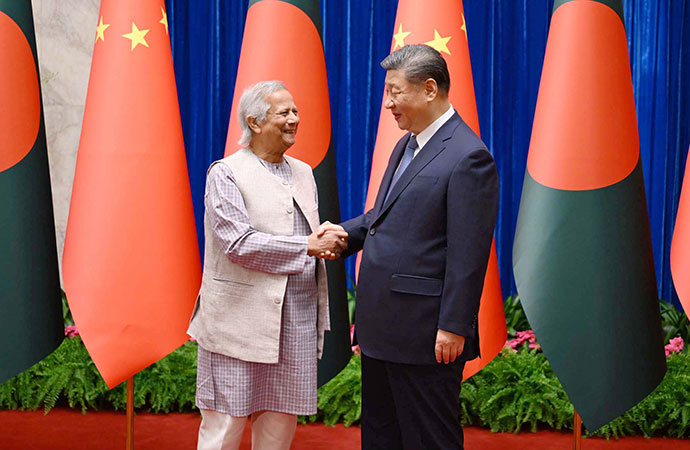
Bangladesh Chief Adviser Muhammad Yunus with Chinese President Xi Jinping in Beijing. Photo: PID
“Bangladesh and China are navigating towards a shared future, marked by strategic cooperation, economic development, and mutual respect. The two countries are forging a path to a joint destiny, characterized by strategic collaboration, economic advancement, and reciprocal regard, through the refinement of their partnerships and subtle adaptations.”- Enayetullah Khan
As Bangladesh and China mark 50 years of diplomatic ties, both nations are looking at ways to deepen their cooperation. The Golden Jubilee has been an occasion not just for reflection, but also for outlining new areas of partnership. From trade and infrastructure to cultural links and civilisational dialogue, the relationship is entering a different phase.
Dhaka Courier brings together voices from diplomats, business leaders and scholars in this special supplement, Bangladesh and China: Towards a Shared Future.
"An inseparable part of the Asian chain" - Liu Zongyi
"China and Bangladesh have become an inseparable part of the Asian industrial and supply chains, which is the fundamental guarantee for the economic prosperity of both countries," writes Liu Zongyi, senior fellow and secretary general of the South Asia and China Center at the Shanghai Institutes for International Studies.
Liu's article, 76 Years of Endeavours, 50 Years of Partnership, appeared on 1 October 2025. He argues that Bangladesh, like many countries in the Global South, faces pressure to align with big power strategies.
"In order to contain China, Russia and some other countries, the United States is now engaging in global diplomacy to gain support from developing countries," he writes. "But most developing countries are more concerned about climate vulnerability, access to advanced technology, infrastructure, healthcare, and education."
Western sanctions on Russia, Liu adds, had an indirect but serious impact on South Asian nations: "The radical economic sanctions imposed by Western countries on Russia have had a strong impact on developing countries, including Bangladesh, especially in terms of energy, fertiliser, and food prices."
A historical perspective - Enayetullah Khan
China, once described by Napoleon as a "sleeping giant," has now taken its place in world affairs. "China has come of age in line with the Napoleonic prediction, and make no mistake, it is ready to play its role in reshaping the world," writes Enayetullah Khan, Editor-in-Chief of Dhaka Courier and UNB, in his essay for the book 'Bangladesh and China: Towards a Shared Future'.
Khan, also the founder of Cosmos Group, traces ties back to the Silk Routes, where Bangladesh (then Manjala in Chinese records) was a trading link for goods, ideas, and people. Today's Belt and Road Initiative is seen as a continuation of that history.
He points out that President Xi Jinping's 2016 visit to Dhaka was a turning point. Since then, cooperation in defence and infrastructure has expanded. China is now Bangladesh's largest trading partner, with trade worth $24 billion. Although the balance tilts towards China, Khan says a Free Trade Agreement could help Bangladeshi exporters.
"Bangladesh and China are navigating towards a shared future, marked by strategic cooperation, economic development, and mutual respect. The two countries are forging a path to a joint destiny, characterized by strategic collaboration, economic advancement, and reciprocal regard, through the refinement of their partnerships and subtle adaptations," he adds.
China's domestic experience-lifting 850 million people out of poverty since 1978-offers lessons, Khan says, mentioning that Xi Jinping's emphasis on workers, innovation and discipline resonates with Bangladesh's development path.
"Bangladesh and China are navigating towards a shared future, marked by strategic cooperation, economic development, and mutual respect," he concludes.
Business voices
"We manufacture Chinese brands here" - Md Nurul Afser
Md Nurul Afser, Deputy Managing Director of Electro Mart Group, stresses how closely business links are tied.
"For those of us in business, whether it's raw materials or machinery, around 70 to 80 percent comes from China," he says. Electro Mart has long worked with Gree and Konka, two top Chinese brands in Bangladesh.
"We are now producing products under these brands locally. This collaboration transfers technology and knowledge to Bangladesh," he explains. Products meet international standards and are exported as well.
Afser highlights that nearly 99% of Bangladeshi goods enjoy duty-free access in China, but low production holds back full use of this advantage. He argues for expanding local production and creating policies to attract Chinese investment-similar to Thailand and Vietnam.
"Chinese raw materials are the foundation" - Md Asraf Uddin
Md Asraf Uddin, Managing Director of Anira International Limited, underlines the importance of Chinese supplies in mobile manufacturing.
"We import raw materials from China and use them to manufacture mobile phones," he says. But Bangladesh still does not export mobiles, despite a booming global market.
Uddin calls for policy changes-bond licences for raw materials, lower taxes, and support from the Chinese Embassy to secure advance payments to suppliers. "If policies were simplified, more Chinese firms would invest here. Right now, many are discouraged."
He adds that political instability has slowed trade, but a stronger Dhaka-Beijing partnership could bring new investors in.
Beyond politics - Dr Shamsad Mortuza
Dr Shamsad Mortuza, Professor at the University of Dhaka, reminds us that ties between the two nations are older than modern statehood.
"For centuries, commerce, religion, migration, and intellectual exchange have linked our people," he writes. "Today's milestone marks more than fifty years of diplomatic partnership; it is a civilisational dialogue that continues to shape a shared future."
He sees the Belt and Road Initiative as a revival of this ancient spirit, where "exchange replaces distance, learning replaces conflict, and coexistence replaces hegemony."
A new chapter after August 2024
The arrival of an interim government led by Professor Muhammad Yunus on August 8, 2024 marked a shift in Dhaka's foreign policy. The new administration has taken a cautious approach-focusing on trade and development while reviewing older, costlier projects.
Key Developments
• CA Visit to China (March 2025): Chief Adviser Professor Muhammad Yunus visited China and met President Xi Jinping with China making a pledge of $2.1 billion in new investments, loans and grants for Bangladesh. During the Chief Adviser's tour, China also pledged to extend zero-tariff access for products from Bangladeshi until 2028 since Bangladesh is scheduled to be graduated from the LDC category.
• Growing Trade Ties: Key areas like technology, clean energy, agriculture and infrastructure took the centre stage of cooperation between Bangladesh and China. The two countries agreed to further develop the Chinese Economic and Industrial Zone (CEIZ) in Chattogram, the industrial belt of Bangladesh with a deal that includes a $350 million investment from China.
• Project Reassessment: The interim administration in Bangladesh is expected to scrutinize existing infrastructure projects initiated by the previous administration to address concerns over fiscal mismanagement and project viability. It has also requested China to lower interest rates on existing loans.
• Water management collaboration: In March 2025, Bangladesh invited Chinese companies to participate in the Teesta River Comprehensive Management and Restoration Project. This represents a shift from the previous government, which refused Chinese financing for the project to appease India. In May 2025, Bangladesh and China signed an agreement to strengthen cooperation in water management and flood control, including sharing hydrological data for the Brahmaputra (Jamuna) River.
• Rohingya crisis mediation: China has reaffirmed its support for Bangladesh in finding a solution to the Rohingya refugee crisis. It has offered to mediate the repatriation process with Myanmar and provide continued support.
• Medical tourism cooperation: China has entered Bangladesh's service sector by facilitating medical tourism. Following restrictions on visas for Bangladeshis seeking medical treatment in India, China has emerged as an alternative destination by dedicating hospitals in Kunming and arranging direct flights.
Key areas of the relationship
• Economic relations: China has been Bangladesh's largest trading partner for 15 consecutive years, with bilateral trade reaching over $25 billion. The trade balance is heavily in China's favor, though new zero-tariff measures are expected to boost Bangladesh's exports. China is also a major source of foreign direct investment (FDI) in Bangladesh.
• Belt and Road Initiative (BRI): Bangladesh was the first South Asian country to join the BRI, which has funded major infrastructure projects, such as the Padma Bridge Rail Link and the Bangabandhu Sheikh Mujibur Rahman Tunnel.
• Defense cooperation: China is the largest supplier of military hardware to Bangladesh, providing fighter jets, tanks, and naval vessels. In 2024, China continued to express interest in deepening defense cooperation.
Geopolitical considerations
• Balancing act: The new interim government is navigating complex regional power dynamics involving China, India, and the United States. The country's strategic foreign policy emphasizes trade and economic development while avoiding security entanglements, which helps it maintain a balance in the China-U.S. rivalry.
• Indian influence: With the change in government, Bangladesh's relations with China have become more pronounced. Experts suggest that India's influence in Bangladesh has been negatively impacted by the shift. However, China's increasing engagement in infrastructure, like the Teesta River project and Mongla port, continues to cause concerns in New Delhi.
• Debt concerns: While Bangladesh's debt-to-GDP ratio is manageable, concerns exist regarding potential "debt trap diplomacy" associated with Chinese investments. Some Chinese-backed projects have experienced delays and underperformance. The interim government is reportedly seeking to reduce interest rates on loans and enhance transparency.
The road ahead will not be without challenges-imbalances in trade, cautious policies, and geopolitical competition are real. Yet both sides continue to emphasise a "shared future," one built on mutual respect and common aspirations.
A Independent Newsweekly
© Copyright 2026 | Designed by ARK Reepon & Developed by Cosmos Group Software Team




Leave a Comment
Recent Posts
Dhaka, Tokyo relationship to c ...
Deputy Chief of Mission of the Embassy of Japan in Bangladesh Yoshida ...
Democracy puts a premium on et ...
And just like that, the deed was done. With a volley of 'Ayes!’( ...
Dhaka still eyeing ‘conducive’ setting for PM’s Delh ..
Gallery Cosmos Artist Residency, 2026
Summit seeks reinstatement of FSRU deal
Hatful of medals for Bangladeshi whiz kids at WMI 20 ..