



Featured 2
‘No way out’: the closing spaces for Rohingya livelihoods


An Independent Newsweekly





Featured 2
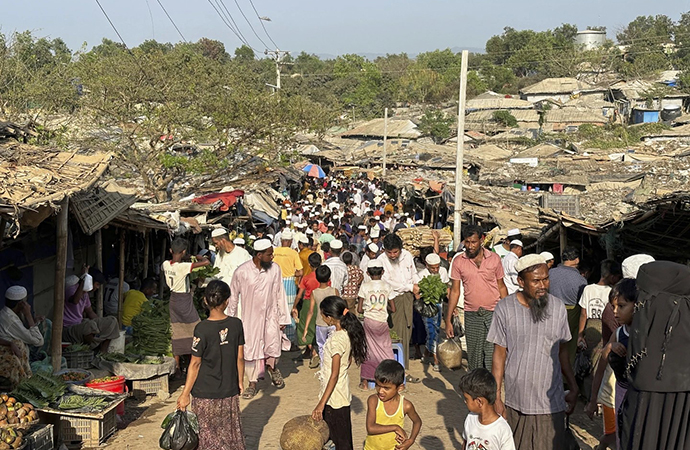
Photo: AP/UNB
Rohingya refugees in Myanmar and Bangladesh find work where they can, but their rights are increasingly restricted
Rohingya refugees are increasingly relying on informal work to survive on both sides of the Bangladesh-Myanmar border. Already tightly controlled, life both inside and outside refugee camps became more restricted after renewed fighting broke out between a rebel group and the Myanmar military in 2023. Now that US aid cuts have also come into force, the list of options for refugees in both countries has shrunk even further.
The economic crisis facing the Rohingya in Bangladesh and Myanmar is not just a result of poverty. It is a result of exclusion. In Bangladesh, refugees are banned from working formally and must rely on rations or precarious informal jobs. In Myanmar, livelihoods are disappearing under conflict, military restrictions, and growing distrust between ethnic groups.
Refugees are navigating the limited and precarious work opportunities available in both countries as best they can. Some jobs can still be found in sectors like small-scale farming and construction. A few have managed to open small businesses, while others have turned to family and friends abroad for help. Still others set their sights on migration, journeying to Thailand, Malaysia or other areas in Myanmar to try to find something better.
As a Rohingya and a research analyst, I have seen first-hand how exclusion from livelihoods has worsened poverty and despair. I have seen how Rohingya people try to survive by opening small tea stalls, used clothes shops or tuition centres in the camps, and how some must seek permission from armed groups just to fish or cultivate their land.
These daily struggles are not just about poverty. They are about exclusion from basic rights and opportunities. A political and sustainable solution is ultimately what is needed to end this cycle of displacement and precarity.
But in the meantime, small but crucial policy changes could drastically improve the lives of hundreds of thousands of displaced Rohingya on both sides of the border. These include: allowing supervised work opportunities for refugees in Bangladesh, brokering labour agreements with other countries to send Rohingya workers abroad, easing movement restrictions, continuing foreign aid, and supporting community-led initiatives.
Continuing conflict in Myanmar
The Rohingya people have faced marginalisation, violence and statelessness in Myanmar and Bangladesh for decades.
More than 1.3 million Rohingya refugees now live in camps in Cox's Bazar, Bangladesh, the majority having fled the Myanmar military's assault on the Muslim Rohingya population that began in late 2016. Around 10,000 people were killed and villages were burnt to the ground in 2017.
Another 150,000 Rohingya people remain displaced inside Myanmar. Many live in the central Rakhine state, in overcrowded camps or urban areas under tight surveillance, without freedom of movement or formal access to jobs, education or healthcare.
The latest round of fighting broke out in November 2023 between the Arakan Army, a rebel group, and the Myanmar military, following a year-long, informal ceasefire. Around 150,000 people have fled the fighting to Cox's Bazar as a result of this latest violence.
The situation escalated further in April 2024, when the Arakan Army launched a major offensive in northern Rakhine. Entire villages in Buthidaung and Maungdaw were burned to the ground and thousands of families were displaced again. Some attempted to cross into Bangladesh despite border closures. Others were killed while trapped between warring forces.
Transport routes were blocked by the Myanmar military, and food and medicine disappeared overnight. Markets collapsed and prices rose. Humanitarian aid that had once been distributed by international NGOs and local charities has also stopped reaching the villages. Travel permits are unaffordable, and families without relatives abroad to send them money are simply going hungry.
Farming and fishing, once central to Rohingya survival, have also all but collapsed. Armed checkpoints, extortion, and displacement have shut down most agricultural activity. With fuel and fertiliser shortages worsening, many have simply stopped trying. In Maungdaw township, a resident said, "We don't have any income source anymore. Even if we want to start a business, there are no customers. Most people already fled."
Bits and pieces of cross-border trade are still making it into Rakhine state from India and Bangladesh, but commerce is unreliable and expensive. Fighting continues to block key roads and informal trade routes face constant disruptions. What does arrive is unaffordable for many, so they must do without.
A camp economy
In the camps of Cox's Bazar in southern Bangladesh, survival has always been difficult. Bangladesh is not a signatory to the 1951 Refugee Convention. Its policy is that Rohingya are temporary guests who must eventually return to Myanmar under safe, voluntary and dignified repatriation agreements. As such, the Bangladeshi government does not legally recognise Rohingya as refugees. They are officially labelled 'Forcibly Displaced Myanmar Nationals', and are restricted from leaving the camps.
UNHCR, the UN refugee agency, is allowed to operate in the area alongside the Bangladesh Refugee Relief and Repatriation Commissioner (RRRC). Rohingya are issued biometric identity cards, which gives them some access to protection, support, and advocacy.
In March 2024, the UN's World Food Programme warned that without urgent funding, food rations for over one million Rohingya in Bangladesh would be cut from $12.50 to just $6 per person per month. This would effectively halve aid for a population almost entirely dependent on humanitarian support. Aid officials pointed to the withdrawal of major donors like the United States as a critical blow, and community members stressed that $12.50 was already inadequate. They said survival on $6 would be nearly impossible.
Rohingya in Bangladesh have little or no access to jobs, education or livelihood opportunities. The cuts are also coming at a time of renewed conflict in northern Rakhine, which has driven an estimated 150,000 new arrivals into Bangladesh. Refugees warned of rising malnutrition, social instability and protection risks, with families forced to pull children from school, marry off young women, and seek dangerous informal work just to survive. Most Rohingya families have survived on aid alone up until this point. Now, many have to find whatever informal work they can or they will not eat.
Those with access to grants from charities, money from family members abroad, or personal savings open betel shops, selling nuts and leaves that work as mild stimulants. Others run vegetable or clothing stores inside the crowded camp markets. Young men repair mobile phones or tuk-tuks, or run tuk-tuk taxi services to move people around the sprawling camps.
Some work as teachers in local religious or NGO-run schools, sometimes without pay or with support from small donations. Women with sewing skills take tailoring orders from neighbours and work from their shelters.
Others try to leave the camps in secret, risking arrest to take informal jobs in nearby Bangladeshi villages and towns in construction, cement work or loading goods. But there's heavy competition with Bangladeshi workers, and many are turned away. Those who do find a job often experience exploitation and dangerous working conditions. Some Rohingya women take on domestic work and childcare in Bangladeshi households, where they also risk exploitation and abuse.
For many young people, the lack of purpose and opportunity can take a significant toll on their mental health. Many decide to take their chances in precarious boats bound for southern Myanmar, Malaysia or Thailand. Some of those who stay have turned to online gambling, or have fallen into criminal networks or gang violence. A spate of recent kidnappings in the camps have reportedly involved coordination between Rohingya youth and local Bangladeshi gangs.
Fear and hopelessness are growing. "We are just locked inside," one refugee youth said. "There is no way out. No future."
Small shifts, real impact
Rohingya refugees cannot wait for perfect conditions or a long-delayed political settlement. While repatriation and rights remain long-term goals, there are immediate actions that could reduce suffering now.
In Bangladesh, the government must end its insistence that Rohingya are only temporary guests. As survival on aid alone is no longer possible, Rohingya must be allowed to earn income. Carefully regulated work permits in selected sectors could provide livelihoods, reduce irregular migration, and lessen youth recruitment into criminal networks.
Support for existing informal work is also necessary. Refugees already run tea stalls, tailoring shops and informal schools or training centers, but without recognition they remain fragile. Formal support for these initiatives would strengthen communities and ease pressure on overstretched aid programmes.
Meanwhile in Myanmar, conflict in Rakhine State has left Rohingya communities trapped between armed forces and the expanding territorial control of the Arakan Army. Villages have been burned, humanitarian access has collapsed, and even basic livelihoods like fishing or farming are generally out of reach. The UN has warned that more than two million people in Rakhine are at risk of famine due to restricted access, destroyed markets and soaring food prices.
Removing these restrictions and opening cross-border humanitarian channels are urgent steps to prevent catastrophe. International actors must press both the Myanmar Army government and the Arakan Army to permit relief operations. They must also support local civil society organisations, which remain among the few capable of reaching Rohingya communities on the ground.
International donors must finally reconsider the consequences of aid withdrawal urgently. Cuts are already exacerbating hunger and desperation, pushing families into debt, child labour and dangerous migration. Without renewed assistance, fragile coping strategies in Bangladesh and Myanmar will collapse. As a Rohingya research analyst, I see these consequences every day.
The Rohingya crisis is both a humanitarian and political crisis. Its cost will reverberate far beyond the camps if the world continues to look away. Timely assistance and just policies can be the difference between hope and despair for the Rohingya community. Don't abandon us.
From openDemocracy
A Independent Newsweekly
© Copyright 2026 | Designed by ARK Reepon & Developed by Cosmos Group Software Team






Leave a Comment
Recent Posts
Is the international community ...
A spate of downgraded economic projections, from Bretton Woods to Mani ...
A Childhood Lesson in Arithmet ...
As children, we learned a simple mathematical rule: if we know the pri ...
Indian authorities launched a major security crackdo ..
Police dispersed garment workers from the Azampur ro ..
Why Saudi Arabia has struggled to defend itself agai ..
Iran-backed Houthis strike Saudi oil company Aramco’ ..