



Column
The Fall of Sheikh Hasina: This Is How It Ends

An Independent Newsweekly





Column
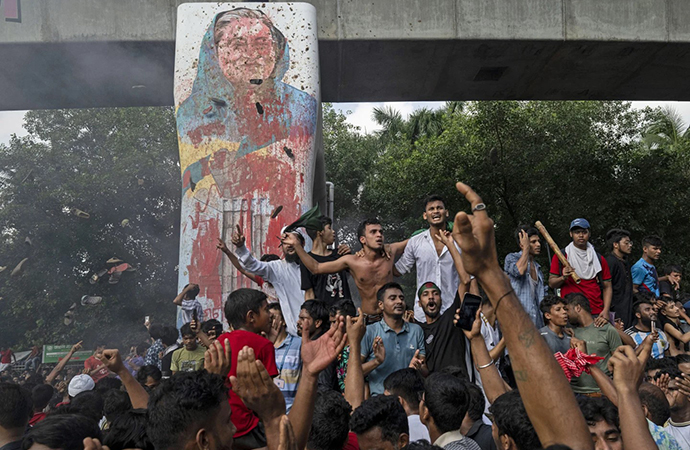
Photo: AP/UNB
If you search YouTube, you can still find the video. Former Prime Minister Sheikh Hasina stands surrounded by Bangladeshi artists and actors, swaying as they sing "Tumi bondhu kala pakhi, ami jeno ki." At one point, a smiling Hasina pulls her sister Rehana into the circle of joy. In that moment, the most powerful leader of a poor nation-and her loyal courtiers-could not imagine that the music would soon stop, the lights dim, and they would flee their own country like fugitives. Even while in exile, the executioner's snooze would await her.
On August 5 of last year, when Hasina and her sister left Dhaka with four suitcases, the smiles and impervious confidence were gone-replaced by fear and deep anxiety. Reports suggest she hesitated until the very end. Even after learning that hundreds of thousands were marching toward Ganabhaban, she ordered her military to use "lethal weapons" to stop the uprising.
The generals refused. "Madam, this could endanger your life-and all of ours," they told her.
In desperation, she reached out to her son, Sajeeb Wazed Joy, a U.S. citizen. His advice was blunt: "Mother, it is time to leave." One can imagine, moments before boarding the helicopter, a stunned Hasina might have whispered to herself:
"After everything I've done-this is the return I get?"
Hasina is hardly the first powerful ruler to flee before a furious public. East Germany's Erich Honecker, Iran's Shah Reza Pahlavi, the Philippines' Ferdinand Marcos, Afghanistan's Ashraf Ghani-all were driven out in similar fashion.
Among them, Marcos offers the closest parallel.
After 21 years in power, Marcos was toppled by a popular revolt on February 25, 1986. The assassination of opposition leader Benigno Aquino three years earlier had already shaken the nation. Marcos tried to regain legitimacy through a snap election, but rampant fraud only intensified the protests. Believing U.S. troops would ultimately rescue him, Marcos waited in the Malacañang Palace with his wife Imelda as Manila exploded in revolt. Repeated attempts to reach President Reagan failed.
Instead, a call came from Reagan's envoy Paul Laxalt:
"Mr. President, I think you should cut and cut clean."
Marcos turned pale. "So this is it. It's over," he told Imelda. Hours later, U.S. helicopters lifted them out. His final words as he left:
"So, this is how it ends."
History teaches the same lesson over and over: abuse of power eventually brings a ruler down. And the fall comes fast-too fast for preparation, alliances, or illusions. Reza Shah, Marcos, Hasina-their political trajectories were eerily similar. In each case, the state, the government, and the leader fused into one. They became not just the center of power, but its sole source.
That is how autocrats fall.
When the leader becomes the axis around which everything turns, there is no one left to hold it up when it begins to crack.
Consider Hasina. One of the most powerful leaders in the world-yet when danger arrived at her doorstep, she stood alone. Even the military she had personally built walked away.
Autocrats do not survive by force alone. They must also craft a narrative of indispensability. Hasina in Bangladesh, the Shah in Iran, Hosni Mubarak in Egypt, Nicolae Ceaușescu in Romania-each sold themselves as the only guarantee of their nation's survival.
"I am Bangladesh," Hasina declared.
"If I am gone, the country will be washed away in floods," Marcos warned.
Mubarak insisted that without him, Egypt would "fall apart."
Flatterers are always on hand to amplify these fantasies. Whether the public believed them or not, the rulers themselves increasingly did. That is why Hasina was reportedly shocked to realize that the very people for whom she claimed to sacrifice everything now demanded her resignation.
In December 1989, Ceaușescu, equally deluded, insisted on addressing a crowd from the balcony of the Communist Party headquarters, declaring that Romania stood united behind him. The crowd roared with laughter.
Insiders say that, in her final hours, Hasina too wanted to address the nation-an idea her handlers wisely rejected. The reaction might well have been the same.
Autocrats rarely recognize their own decline, but their beneficiaries always do. That is why underlings are the first to flee. Just as Fazle Hossain Taposh and many others did in Dhaka.
From Hasina's fall-and from the court verdict that last week sentenced her to death in absentia-we are reminded of a simple truth:
No leader is indispensable.
Neither fear nor mythology nor propaganda guarantees permanent power.
As George Orwell wrote:
"All tyrannies rule through fraud and force, but once the fraud is exposed, they must rely exclusively on force."
But even that force evaporates-like camphor-leaving behind only the frightened, bewildered face of the fallen autocrat.
A Independent Newsweekly
© Copyright 2026 | Designed by ARK Reepon & Developed by Cosmos Group Software Team






Leave a Comment
Recent Posts
When the moral compass is lost
The brutal and depraved cases of rape and murder of four young childre ...
UNGA Presidency: Attention now ...
Questions continue to surround what Foreign Minister Dr Khalilur Rahma ...
The Mathematics of Discontent: Decoding the Strategi ..
Indirect 'tax traps' in budget risk widening economi ..
From Early Leadership to Plastic Crisis: Bangladesh’ ..
Eat well