



Column
Pohela Boisakh: Celebrating taxation or what?


An Independent Newsweekly

Column
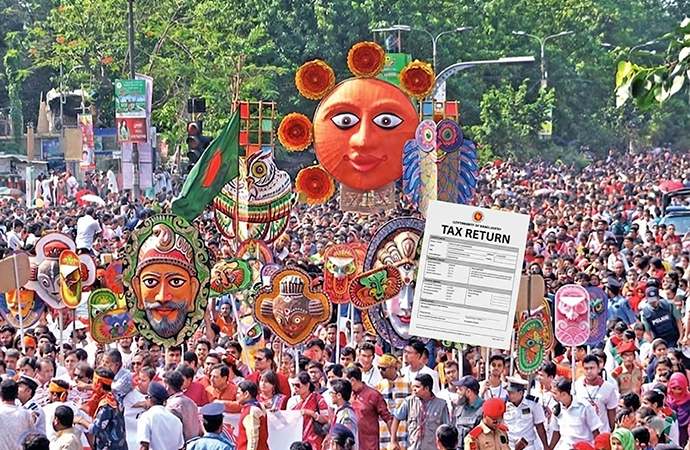
Pohela Boisakh is as much a cultural activity as much as it's a political battle field in Bangladesh. Let's face it, most see it not as much of a celebration as much as they see it as an event of political confrontation over the social and cultural opposition at any time. And it all began as an income tax issue in the hoary past.
Most of us aren't thrilled by the fact that we shall have to file our tax documents by the middle of the year. It's the moment when we have to part with money which ends up in GOB coffers and then God knows where it goes. Few trust the process and it's a very non-transparent informal payment driven system.
Having paid it for all my working life, I see it as a sort of institutional "chandabaji". Either you pay or you get into trouble. Sorry NBR or whoever collects it, that's how most of us feel. Nothing could be further from celebration.
However, kings and emperors once used to take taxes directly from the peasants as they didn't have so many sources from which to extract money to fund their life and lifestyle. It's difficult to imagine this extraction was celebrated by the taxpayers. I mean seriously...?
Hundreds of full or partly impoverished peasants going around singing and dancing and celebrating their loss of money? But then maybe people in those days were different. They loved to be losers.
Well anyway, that's what everyone says or believes but let's not just ask that one has to believe it too.
The so-called roots
According to Gemini, "Pohela Boishakh, the Bengali New Year, has its roots in the 16th-century Mughal era when Emperor Akbar introduced the Bangla calendar to facilitate land tax collection, transitioning from the Islamic Hijri calendar to a solar one. It evolved from a fiscal necessity into a celebration of agricultural life, rural culture, and secular identity." I mean seriously once more?
But it does show that by introducing singing and dancing and not sure if it was followed by other ritualized acts of entertainment or fun not, Akbar pulled a fast one on the sort of not so bright peasantry. They got conned into believing that giving taxes was a great fun idea. I mean you can't get more ... "neuro-diverse" than thinking that parting with a part of your hard-earned money is a great idea and you actually enjoy it.
By the way, it does indicate why the Islamists hate Pohela Boisakh. Akbar Sir moved away from the Islamic calendar OMG. no wonder. explains a lot.
Down the stairs of time
Dear Old Mughal emperor Akbar kicked off the calendar in 1556, linking it to the spring harvest, creating a new fiscal year known as "Fasli San" (harvest year) which later became the Bengali year (Bangabda).
In the pre-Akbar days, landowners would mark the day of accounts settlement and closing of books like in banks it was called "Halkhata" (opening a new ledger) as all know. Naturally, they were in a jolly mood and would often treat payees and customers with sweets. I had a lot of gorging when we were young but apparently it still remains a tradition in some circles though not so widely practiced.
Over time and as expected the rural folk thought that this was not such a fun idea after all and probably dented the pain of tax payment and in came rural festivals including fairs, cultural shows, feasting, and community gatherings etc. I mean you get the drift of it don't you ...?
In the bland life of a peasant full of planting and ploughing rice fields , at least one could shake a leg or two. And let's face it, today's Bengalis are essentially rural farmers living in the cities so the arrival of Pohel Boisakh to the urban zone herded by cow-carts and "gariyal" bhais singing was just a matter of time.
And when cultural activities come to the city can politics be far behind?
Key Political Milestones
Immediately after 1947 or the birth of Pakistan which was not the goal of the Bengal Muslim League anyway, they developed cultural activism as the ideal form of political protests. It was not just the language thingy that was the issue but cultural activities too.
Between 1947 to 1951 it was not a cultural ritual of defiance -mostly "halkhata" type events- but in 1951, it became a public celebration which was duly termed as "anti-Islamic" while the rest called it Bengali culture. The tussle had begun.
It grew as an issue in 1952 as well and in 1954, the United Front government officially declared "Pohela Boishakh" a public holiday. It continued to grow in the public space without any official patronage and criticism of its observance by East Pakistanis as pro-Hindu was on but that didn't dampen the anti-Pakistan sentiment or celebrations either.
In 1967, the cultural organization "Chhayanaut" disregarded a ban on promotion of Rabindranath Tagore, held its first open-air concert at Ramna Batamul kicking off a tradition of observing Pohela Boisakh. Much later in 1989, Mongol Shobhajatra - the auspicious procession- became a rallying point for political resistance against Ershad, the ruler at that time.
And today?
With the rise of pro-Islamic politics, whatever that means, governments are sensitive about sounding more Hindu than Muslim. So, the term "Mongol" -auspicious but popular amongst Hindus is gone and Boisakh Shovajatra has come in. Some have petitioned for the ban on the procession and its obvious symbols have become more important than substance. But the fight goes on and why not. No tax but festivities are fun but may we have a 1st may tax holiday day too please.
A Independent Newsweekly
© Copyright 2026 | Designed by ARK Reepon & Developed by Cosmos Group Software Team




Leave a Comment
Recent Posts
Is the international community ...
A spate of downgraded economic projections, from Bretton Woods to Mani ...
A Childhood Lesson in Arithmet ...
As children, we learned a simple mathematical rule: if we know the pri ...
Indian authorities launched a major security crackdo ..
Police dispersed garment workers from the Azampur ro ..
Why Saudi Arabia has struggled to defend itself agai ..
Iran-backed Houthis strike Saudi oil company Aramco’ ..