



Column
A new West Bengal

An Independent Newsweekly



Column
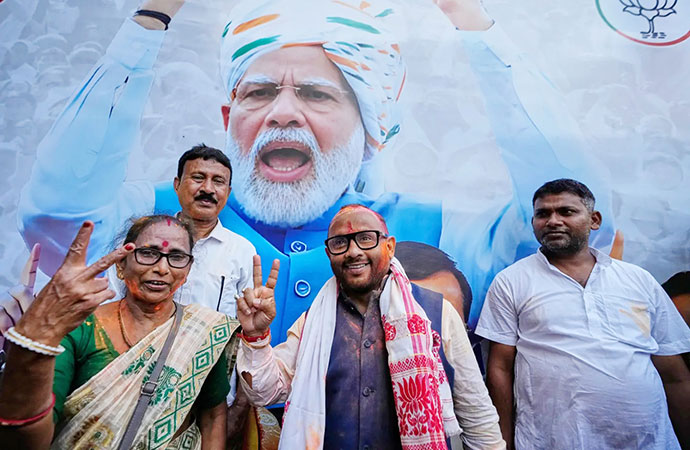
Diplu Ranjan Sarmah, center, New Guwahati candidate of Bharatiya Janata Party shows victory sign after winning in recent held state election in Guwahati, India, Monday, May 4, 2026. Photo: AP/UNB
India's ruling Hindu nationalist Bharatiya Janata Party (BJP) has just won its first election in West Bengal. It has dislodged the All-India Trinamool Congress (TMC) from 15 years in power in the state by taking 207 seats out of 294 in the West Bengal Legislative Assembly polls, leaving the TMC with 80 seats - an astonishingly neat mathematical reversal of the TMC's 213 seats and the BJP's 77 seats that were won in the 2021 polls.
Just before the election, lakhs of electors in the state had their names deleted from voters' lists in an exercise carried out by the Election Commission of India called the Special Intensive Revision (SIR) of voter rolls aimed at cleaning records of dead and duplicate voters. Others, too, were hit in the administrative exercise, including Hindus and a large number of Muslims who could not qualify because of logical discrepancies, or voter data anomalies meant to identify potential errors or invalid entries in the electoral rolls.
Trinamool, under its leader Mamata Banerjee, claimed that SIR had hurt its electoral chances. This is obviously true because Muslims formed a solid voting bloc for the party. However, it is equally true that the BJP managed to consolidate the Hindu vote as never before to give West Bengal its first religious nationalist government. Chief Minister Mamata Banerji was unseated in her own Kolkata constituency of Bhabanipur by the BJP leader Suvendu Adhikari, who used to be her protégé once.
Spontaneous outbursts of "Jai Shri Ram" - the BJP's signature cry - filled Kolkata's festive air on the night of May 4 after the election results were announced. The stretch of Bengal outside 30-B Harish Chatterjee Street in south Kolkata, where Mamata Banerjee's house stands, was unusually deserted. It had been discarded from West Bengal's electoral geography because its reigning deity was gone finally from her famously mercurial power. However, a newspaper report says that two-wheelers and cars converged outside Shantiniketan, the residence of Abhishek Banerjee, her nephew and heir apparent. People raised slogans: "Goru chor, koyla chor (cattle thief, coal thief)."
It was not quite the Ganobhaban moment of Bangladesh in 2024. I wrote in these pages then:
"The sight of lumpen elements storming Gonobhaban, after the unanticipated departure of Sheikh Hasina, was truly disgusting. There is no way of supporting or even condoning it. But this is what happens. The lawlessness of ordinary life takes over the moment when entrenched elites relinquish their apparently timeless roles. When they do so in unseemly haste, people reclaim royal residences in boisterous, violent, epiphanic joy.
"What occurred in Dhaka was preceded by recent events in Colombo, Baghdad and Kabul. In the case of Bangladesh, one video showed a group of hungry vandals invading the patrician kitchen, where the sight of what appeared to be kacchi biryani (with the chicken drumsticks yet to be added) elicited expectant roars of plebeian joy. A man was captured on video relishing a drumstick in everlasting homage to the culinary foundations of democracy. This was a feast of gonobhojon at Gonobhaban.
"Also revealing was the sight of uninvited guests carting away state furniture, principally chairs, from the hallowed precincts. This struck me as vulgar theft at first, until I realised that the mob was stealing chairs less to sit in them than to display them as trophies back home. In an ecstatically wayward display of symbolic labour, the mob was metaphorically removing state chairs - proverbially the seats of the powerful - from the political bottoms of the heavyweights who had occupied them once.
"Meanwhile, someone lay down on a regal bed for a moment to savour the comforts of rest that arrive after the daily toil of carrying the affairs of the state on one's shoulders. That the interloper had never done so did not matter: What mattered was that he was recreating vicariously the dialectic of work and rest that is played out on spacious royal beds even as most humans have to content themselves with overpopulated beds at home or with the spartan comforts of pati-kantha-kambal floors. For a few minutes, the imposter statesman lying on the Gonobhaban bed caricatured the idea of power at rest. Power can rest, but it cannot ever be at peace."
None of that occurred at Mamata's 30-B Harish Chatterjee Street or at Shantiniketan, the abode of Abhishek's fictitious peace. This is the difference that democracy makes. In a democracy, losers are willing to still believe in a restorative future: Once democracy disappears, they grab whatever they can from the departure of the forever present - from a sudden buffet of kachhi biryani to the wooden politics of revolving chairs.
Commendably, Bangladesh has returned to democracy since then. Of course, I am not insinuating that its present leaders face the prospects of uneasy departure. Why should I? They are honourable people. They need five years at least to make Bangladesh a better home for its people.
Bangladeshis would understand, however, how fickle power can be. The Mamata-Abhishek phenomenon passed into history overnight.
And morning is but another day in politics.
The writer is Principal Reserch Fellow of the Cosmos Foundation. He may be reached at epaaropaar@gmail.com
A Independent Newsweekly
© Copyright 2026 | Designed by ARK Reepon & Developed by Cosmos Group Software Team




Leave a Comment
Recent Posts
Is the international community ...
A spate of downgraded economic projections, from Bretton Woods to Mani ...
A Childhood Lesson in Arithmet ...
As children, we learned a simple mathematical rule: if we know the pri ...
Indian authorities launched a major security crackdo ..
Police dispersed garment workers from the Azampur ro ..
Why Saudi Arabia has struggled to defend itself agai ..
Iran-backed Houthis strike Saudi oil company Aramco’ ..