



Reportage
COP31: Confronting the Moment of Truth


An Independent Newsweekly






Reportage
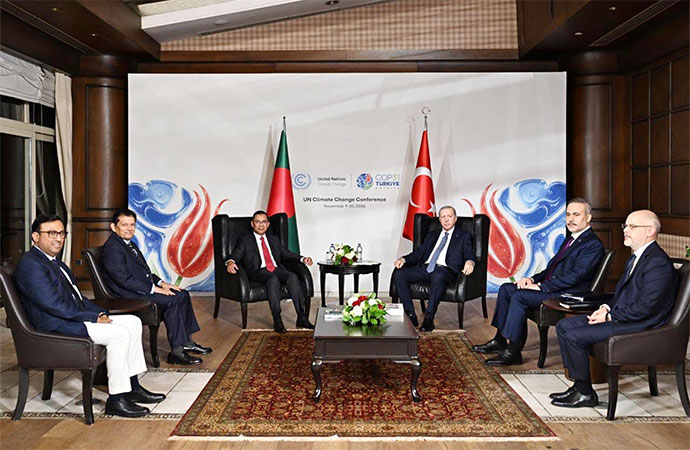
Photo: BNP Media Cell
Global efforts to combat climate change have made little progress over the past five years, as unfulfilled commitments and cancelled-out initiatives have prevented the world from slowing the pace of global warming. The assessment came during a UN climate conference in Antalya, Türkiye, where world leaders gathered to deliver further statements on the worsening climate crisis and their plans to address it.
According to an independent report by Climate Action Tracker, collective climate action has effectively stalled for five consecutive years, with positive and negative measures offsetting each other. During the first five years after the 2015 Paris Agreement, global climate initiatives reduced projected warming by a full degree Celsius (1.8 degrees Fahrenheit). However, the situation has remained unchanged since then, the report said.
Climate change is primarily driven by greenhouse gas emissions released through the burning of fossil fuels such as coal, oil and gas. Tackling the crisis requires substantial annual reductions in emissions. Countries outline their individual commitments to cut emissions through nationally determined contributions (NDCs), with the pace and methods varying from one country to another.
As collective efforts have failed to significantly reduce global emissions, the world is now heading towards an irreversible breach of the 1.5-degree Celsius (2.7-degree Fahrenheit) warming threshold above pre-industrial levels set under the Paris Agreement, the report warned.
Even if all countries fulfil their existing climate commitments, the global temperature is projected to rise by 2.6 degrees Celsius (4.7 degrees Fahrenheit) by the end of this century.
That projection remains unchanged from 2024 and 2025, indicating that the latest round of commitments made last year has failed to significantly alter the expected warming trajectory, said Sarah Heck, a climate policy analyst at Climate Analytics and lead author of the report.
"This is still not enough," Heck said, stressing that countries need to strengthen their climate targets.
Leaders of island nations delivered a similar message to the international community on Wednesday (Nov. 11), with more expected to reiterate their concerns on Thursday. Although climate change is intensifying storms, heatwaves, droughts and floods worldwide, island nations face an additional existential threat as rising sea levels gradually swallow their territories.
"Every new oil well drilled, every piece of coal extracted is a threat to my country's future. The discovery of new fossil fuel resources is not something to celebrate, but something to fear," Marshall Islands President Hilda Heine said on Wednesday.
She was joined in raising concerns by leaders from Tuvalu, the Bahamas, Antigua and Barbuda, Niue and other island nations, who were expected to make similar appeals.
"No one has the right to pollute their neighbours," Heine said, urging the world to wake up to the climate crisis.
Recalling how coral reefs she had seen this year had turned from "bright and lush" to white due to bleaching, she warned that the global response to the inevitable breach of the 1.5-degree warming limit must be overwhelming or the world as people know it would be lost.
Meanwhile, Barbados Prime Minister Mia Mottley said wealthy countries must move beyond making financial promises and provide more funding to poorer nations to help them recover from climate-related damage and adapt to rising temperatures.
"Pledges are not payments. But even the promised pledges are now 70% below previous levels," Mottley told fellow leaders on Wednesday. She added that applause and expressions of support at international meetings had never rebuilt a single home in any country.
That is something climate-vulnerable Bangladesh knows well. The country has a history of seeking grants, technology transfer and financial support to tackle the growing impacts of climate change. Coming into COP31 in Antalya, the biggest challenge remained turning international promises into tangible assistance.
With adaptation costs rising and the country facing mounting threats from cyclones, floods, salinity and rising sea levels, the summit has once again put the question of climate justice and equitable financing at the centre of Bangladesh's diplomatic agenda. But whether this year's negotiations will deliver real financial commitments rather than another round of pledges remained uncertain.
As the global climate negotiations concluded, a key question remains: will the longstanding demands of vulnerable countries like Bangladesh translate into concrete financial support, or will they remain confined to declarations and promises, as in previous climate summits?
Experts said Bangladesh's major priorities at COP31 should include securing grants instead of loan-based financing, ensuring easier access to adaptation funds, obtaining technological assistance and securing adequate funding to address climate-induced losses and damage.
They also stress the need for stronger diplomatic engagement and coordinated positions with other least developed countries (LDCs) and climate-vulnerable nations to strengthen Bangladesh's bargaining position.
Diplomatic engagement crucial
The effectiveness of Bangladesh's position at COP31 will largely depend on its diplomatic capacity and coordination with international alliances, Bangladeshi experts attending the summit said. Professor Ainun Nishat said negotiations at COP summits primarily take place at the state level, with two separate spaces playing different roles.
The Blue Zone is where heads of state and government representatives discuss and negotiate the Paris Agreement and global climate policies, while the Green Zone provides a platform for civil society, NGOs and other organisations to present their demands and positions.
He said the main decision-making authority rests with government representatives. Therefore, diplomatic engagement by the head of government, environment minister, secretaries and relevant officials is crucial to advancing Bangladesh's interests. He also stressed the importance of using bilateral meetings to raise issues relating to climate financing and the challenges faced by vulnerable countries.
Dr Atiq Rahman, meanwhile, said Bangladesh should not focus solely on its national interests but also highlight the collective demands of LDCs and other climate-vulnerable countries. A united position in international negotiations could strengthen Bangladesh's efforts to secure its demands, he said.
Bangladesh needs substantial financial resources to address climate adaptation and climate-induced losses and damage. However, despite international pledges, significant challenges remain in securing actual disbursements, accessing funds on favourable terms and implementing projects.
M A Hasan of the Coast Foundation said international climate negotiations frequently feature announcements of large financial commitments, but their success cannot be measured merely by the amounts pledged.
He said it was important to determine who would provide the money, where it would come from, when it would be disbursed, under what conditions it would be provided, who would receive it and what tangible changes it would bring.
"Countries of the Global South are not asking for charity; they are demanding climate justice," he said. Countries that have contributed the least to the climate crisis should not be forced to take on additional debt to protect their populations, he said, adding that financing arrangements that increase national debt or prioritise lenders' interests over people's needs are unacceptable.
The issue is particularly significant for Bangladesh, as taking on additional loans to address climate impacts could further increase economic pressure on the country. Securing grant-based international climate assistance has therefore become a major priority.
Professor AKM Saiful Islam of the Institute of Water and Flood Management at Bangladesh University of Engineering and Technology (BUET) said international politics had emerged as a major obstacle to climate financing and emissions reduction. He said the United States' withdrawal from the Paris Agreement, global conflicts and the positions of oil-rich countries had complicated international climate cooperation and financing.
According to him, key issues at this year's summit include adaptation financing, direct grants and technological support to address losses and damage, implementation of international climate finance targets and a just transition in the energy sector. He also highlighted the challenge of delivering on the climate finance commitments of $300 billion annually by 2035 and a longer-term target of $1.3 trillion.
The experts we spoke to said securing climate financing will remain difficult amid the prevailing global political and economic uncertainties. Bangladesh will therefore need to intensify bilateral and multilateral diplomatic efforts while pressing developed countries to fulfil their responsibilities.
'More grants, not loans': Tarique Rahman
Prime Minister Tarique Rahman on Thursday addressed the high-level segment of the conference, outlining five urgent actions to address the needs of climate-vulnerable countries, including allocating at least 50 percent of international climate finance to adaptation and introducing debt-relief measures.
"Climate-vulnerable countries need grants, not more loans that increase their debt," he said.
Tarique also called for reliable financial support, access to modern technology and stronger assistance for adaptation, saying the global climate finance system remained inadequate and did not properly address the needs and priorities of developing countries.
Guided by the principle of 'Common but Differentiated Responsibilities and Respective Capabilities', the Bangladesh prime minister placed five proposals before the international community.
First, he called for allocating at least 50 percent of international climate finance to adaptation, based on each country's priorities, while continuing to support efforts to reduce emissions.
Second, Tarique urged the introduction of debt-relief measures, including Debt-for-Climate Swaps and Climate-Resilient Debt Clauses, for vulnerable countries.
Third, he called for fair access to climate-friendly technologies and support for their transfer to developing countries.
Fourth, the Prime Minister stressed the need to accelerate the shift to renewable energy through affordable financing, skills development and a fair energy transition.
Fifth, he urged world leaders to adopt the Belem-Antalya Action Mechanism for a just transition at COP31, with fair finance and fair trade at its heart.
Tarique said climate-related losses and damages were putting a heavy burden on economies, while rising debt payments and limited financial resources were making the situation more difficult.
He said Bangladesh was on the frontline of climate change, although its contribution to global greenhouse gas emissions was less than 0.5 percent.
Despite these challenges, Bangladesh remained committed to building a trillion-dollar, climate-resilient and sustainable economy, the Prime Minister added.
Guided by the philosophy of "Bangladesh Before All", the government believes economic growth and environmental protection must go hand in hand, he said, stressing that industrialisation and development must protect nature and maintain ecological balance.
Tarique said Bangladesh had set a target of meeting 20 percent of its electricity needs from renewable sources by 2030 and was working to develop 4,000 megawatts of solar power with special tax incentives.
He said the government was also promoting waste-to-energy initiatives, green industries, electric vehicles and environment-friendly products such as jute bags, while developing a national framework for carbon trading.
The prime minister said the country planned to plant 250 million trees over five years. He also highlighted plans to excavate 20,000 kilometres of rivers and canals, alongside the Padma Barrage and Teesta Barrage Master Plan, to retain water, reduce flood risks, revive wetlands and recharge groundwater.
Bangladesh was also restoring mangroves on reclaimed coastal land to protect communities and strengthen climate resilience, Tarique added. He called for ensuring the participation of women and young people in climate action, creating decent green jobs and reducing global emissions to keep the 1.5-degree Celsius goal within reach.
The prime minister also expressed hope that COP31 would deliver meaningful, balanced and ambitious results, particularly for countries most vulnerable to climate change. "Let us turn our commitments into action. Let us strengthen global solidarity and build a sustainable future together."
Dr Saimum Parvez, Special Assistant to the Prime Minister for Environment, Forests, and Climate Change who was part of his entourage at COP31, said the prime minister's participation in the summit reflected Bangladesh's commitment to environmental protection and climate action.
He said ensuring a just transition in the energy sector was one of the country's key priorities at the summit.
The government wants to move from a fossil fuel-dependent economy towards one based on renewable energy while protecting the livelihoods and employment of existing workers and creating new green jobs, Parvez said.
He said the government had undertaken major programmes, including planting 250 million trees and excavating and re-excavating 20,000 kilometres of canals over the next five years.
Other priorities include renewable energy development, waste management, methane emission reduction and the promotion of environmentally friendly industries.
Highlighting Bangladesh's experience in climate adaptation, he said the country had made considerable progress in disaster preparedness through early warning systems for cyclones and floods, active volunteer networks, salt-tolerant crops and floating agriculture.
These initiatives could serve as examples for other climate-vulnerable countries, he added.
Alongside international financing, Bangladesh's domestic environmental and energy policies largely shaped its position at COP31.
Is the Paris Agreement dead?
The Paris Agreement, adopted at COP21 in 2015, aimed to keep the rise in global temperatures well below 2 degrees Celsius above pre-industrial levels while pursuing efforts to limit the increase to 1.5 degrees Celsius.
However, now more than a decade after its adoption, progress towards achieving these targets has remained insufficient. Dependence on fossil fuels, inadequate investment, disagreements between developed and developing countries and shortages in climate financing have further complicated the situation.
Floods, cyclones, wildfires, droughts and heatwaves are intensifying in different parts of the world. Meanwhile, conflicts, energy security concerns and geopolitical instability are making international climate cooperation increasingly difficult.
Earlier this year, the United Nations Environment Programme (UNEP) found there is no realistic pathway to prevent warming from exceeding the 1.5 degree-threshold. "The most stringent emission reduction pathways that were available around the time of the Paris Agreement are no longer feasible," it said.
The finding was the first by a UN agency to treat the 1.5ºC target as no longer within reach - and the math doesn't give its authors much choice. To stay under 1.5ºC, total emissions from 2026 onward cannot exceed 130 billion tonnes of CO2. With current emissions at roughly 40 billion tonnes per year and still rising, that restriction will be breached in just three years.
For Bangladesh, the situation is particularly concerning, as climate change continues to threaten coastal communities, agriculture, livelihoods, water resources and food security.
Consequently, effective international cooperation on adaptation and addressing losses and damage remains essential alongside efforts to limit global temperature rises.
Bangladesh's demands at climate summits are not new. At previous conferences, the country repeatedly highlighted adaptation, loss and damage, technology transfer and climate financing.
However, a significant gap remains between international commitments and actual financial support. At last year's COP30 in Belem, Brazil, Bangladesh did not secure any significant country-specific financial commitment or major visible achievement, according to the report.
Against this backdrop, actual disbursement of funds, simplified access to financing and guarantees for implementation have become more important than fresh declarations or pledges at COP31.
Analysts say the success of the summit for Bangladesh will depend not merely on the announcements made but on how much grant-based financing is secured, how much technological assistance is delivered and how far such support improves the lives of people vulnerable to climate change.
The central question, therefore, is whether the international community's commitments will finally translate into tangible financial support or whether Bangladesh and other vulnerable countries will continue to shoulder additional debt while dealing with a crisis they have contributed little to creating. For Bangladesh, the climate negotiations are not simply about securing financial assistance. They are also about climate justice, equitable rights and protecting future generations.
Additional reporting by A.R. Jahangir in Antalya
A Independent Newsweekly
© Copyright 2026 | Designed by ARK Reepon & Developed by Cosmos Group Software Team









Leave a Comment
Recent Posts
BNP on high alert to thwart AL ...
What the month of December holds has been a major topic of discussion ...
Towards a new compact between ...
The continued unrest in the garments sector, even as negotiations for ...
Doa mahfil held for UNB’s Bogura correspondent
Hasina’s extradition: India says travel documents re ..
India desires positive relationship with Bangladesh, ..
US Ambassador meets Indian High Commissioner Trivedi