



Column
How did elite Sanskrit get whacked by am janata Prakrit?

An Independent Newsweekly

Column
AI Generated Image
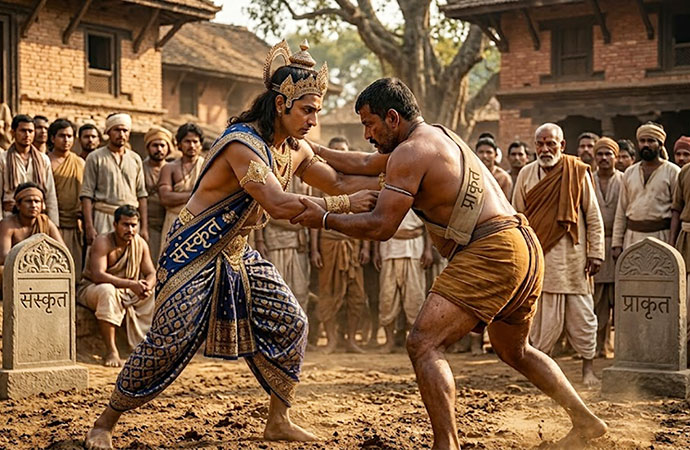
Did anyone say that people spoke Sanskrit amongst themselves and called people up on mobile phones and said "hello" in Sanskrit? Maybe they would have if they had smartphones in the ancient era. After all, it was the language of ancient bhadroloks while the plebeians spoke in Prakrit. But yes, Sanskrit was once a language of everyday use and not just arcane books and mantras but history overtook it and soon the language of the lesser elite and not-elite-at -all -Prakrit- pushed it off the shelf.
Soon it was squeezed as kings and socio-religious leaders also began to speak Prakrit. It even switched to more humbler forms till we had Bengali, Hindi and other languages. And no, it was not the Bangla Academy or bhasha andolon that played a role, just ordinary people speaking ordinary everyday language for ordinary conversation that led to the triumph of the Magadhi script-based Prakrit.
Vedic era Sanskrit and Prakrit
Basically, Sanskrit means "refined" or "perfected" and was used for religious, ritualistic and other holy purposes. It was the language of the elite, scholars, and Brahmins. Prakrit means "natural" or "original" and was the common spoken tongue of the people, very am- janata lingo so to speak.
But as history shows you can never predict when uprisings occur.
Both languages were rooted in the ancient languages of Europe and Central Asia from where Indo-Iranian groups migrated to India bringing early dialects. So, its linked to Indo- Aryan groups, the final migration cluster of North India and later elsewhere only Bengal.
Do you know Panini? Well, this guy was a grammar fixer and he did more than others to construct the grammar, probably the most awful topic we had to study. And the language structure of Sanskrit was formalised by him.
But in one sense, Panini made it difficult for Sanskrit by trying to make it more establishment friendly and formal. Speaking allowed Prakrit to simplify complex Sanskrit phonetics for everyday use while Sanskrit said, "you can't change me"
However, Prakrit continued to evolve and reached the Apabhraṃśa stages later and modern languages like Hindi, Bengali, Punjabi, and Marathi directly emerged from regional Prakrits.
Sanskrit .... meanwhile
Sanskrit required memorising highly complex grammatical systems. Nouns changed forms across eight distinct cases, verbal conjugations and verbs changed moods radically based on tense, mood, and person or morning bowel movement or whatever shit.
Meanwhile, spoken Prakrit dropped difficult sounds and complex grammar and were not averse to slangs either I guess. Priests and kings guarded Sanskrit as a sacred language and the lower class. women, and lower castes naturally were not even allowed to learn the language.
What Guatama and Mahavira did
And then Sanskrit got hit from an unlikely source. Gautama Buddha, the chap who made starving for a cause popular not only developed a new "religion" if you will but rejected Sanskrit to preach directly to the crowd and in Pali, a Jain variant of Prakrit. Worse, he was a kshatriya and a member of a royal family. He of course had his example, Mahavira, the founder of Jainism who had used Ardhamagadhi Prakrit to popularise his teachings so Buddha just copied the success formula.
This hit to Sanskrit came from the very core of the Sanskrit upholder, the elite class. They used mass languages to appeal to the Prakrit crowd making it so popular that it weakened the core of Sanskrit holy foundations. And when Emperor Ashoka after conquering all lands that he could want a break, he turned to popularising his ideas and of course used Prakrit because the masses spoke that. He made it sort of an official state language.
Major cities used Sanskrit in universities but Prakrit on the streets, educated elites switched between both languages depending on their audience. And soon dialects and variants overtook the mother language if that's what you want to call Sanskrit.
A brief timeline
We see three time zones.
1. Old Indo-Aryan Era (c. 1500 BCE - 500 BCE) Sanskrit Dominance: Vedic Sanskrit was the living, spoken vernacular of the early Indo-Aryan tribes.
2. Towards the end of this period (c. 600 BCE), regional spoken variants began splitting from the rigid grammatical structure of what would become classical Sanskrit.
3. Between 500 BCE - 1st Century CE Sanskrit declined as an everyday spoken language and became frozen as a liturgical and elite literary tongue.
4. The emergence of Buddhism and Jainism around 500 BCE made early Prakrits (like Pali and Ardhamagadhi) prominent public vernacular
5. Ashoka, the Mauryan Empire (c. 322-185 BCE) made Prakrit the official language of state administration and public rock edicts.
6. Around 1st Century CE - 1000 CE, Regional Prakrits (Maharashtri, Shauraseni, and Magadhi) became the primary spoken vernaculars across the Indian subcontinent.
7. Prakrit became so dominant that it established its own parallel classical literature alongside Sanskrit in royal courts. By the late phase (c. 600-1000 CE), these dominant Prakrit strains broke down further into Apabhraṃśa dialects, which directly led to modern languages like Hindi, Bengali, and Marathi.
Interestingly, Kolkata babu Bengali community during the colonial era tried reviving Sanskrit and did introduce Totsom and Totbhobo streams in Bengali but it didn't help any Sanskrit revival. Modern Prakrit won the day. Meanwhile, each foreign entry had brought other languages such as Persian and English and grew fatter.
It seems, experts, purists and activists may talk but in the end it's ordinary people who decide which way the language will go by wearing which kind of dress.
A Independent Newsweekly
© Copyright 2026 | Designed by ARK Reepon & Developed by Cosmos Group Software Team




Leave a Comment
Recent Posts
An important visit awaits
Sergio Gor, the US Special Envoy for South and Central Asia, is set to ...
Building Young Environmental L ...
Waste is one of the fastest-growing environmental challenges facing Ba ...
WildTeam, Friendship launch community healthcare ini ..
Thousands of young protesters were camped on the str ..
President Mohammed Shahabuddin may resign shortly ci ..
Can We Roar as Loudly for Bangladesh as We Do for Fo ..