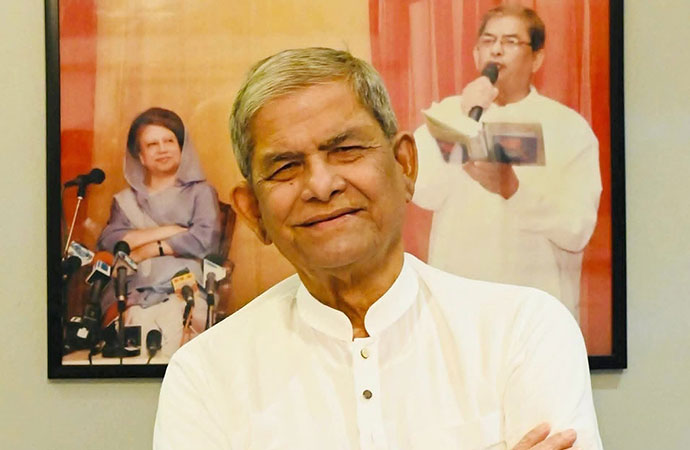
On February 15, 2024, Mirza Fakhrul Islam Alamgir walked out of jail for the last time under the Awami League. It was some 39 days after the one-sided January 7, 2024 election that had sounded yet another death knell for democracy in the country, and over three-and-a-half months Fakhrul and other senior party leaders had been picked up centring the BNP's October 28, 2023 programme demanding the coming elections be held under a caretaker government.

Immediately after walking out of Dhaka Central Jail, Fakhrul said the movement to 'restore the right to vote' would continue. He said the BNP did not lose anything - rather it was the government that had lost by holding a one-sided election. In less than six months, these words would prove prophetic. For a good 12 years till Tarique Rahman's return last December, to the extent that the BNP was fighting for democracy in Bangladesh as successive AL administrations grew increasingly repressive, authoritarian and removed from the people, Mirza Fakhrul was its tribune.

Following his appointment as acting secretary general in 2011 following the death of Khandaker Delwar Hossain, through to February 15, 2024, Fakhrul had more than 100 cases filed against him, was jailed multiple times, and remained incarcerated for close to 500 days. Through it all, he remained resolute in his determination to see it through. And see it through he did.

It was only fitting that for one who has led the fight for the restoration of voting rights, a return to Parliament by way of an election that passed the test of all-round acceptance would precede all this. It was left somewhat incomplete, by the absence of the old enemy, but it could hardly be helped. Besides, Mirza Fakhrul was one of those who managed to get elected even when AL were manipulating the process most nakedly, in 2018 - now famous, or rather infamous, as 'the Midnight Election'. He was left so appalled by what transpired that he ended up not taking his oath, despite winning Bogra-6.

It also happened to be the one time Fakhrul could be said to have led the BNP in an election. At the time, the late Begum Khaleda Zia's iron will was being tested in jail on trumped up charges, and Tarique Rahman still had no chance of returning to take part in politics, although he continued communicating with his supporters from exile in London. But for all intents and purposes, Fakhrul was the face of the BNP in that election.

There used to be a great debate within BNP circles on the decision to take part in that election as part of Oikya Jote - whether it was the right decision or not, in retrospect. There are those who consider it to have been a disaster, and blame Fakhrul for getting the party mixed up in the whole Oikya Jote. If they hadn't done that, could AL's exit have been ushered in sooner? Although there are those who contend so, there is really no way of knowing. What we do know is that 2018 stood out as yet another waypoint in AL's drift into 'electoral autocracy'. And after the vote, Mirza Fakhrul did the principled thing by not taking his seat.

Even before what transpired on the eve of the election, the unprecedented level of violence directed at BNP/Oikya Jote candidates (the alliance that came together with the push from Gono Forum, which had no voter base) set 2018 apart, and showed the world that AL's dictatorial streak had become incorrigible. It also laid the groundwork for the movement ahead of the 12th general election, and its demand that they be held under a neutral authority (like the caretaker government AL had scrapped in 2011, two-and-a-half years after returning to power).

So was that the right decision? If he hadn't survived to see the fall of the Awami League, this debate could have gone on forever. But having seen it through to the end, you can really only go by what you have in front of you. And 2014-2018-2024 are part of a continuum that is now generally accepted to have been fatal to AL. Just as Fakhrul had said, six months before it all came crashing down. And countless times before of course. History can be a tenuous thing in Bangladesh, but from where we now stand, we can at least say that Mirza Fakhrul wouldn't need to go back on a single word he uttered in those 12 years and more. Every decision he took as GS, and everything he said, has been proven right in the light of history.

A gentleman, and humane too

Although steeped in politics throughout his life, it is his innings as the BNP's secretary-general during the hardest years it ever witnessed - the hardest years arguably any mainstream political party has endured in independent Bangladesh, as the principal obstacle to AL autocracy post-2009 - that will have guaranteed his legend, and it is also what makes him eminently suited to be President, the top constitutional post in the republic.

Ideally, the occupants of Bangabhaban are expected to remain above the fray of politics, although it has come to be politicised. Short of the reforms envisioned in the July Charter, the post remains largely ceremonial, with not much scope to 'rock the boat'. It can be just reward for the 78-year-old Fakhrul, whose reputation as a 'gentleman politician' - a confirmed rarity in the environment in which he operates - precedes even his advocacy for democracy. He was very much the chairperson's pick, and remained loyal to his leader till the end, without compromising his own sense of self or his own persona.

Perhaps less known is the humane face he brought to the role, at a time when it was most needed. As AL repression of its party activists kept growing, it fell to Mirza Fakhrul Islam Alamgir to stand by them and their families, and assure them that it was still worth sticking it out with this party, even through the darkest corridors. He has attended countless programmes under the 'Amader BNP Poribar' banner - the party's initiative to stand by the families of activists who may have been jailed, disappeared or even killed simply for supporting the BNP.

Whenever he has spoken at these programmes, it has been from the heart, and with utmost respect towards the victims, never trivialising their loss. On more than one occasion, in fact on numerous occasions, he has himself broken down while relaying the suffering of some grassroot activist. He has apologised profusely to the families "for being able to do nothing for them". Yes, whatever compensation or support has been provided, has never been publicised with fanfare - something that has stood out about the initiative.

On none of these occasions did you get the impression that he was putting on a show. Some politicians would bleed themselves dry to shed some genuine tears in front of the camera - in Mirza Fakhrul's case, you always felt he tried his best not to cry - yet couldn't help himself. Again, it may not have been everyone's cup of tea within the party. But it is this brand of honest, humane and principled leadership that proved vital to holding the BNP 'poribar' together through all those years, against tremendous odds.

2022: His finest year?

Mirza Fakhrul and the BNP, as part of the pro-democracy movement in Bangladesh, must've sensed that 2022 would have to be the year for the lessons of the Midnight Election in 2018 to start bearing fruit. The timing of its push for a caretaker or neutral administrator would have to be just right. Despite the political, cultural and media establishment acting against it, the aim would be to show that the party still commanded such massive support among the general public that you couldn't ignore its demands.

By the end of the year, The Daily Star, in its year-end review of politics for the year, was writing: "The year 2022 marked a major turnaround for the BNP as the party seemed to have overcome the organisational weaknesses and political inertia that had been plaguing it since the disappointing results of the 2018 national polls." ("Politics in 2022: BNP's year of dramatic rebound," The Daily Star, December 30, 2022)

Fakhrul was ending the year in jail again, having been picked up on the eve of a hugely anticipated rally in Dhaka on December 10, that would be the culmination of a three-month programme during which the party sprang into life again. The government was clearly nervous. It was in September that Mirza Fakhrul had announced a series of public rallies in 10 divisional cities, ostensibly to denounce the price hike of daily essentials and fuels, the death of five party men in previous police action in Bhola, Narayanganj, Munshiganj and Jashore, and to demand freedom for Chairperson Khaleda Zia.

Each of the first 9 rallies - in Chattogram, Mymensingh, Khulna, Rangpur, Barishal, Faridpur, Sylhet, Cumilla and Rajshahi - had been a roaring success, with huge turnout. Activists were turning up from all corners, and taking over these divisional headquarter towns for entire weekends at times. One of the things that stood out glaringly for all to see was how the government would do everything in its power to prevent people from turning up at the programmes - for example halting public transport from serving the area - yet fail miserably. Many even swam to join these events, at a time when most government rallies had to bus people in. Most impressively, they were being held peacefully, and the messages emanating from the stage spoke of democracy - the nation's founding aspiration.

This finally, was the party in Fakhrul's image. He of course attended and addressed the first divisional mass rally at the Polo Ground in Chattogram city, held on October 12 that year.

"The government has turned the Judiciary, Police, RAB into partisan agencies. After 50 years of liberation, we have to fight again for the rights we got through independence," he declared.

Even at that first rally, the government's nefarious efforts were apparent, and Fakhrul noted how despite attempting to obstruct many leaders and activists from joining the rally in various ways, the government could not stop them.

"We cannot be suppressed by fear. The movement for the restoration of democracy that starts in Chattogram will spread to the whole of Bangladesh," he added. It certainly set the tone for the following rallies that came around every weekend - 9 on the trot - and the momentum heading into the Dhaka rally was understandably sky-high. The government reacted as authoritarians do when they get nervous. They arrested Fakhrul and other senior leaders like Mirza Abbas and tried to prevent it from going ahead (but failed). Drawing this reaction from the government probably worked out well for the party in the end. More importantly, the rallies had put to rest any lingering doubts over the BNP's organisational strength, or grassroots support, or the relevance of their political message.

The BNP's message in Bangladesh politics could not be ignored, and it would prove vital to the politics we would witness in 2023 ahead of the 12th parliamentary election. It wouldn't be enough to displace the authoritarian government, nor bring about an inclusive election under a neutral administration, but resisting the BNP's legitimate demands, in hindsight, must have taken its own toll on the government in other ways. Ways that they failed to realise before it was all too late.

BNP would sit out the 2024 election again - refusing to be party to another inevitable sham. The decision would come under scrutiny again from various quarters. Fakhrul's words on leaving jail (mentioned at the start) would be mocked in many quarters, or be met with frustration. But history would prove him right. He was right about everything. Thankfully he's too much of a gentleman to rub it in.

Right and Ready

Perhaps sensing his elevation (or being clued in on it), in one of his last engagements as a member of the cabinet on July 30, Mirza Fakhrul delivered a message befitting his stature, though it risked embarrassing his own government.

Addressing a discussion organised by the Information and Broadcasting Ministry in the capital, Fakhrul lamented that although the July Uprising was driven by a desire for change, the old ways continued to persist within the administration.

"I say this with deep pain. After serving as a minister for the past four or five months, I feel I should share some of what I have experienced. From what I have seen, nothing has changed. Those who took bribes before are still finding ways to do so, and those who obstructed good initiatives are still standing in their way," he said.

"I am saying these things with regret. I am old. This time, I truly wanted to see change. So far, I do not see that change among us. Not only the government or political leadership, but the mindset of every person in society also needs to change. Otherwise, the sacrifices of July will not bring the desired result," he added.

His tone was like in those Amader BNP Poribar programmes - frank and heartfelt, not hectoring. It was compelling. And eminently presidential.

A life steeped in politics

Mirza Fakhrul Islam Alamgir, who has risen through the political ranks from grassroots activism and steered the BNP through some of its most difficult years, is now the party's nominee for the presidency.

A BNP delegation submitted the nomination paper to Chief Election Commissioner AMM Nasir Uddin at Nirbachan Bhaban in the city's Agargaon area Thursday afternoon, formally putting forward its Secretary General for the country's highest constitutional office.

Earlier, BNP Chairman and Prime Minister Tarique Rahman nominated Mirza Fakhrul Islam Alamgir as the BNP's candidate for the presidential election.

Tarique announced his decision at the beginning of a meeting with the party's Standing Committee members and senior leaders at the Prime Minister's Office at the Secretariat.

Mirza Fakhrul was a student leader in his youth, an economics teacher in his professional life and eventually a politician who went on to become a municipality chairman, a member of parliament, a state minister and a minister.

Now, he is set to become the country's 23rd president.

At 78, Fakhrul has had a long and varied political journey, marked by political responsibility, organisational leadership and periods of adversity.

Fakhrul, widely regarded as a moderate and seasoned politician within the BNP, remained one of the party's most visible leaders during its prolonged political struggle against the Awami League government.

Early life and education

Mirza Fakhrul Islam Alamgir was born on January 26, 1948, in the Kalibari area of Thakurgaon town. His father, Mirza Ruhul Amin, was a lawyer who served twice as a member of the Pakistan Provincial Assembly and later as a member of Bangladesh's Parliament. He also served as a minister in the Ershad government.

Fakhrul completed his primary and secondary education in Thakurgaon before passing his Higher Secondary Certificate examination from Dhaka College. He then enrolled in the Department of Economics at the University of Dhaka where he obtained both his bachelor's and master's degrees.

His involvement in politics began during his university years. He joined leftist politics and became president of the East Pakistan Students' Union's Dhaka University unit.

He also served as the elected general secretary of the organisation's SM Hall unit.

During the 1969 mass uprising, Fakhrul was president of the Dhaka University unit of the Students' Union.

From teaching to politics

After completing his studies, Fakhrul joined the teaching profession and worked as a lecturer in economics at Dhaka College.

He later entered government service but left his job in 1986 to pursue politics full-time.

His political career took a new turn when he was elected chairman of the Thakurgaon municipality as an independent candidate in 1988.

Earlier, in 1979, during President Ziaur Rahman's administration, Fakhrul had served as private secretary to then Deputy Prime Minister S A Bari.

His entry into national politics came through the National Awami Party (NAP) of Maulana Abdul Hamid Khan Bhashani before he eventually joined the BNP.

Rise within BNP

During the anti-Ershad movement in the early 1990s, Fakhrul joined the BNP. He was appointed president of the Thakurgaon district unit of the party in 1992 and subsequently rose through the party hierarchy, serving in several key positions before becoming a senior joint secretary general.

He served as BNP acting secretary general from 2011 and was elected secretary general at the party's sixth national council in 2016. He has remained in the post since then.

Before reaching the party's top leadership, he also served for years as the first vice-president and later president of the BNP's farmers' organisation, Jatiyatabadi Krishak Dal.

Fakhrul's political journey has been marked by prolonged challenges, particularly during the period following the 1/11 political changeover and the Awami League's long tenure in power, when the BNP faced repeated repression and political setbacks.

During the Awami League government, then BNP Chairperson and firmer prime minister Khaleda Zia was imprisoned for nearly two years from 2018 and later remained largely inactive in politics due to illness.

Meanwhile, then acting chairman of the party Tarique Rahman left Bangladesh for London in 2008 during the military-backed caretaker government and continued to lead the party from there.

In their absence, Fakhrul provided the BNP's main leadership from within Bangladesh. He remained at the forefront of the party's movement against the Sheikh Hasina government and was jailed several times while leading those political programmes.

With the BNP's top two leaders largely absent from the country's political arena for extended periods, Fakhrul emerged as the party's most visible leader at home, helping steer the organisation through successive crises and leading its movement against the Awami League government.

Fakhrul was elected to Parliament from Thakurgaon-1 constituency in the 2001 general election on the BNP's electoral symbol.

He served as state minister for agriculture and later as state minister for civil aviation and tourism during Khaleda Zia's government.

In the 2018 general election, he contested from Thakurgaon-1 and Bogura-6 constituencies and won Bogura-6. However, amid allegations of widespread vote rigging, he did not take oath as an MP, an unusual episode in Bangladesh's parliamentary history.

Under the current government led by Prime Minister Tarique Rahman, Fakhrul serves as the Local Government and Rural Development Minister. His parliamentary seat is next to that of the Prime Minister.

A long-serving party leader

Senior BNP leaders have often credited Fakhrul with holding the party together during periods when its top leadership faced legal, political and organisational challenges.

His nomination for the presidency therefore comes after a long career spanning student politics, teaching, government service, local government, parliamentary politics, ministerial responsibility and the leadership of the country's principal political party.

Fakhrul is married to Rahat Ara Begum. They have two daughters, Mirza Shamaruh Mirza and Mirza Safaruh.

His wife, a former senior official of a private financial institution, is now retired.

Their elder daughter lives in Australia and works as a postdoctoral fellow in Sydney, while their younger daughter teaches at an English-medium school in Dhaka.

With the submission of his nomination paper, Fakhrul's decades-long political journey has now brought him to the threshold of the country's highest constitutional office.

Leave a Comment

Recent Posts