



A master of his medium: Aminul Islam’s first death anniversary observed

Staff Correspondent
Saturday, July 14th, 2012


July 8 marked the first death anniversary of painter Aminul Islam. On the occasion, artists, social and cultural activists, writers placed wreaths at his grave at Banani Graveyard in the city. A number of art institutes and galleries also organised discussions on his life and immense contribution to the world of art.


Islam is one of the senior most and acclaimed painters in our country. Among Islam’s contemporaries were Hamidur Rahman, Bazle Moula, Imdad Hossain, Khaled Chowdhury, Loknath Dhor and Ali Humayun (first batch of the Government College of Arts and Crafts, later renamed Faculty of Fine Arts, University of Dhaka in 1948). The group was very committed and most of them were involved in left leaning politics. Their preferred themes were nature, urban life and surrounding atmosphere.


At the time, Dacca (now Dhaka) was a quiet city and had lots of green landscapes. Painters frequently visited the Buriganga river, Waiz Ghat and other scenic spots for inspiration. Zainul Abedin particularly stressed on drawing and successfully gave Islam and his comrades an understanding of this genre of art and its various significant aspects. The students also portrayed political chaos, economic crises, city life, rural life, still life and other subjects. Some of them were greatly influenced by internationally acclaimed impressionist painters.


Among his contemporaries, Islam made an immense contribution by introducing modern paintings in Bangladesh. “Painting, for me, is the best way to knowledge, the best means to participate profoundly in global life,” Islam used to say.The painter also said, “Painters are of two kinds – one group works with emotions and the other works with intelligence. My position is in the middle. Both aspects are inherent in me.”


On the completion of his primary education, Islam gained admission to Armanitola High School. He started copying Japanese and Chinese art in school. He would also copy Indian painters’ works. He appreciated the cubist and semi-cubist works of Gagendranath Tagore. However, his parents did not want him to take up painting as a profession.


Islam passed his matriculation in 1947. He then sought admission in Calcutta Art College. While in Calcutta (now Kolkata), he met Zainul Abedin, Quamrul Hassan and Safiuddin Ahmed. They suggested that he avoided seeking admission in Calcutta Art College as an art college was to be established in Dhaka very soon. Islam returned to Dhaka with Zainul Abedin. However, since there was no sign of any art college being opened, he got admitted at Dacca College.


The Government Institute of Art opened in 1948. Islam got admitted there and completed his BFA. Then he went to Florence, Italy to pursue higher studies in art. His three years there proved very formative, as he found answers to many of the questions he had earlier about art and aesthetics.


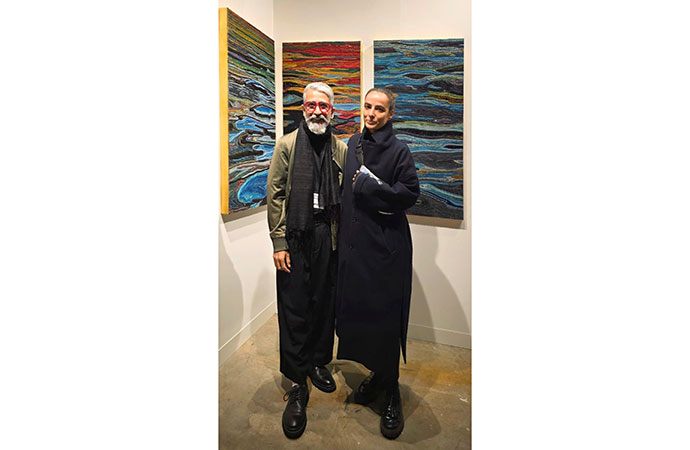
After moving back to Dhaka, Islam’s style underwent a fundamental change. Lines, colours and space became the prime focus in his paintings. Throughout his chequered career, he frequently returned to the nature.


Islam had grown primarily as a non-figurative painter since the early 1960s and started to experiment with different mediums and art forms. Besides painting, Islam also preferred drawing. In the course of his career, he developed several styles, particularly in his drawings and sketches. His figure-based works from the mid-1960s are remarkable; mainly “Homage to Khajuraho”, an erotic drawing series focusing on the physical relationship between males and females. The series articulates the proper emotion and fantasy of human beings. The drawings appear serene and the lines have been meticulously done.


Gradually Islam became increasingly aware of the different qualities of lines produced by pen, pencil, brush, bamboo, discarded brush and other objects. The powerful drawings reveal his mastery over lines and superb composition skills. He also did murals in different parts of the country.


developed by avocats

Leave a Reply

Media Gallery0


<< 123 >>

ad1
0