
Conventional cooking wastes rice

Gazi Rafiq
Saturday, July 14th, 2012


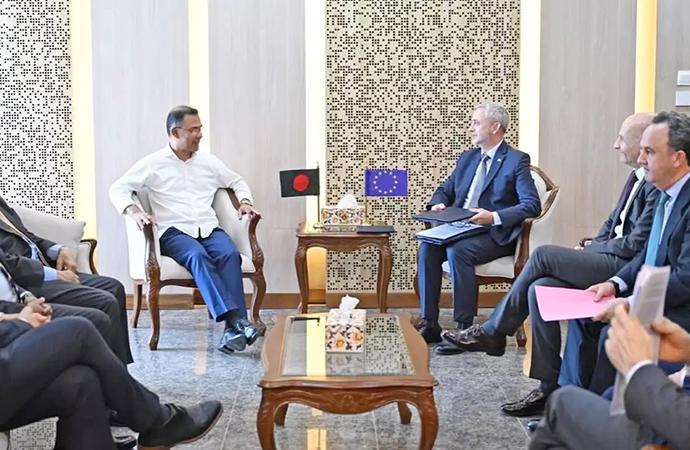
Gazi Rafiq (white cap) presenting his keynote paper at a seminar held on March 8 at National Press Club. Chief guest DU Vice Chancellor AAMS Arefin Siddiq, special guest economist Prof. MM Akash, Nutritionist Dr. Khursheed Jahan, Dr. Khaleda Islam and Moinul Hasan Saber were also present.

About preventing wastage of rice which could potentially lead Bangladesh to be self-sufficient in food.


The prior concern of my study is to represent a new concept regarding food and nutrition situation of Bangladesh. This might help us in preventing wastage and regaining self sufficiency in food. The annual demand of food (rice) in our country is two crore fifty lakh fifty three thousand metric tonnes for 16.50 crore population, with the rate of 416 gram per capita (BBS) [7]. Our production was 33.158 million metric tonnes (2009-2010) [3, 10]. Where 32.257 MMT is rice & 0.901 MMT is wheat. According to this statistics, we are supposed to have 8.105 MMT additional foods and for that we are to import 3.758 MMT foods annually. In these imported foods, 2.430 MMT is wheat & the rest is rice. Now the question arises, how all these 11.855 MMT of food is utilised (Annual Production of 2010-2011 is 3.33 crore metric tonnes). Here we found the fact of wastage which is huge in amount. It matters likewise pre-harvest and post-harvest wastage management which is considered to be in the main factors worldwide. In 2004 the production of rice worldwide was 406.068 million metric tonnes. With the ratio of 1% growth this production reaches almost 434.492 million metric tonnes in 2011. Asia produces and consumes 90 percent rice of the world. Unctad 2004 [17]


Wastage during production


Draught, flood and other natural disasters are referred as pre-harvest factors. The government’s Agricultural Ministry has been very much active in protecting crop from this wastage and achieving the desirable target of production as well. A large amount of rice is wasted during crop cutting, collecting, processing and sending to market places. It is caused by lack of technical knowledge, access to technology and logistics. However, this can be minimised by building awareness and creating access to sustainable technology.


According to Martin Gummert, IRRI post harvest specialist, 15-20 percent of rice grains are lost during post harvest. These losses are often caused by delays in the post harvest chain resulting from labour shortage, unsuitable traditional sun-drying practices, pests, moisture absorption in traditional open-storage systems, as well as from outdated and poorly maintained rice mills that yield as low as 60 percent, and drastically reduce head rice [8].


Engr. Carlito Balingbing, an assistant scientist at IRRI, even noted that poor post harvest management operations expose grains to unfavourable environmental conditions that could cause fungal contamination such as mycotoxins, and further losses. (GRAINGAINS- by Mia Aureus Rice Today- Oct-December- 2009- IRRI, Manila) [8].


So, even 10 percent reduction of post harvest wastage by creating awareness among mass people and farmers will result in success – saving of 30 lakh 20 thousand metric tonnes of rice yearly that would lead us to be a self sufficient country in food.


Wastage during cooking


The recent perspective of rice wastage is at third stage, after boiling the rice we drain away the gruel which could be mentioned as the third stage wastage of rice. This is actually spoiling a large quantity of carbohydrate. Rice also melts away while boiling, so we are wasting the whole grain rice as well. This practice is one of the main reasons of food scarcity in Bangladesh as well as in South Asia. To discuss the matter, I contacted FPMU on January 2, 2011 and INFS on February 8, 2011 to find more information on the quantity loss of edible rice during cooking. But no scientific study was available.


I decided to run few tests to gain some statistical and mathematical proofs of my theory. The proper concern of my study is to represent a new concept regarding rice wastage. By draining away the gruel while cooking rice, we are literally wasting millions of metric tonnes of rice. This simple practice of not draining away the rice gruel while cooking using optimum water level method can play a great role in removing food scarcity. I knew if I can prove my theory, it will help greatly solving food problem mainly of rice, in Asia.


Observation


On the first time attempt, I took two separate samples of parboiled milled rice each weighing 500 gm and boiled them separately draining away gruel from one and drying out the gruel from the other. Now weighing the boiled rice I could get and estimate of how much rice was wasted from the sample we drained away the gruel. And the result was almost 9 percent. When 500 gm milled rice was cooked drying out the gruel while cooking, it became 1650 gm of rice. The same amount of rice was cooked draining away the gruel, it was 1500 gm rice. There lies the difference of 150 gm of rice, which can also be interpreted as in each 100 gm of milled rice adds 30 gm of more cooked rice. So, we are wasting 90.09 gm of rice in each kg of parboiled milled rice while draining away the gruel of cooking rice.


With different types of rice this result can vary from 80 to 100 gm. So we can easily reach to the decision that there is a significant amount or wastage during cooking. Moreover, a little amount of rice also stays stuck in the strainer while we drain away the gruel from boiled rice. This percentage may also be 1.50-2 percent, each time we cook much eventfully wastage may rises up to 11-12 percent. But it was a primary assumption.


Eventually, repeating the test with variable and different types of rice, the third stage wastage of rice was found actually to be 13-15 percent. Which in a larger aspect is a huge possibility of 293 crore 25 lakh dollars annually. This simple fact can impact greatly in the socio economic development and national prosperity of the country. And it can also play a positive role in the Southeast Asian regional perspective of food situation at the same time can eradicate poverty, hunger and malnutrition.


developed by avocats

Leave a Reply

Media Gallery0


<< 123 >>

ad1
0